Archive for the ‘Uncategorized’ Category
Hood Making
 August 14th, 2026 |
  Author:
 I cover the topic hoods in my book ‘Falconry – aspects of care of the trained falcon and hawk’ from the perspective of usage and problems that can crop up with birds. I also discuss the different types of hoods and touch on their construction.
Many falconers will source a hood from an equipment maker and as I say in my book buy two hoods perhaps a Dutch hood and an Anglo-Indian hood. Of course it is useful to have a spare hood but may fit better than the other. In which case if you have bought the hood from a reputable hood maker they should take it back (if not damaged) and discuss its replacement.
Of course hoods – Dutch hoods – for many years hoods were supplied by the Mollen family from The Netherlands until the mid 1930s when production stopped. Thereafter falconers would have to learn to make their own hoods. Many of the homemade hoods afterwards looked rather crude – from what I have seen – and it was not until Phillip Glasier began making his own version of the Dutch hood using a set of Mollen hood blocks that things began to look more professional.
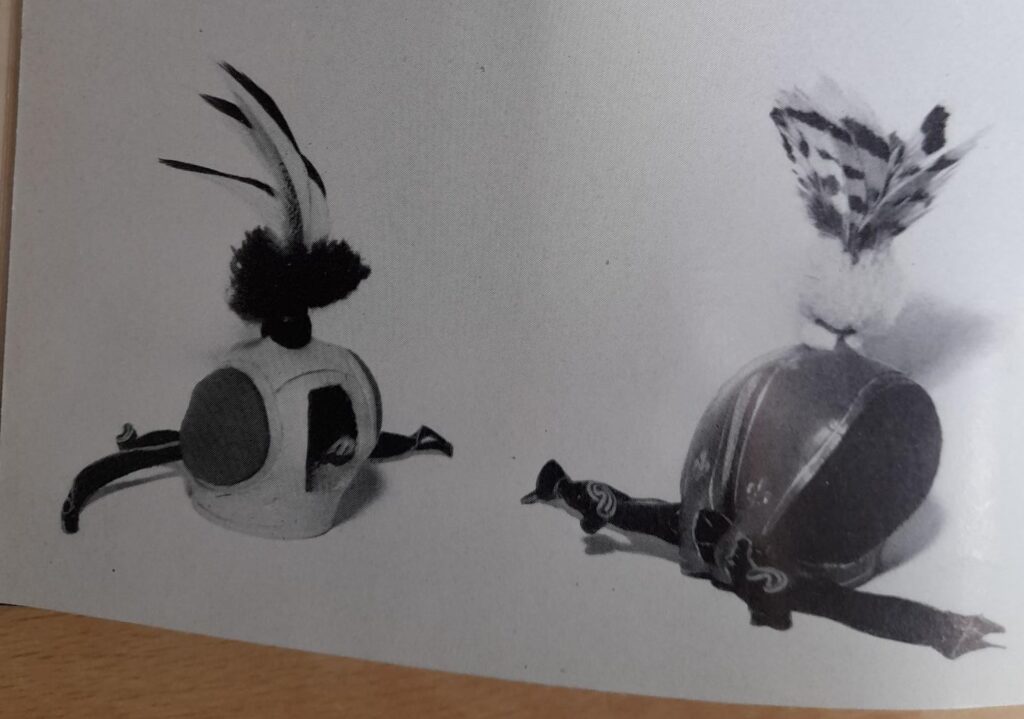
Above photo taken from the book ‘As The Falcon Her Bells’ Phillip Glasier 1963 of two Falconry Centre type hoods and they later became to be called. At the time the best hoods since the Dutch hoods.
In facts his hoods were quite ingenious in the the way there were made. They had all the qualities of the Dutch hood minus some complexities of construction. It was a hybrid hood between a Syrian hood and a Dutch hood proper. When I was an apprentice falconer at the Falconry Centre these hoods were used all the time. I remember Paul Bevan showing one that he had made. Even though they are simpler to make than the Dutch hood they are nonetheless still challenging.
The Anglo – Indian hood – another hybrid hood are relatively straight straight forward to make and usable for all birds. They are made from a single piece of leather and do not need to be blocked.
Phillip led the way but now hood making has changed again with modern modifications particularly around beak opening – more like an Anglo-Indian hood – and changes in construction technique with a generally a lighter very high quality build. Some of the modern hoods are works of art but they still have to fit well.
You can buy hoods that are made in Pakistan as cheap as chips. I am told they are made on machines – that needs to be verified – and their build quality is fantastic – but again they have to fit.
Like many falconers of old I like to make make my own hoods and I use Phillip’s patterns to make the Falconry Centre hood using my own hood block based on the Mollen design. We have to thank Phillip for providing the patterns for these hoods and guide on making them plus guides and patterns for gloves and hoods. They are used the world over. As a teacher of falconry he was second to none.
I have not made a hood for some time and I started to make one the other day. A journey of rediscovery if you like. I made a right mess of it getting the stitching tension wrong so the hood was lop sided. You can adjust when the hood is wetted and turned by stretching the one side down. But in the case the adjustment needed was too much and so I have binned it!
Here is a photograph from some time ago when I was making hood – actually that one was perfect and I use it everyday on Sprite the peregrine.
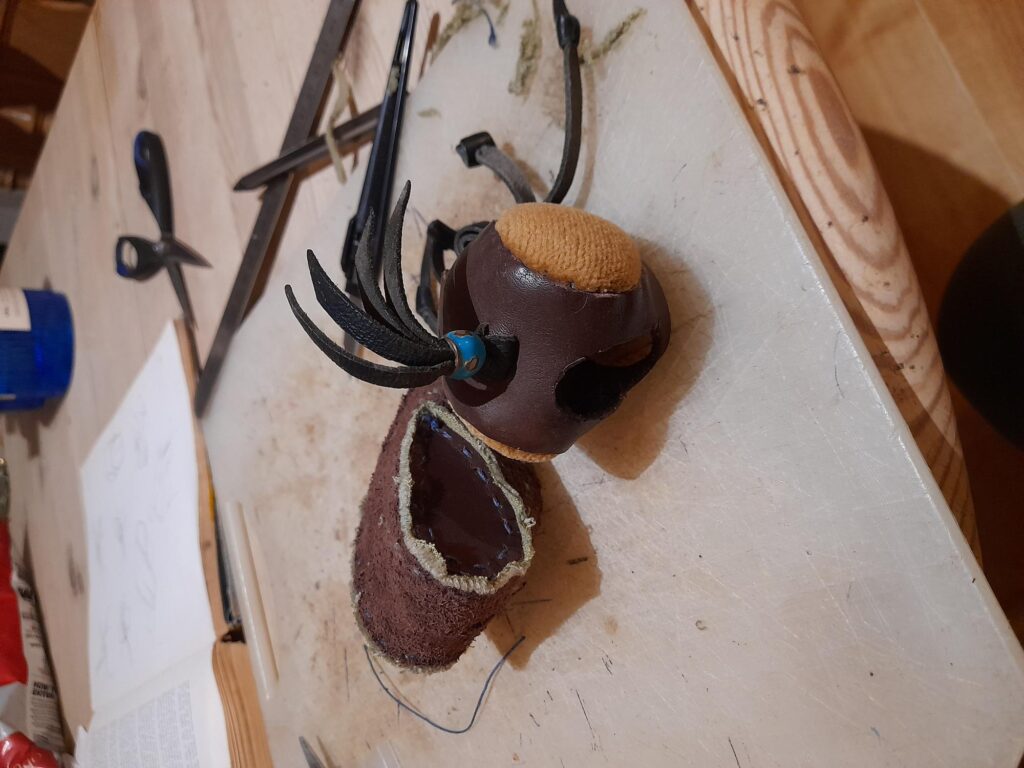
Many falconers just buy in all the kit they need but actually falconry is both an art and a craft and making your own equipment can be very much part of it.
My own book – with its own construction guide to the weathering loft with lots besides is still also very much on sale at Amazon, Coch Y Bonddu books, Waterstones and many other outlets.
 Posted in
Me now!
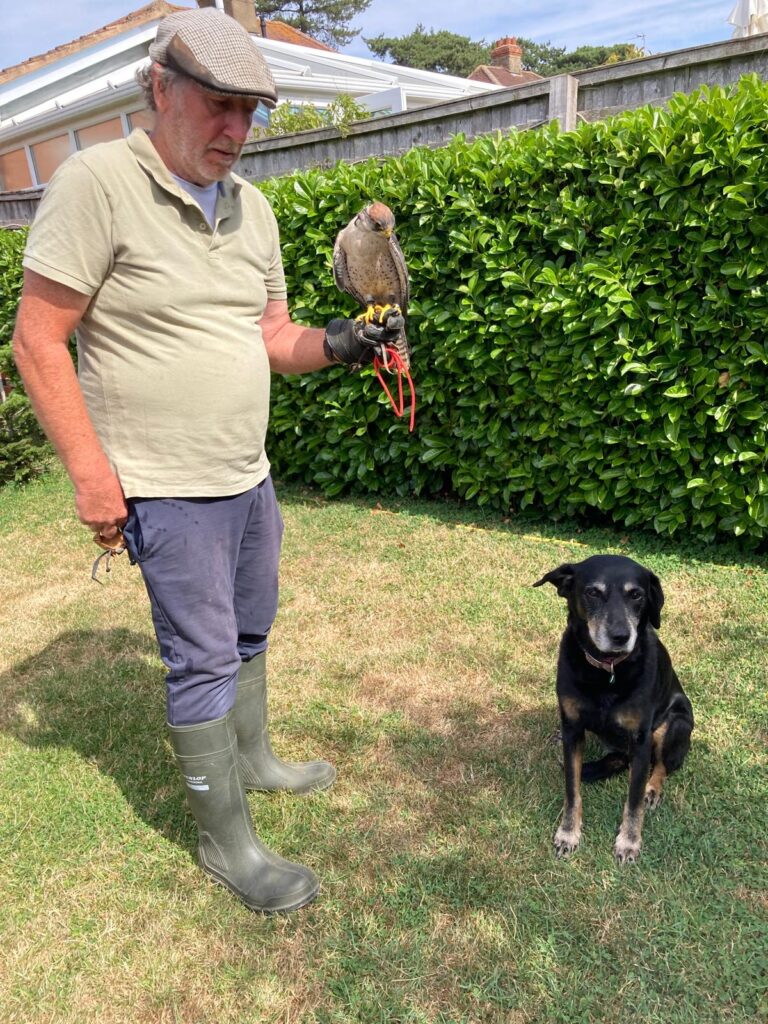
Taken the other day of an aging falconer and an old dog. The falcon is ‘Frank’ a lanneret – 7 years old -who for various reasons I kept back along with Sprite our peregrine. Frank is a typical lanner – lovely – easy to handle, hood and he flies well.
August.
Well the dry hot weather has continued into August and not since 1975 and 1976 have we had two very hot long summers back to back. In 1976 the River Severn was so low you could practically walk across it at Wainlodes in Gloucestershire. Now the water is much higher due to controlled release of water much further upstream.
Looking after animals in hot weather is always a challenge and in my book ‘Falconry – aspects of care of the trained falcon and hawk’ I have a separate section called Water (section 15) which underlines the importance of its availability at all times. It sounds like a no brainer but actually birds can exist without water – obtaining the moisture they need from their food. Nonetheless it is necessary particularly on hot days when birds can often be seen sipping from their bath water after flying and throughout the day or indeed while taking a bath.
In former times with different husbandry methods with nervous wild caught passage birds who were kept on a screen perch or when weathering out on the lawn were often too nervous to routinely hop up and down to sip from their bath water – signalling that it was not needed. We know better now. So I change the bath water every 2 days or more frequently if soiled.
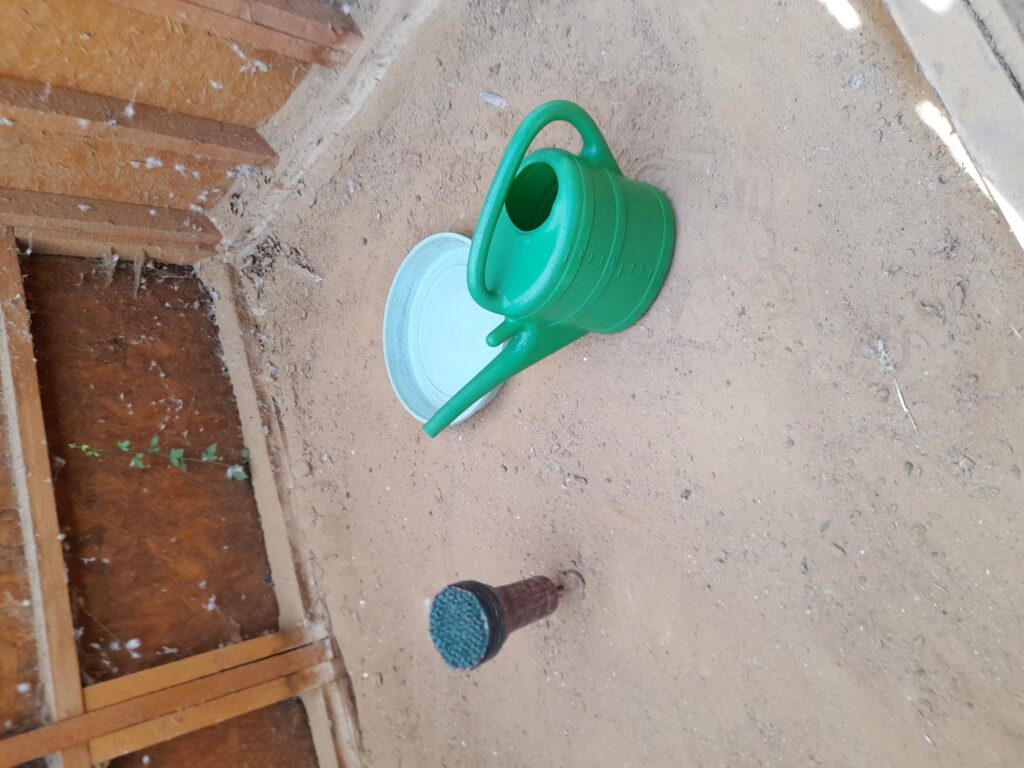

Husbandry of the trained raptor is something I discuss in great detail in my book. Indeed it prompted the section of the ‘weathering loft’ as I call it. A structure where a bird can either be tethered or free lofted. I wanted to make the point with many years of husbandry experience that many parent reared birds in flying condition unless exceptionally tame cannot be kept free lofted. They have have a habit of going wild in the loft and are practically impossible to get out of the loft for daily flying. Imprinted birds because they are imprinted on humans and very tame can in the main be kept lofted in flying condition. There is much confusion about lofting versus tethering and people postulating it should be possible for all birds. This is not so.
At other times however when the bird is not been flown – for moulting, a period of bad weather or the falconer is on holiday – then it can be safely lofted. You are not having to get it out everyday. Food can be dropped down a chute onto a feeding platform and the bird left to get on with it. The ‘Weathering Loft’ is two structures in one. Its construction is presented in my book in a step by step guide.
On to more local matters now. Since last winter – I may have mentioned it in a previous blog – I have seen on several occasions a rather ragged looking buzzard with most of its tail missing. At one point it was being chased about by other buzzards and one could speculate on what calamity had caused its feather damage. Anyway it has been quietly hanging around and has begun to moult. Each time I see it now it is looking more trim. Despite everything it managed to survive the winter and from the moulted broken tail feather – below – I can see it is young bird from last year.

I have seen the peregrine about fairly regularly – it may be more than one bird. It gets drawn at the sight of a falcon stooping to the lure and it hangs around and until it has seen enough. I have also seen a peregrine where I walk the dog always exciting to see.
Below is our peregrine Sprite on the lure after stooping to it. You can see how dry it has been this summer from the yellow grass.

Looking Back

Found this photo on my wife’s desk of me – looking a lot younger! from some time ago in the 90s at an event for ‘Calor Gas ‘- their balloon is in the background.
Duke is sitting on my fist – on of my own gloves (very much a thing of the past!) – looking pretty cool. He was falcon of a lifetime – as I have said before – no bird of mine has ever come close to matching him. A lot of falcons would not like a balloon swirling around in the background with the whooshing sounds of hot air rushing in to inflate the balloon. For Duke he would circle the balloon and use its lift off the top to get additional height!
I do remember this day for another reason my other falcon Peggy – another great flier – decided to disappear and I found her a couple of hours later – using my telemetry – on a Moorhen she had caught. On her day she was a deadly falcon and nothing was beyond her powers – she was great fun – but as the years passed she became less reliable as a demo falcon. But she was so popular with clients for her waiting and stooping flight which was incredible. I was repeatedly asked if was she coming to their next event. She lived to 25 years the last few in retirement with Tizzy Hodson of Tiger airways – who flew her everyday around Staverton Airport.
Also at the Calor Gas event that day was John Whiteley’s Sheep Dog display. We both won arena awards at the ‘Showmans Show’ one year. We got to know many performers on our travels and we were always to happy to meet up and exchange news. Long may it continue. We need young people to come into these activities and take them forward. Nothing can beat training a falcon or dog or to go fishing – they are a good way to help with mental health issues and to connect with nature and wildlife in a different way to just watching it.
Normally I do not remember events having done so many but this one did. No idea who took the photo.
I continue to fly the two falcon here everyday. The lanneret ‘Frank’ is so stylish but our Peregrine ‘Sprite’ has not been flying too great. He is not so good in a stiff breeze surprisingly because peregrines with their extra power usually are. I felt his weight has dropped too low and he was weak in flight. This weight loss or conditioning adjustment was intentional as I was experimenting to try and get the ‘best’ out of him. I had tried this when I was working with pretty much the same results. So for him to fly well he needs to be flown in high condition and so I have started pushing his weight up again. This is 20 grams either way – has I said in my book ‘Falconry – aspects of care of the trained falcon and hawk’ subtle changes of condition can make all the difference. It can bring on the hunting condition in a bird that is not chasing or conversely rein in a hawk that is self hunting with the falconer becoming a passenger while chasing the bird about.
St.Davids
We have a wonderful holiday break at St.Davids, Wales during the recent very hot spell. Luckily for us it was cooler on the Pembrokeshire coast and we really enjoyed our few days exploring the area. In the evenings we would wander down to the Cathedral to sit on one of the benches that over looked it and sat in the evening sun watching the swifts chasing each other about. Something heard less and less now in other parts of the UK. Here is a picture of that scene.

Our two falcons left at home were looked after by our son including caring for the dog. She spent most of the time lying on the tiled floor trying to keep cool.
Both the falcons Frank the lanneret and Sprite the peregrine were lofted – making them so much easier to look after by the non specialist carer. Much of my book ‘Falconry – aspects of care of the trained falcon and hawk’ is about the flexibility of the loft and its construction and lots else besides including looking after birds in hot weather.
The weathering loft is a 2 for 1 structure. I have always had a very collegiate approach to falconry and so nothing I say is prescriptive in the book. It is just my take on how I have done things over the years with much repetition and refinement of technique and husbandry. The book is for sale pretty much everywhere Amazon, Waterstones and Coch y bonddu books.
I will sign off for now.
Wild peregrine waiting on.
3 news blogs in a week – it must be a record!
I got back from walking the dog and the weather – thankfully is much improved – warm but windy.
As I went into the hawk room from outside I looked up and saw the distinctive black anchor shape (Baker) of a tiercel peregrine holding itself against the wind at about 300ft.
I watched it expecting it to speed away but remarkedly it circled the area for the next 10 minutes. It kept coming back over – dropping it legs to lose height – clearly looking for something. My own falcons were calling to it from their weatherings.
As a falconer I assume it had seen something go into cover – and was quartering back and forth to see if it would reappear. Even though it was windy at no time did it attempt to hover like a kestrel – something Baker in his book ‘The Peregrine’ – in my opinion got wrong.
Rather it was waiting on – at a typical peregrine height. Bakers peregrines were far too terrestrial in my opinion.
Trained peregrines can be trained to wait on for game hawking – for grouse or partridge – normally over a dog. In my book ‘Falconry – aspects of care of the trained falcon and hawk’ I talk about teaching a falcon that ‘stoops to the lure’ to also ‘wait on’. This gives variety to whole process and allows you to spend more time flying a falcon. As I say this is distinct from training a game hawk which are not stooped to the lure but taught to circle and climb from the word go.
‘Peggy’ my Lanner-lugger would do everything well including to waiting on. She is featured in my book in the section on the development of the falcon.
Anyway here is a picture of the peregrine above the house – we live in an urban area now and the peregrine clearly does not mind as long as there is prey in the area. Spot the falcon! it was taken on my mobile phone.

Rain.
Well it is not ‘nose’ pressed up against the window time waiting for the rain to stop because this morning it is set in. Pretty miserable for June. I think of those late nesting birds like Sparrowhawks with recently hatched chicks getting wet.
So today for us I have fed the two falcons in the hawk room – it allows me to have some contact with them – feed enough to keep them in flying condition which is more like a winter ration at the moment because it is so cold and then hope for better weather tomorrow.
Sadly my latest flying field is under threat of imminent development – now in train with trenching. I am going to have restricted access to the ground in the short term and no access in the medium to long term. It is such a shame that a sports field used by the community far and wide is going to be ripped up for development – how is that possible? it follows a long line of development in our area and I have lost several places where I fly the birds to development and so now again I must find somewhere new.
I have continued to fly birds – which I still enjoy – and of course I have my book ‘Falconry – aspects of care of the trained falcon and hawk’ which because I continue to have birds I often think about. One is always learning and I ask myself if I would make any changes to the book.. Of course the answer is yes but only small ones. I am very proud of the book as it reflects my working knowledge and life as a professional falconer – which I hope others find valuable.
At some point this morning the rain will ease and I can take the dog out.
I will sign off with a picture of me I think with Sprite our peregrine taken down at the Knoll some years ago – which was a beautiful strip of grassland – and only 200 yards from home! sadly it has now gone with the building of 460 houses.
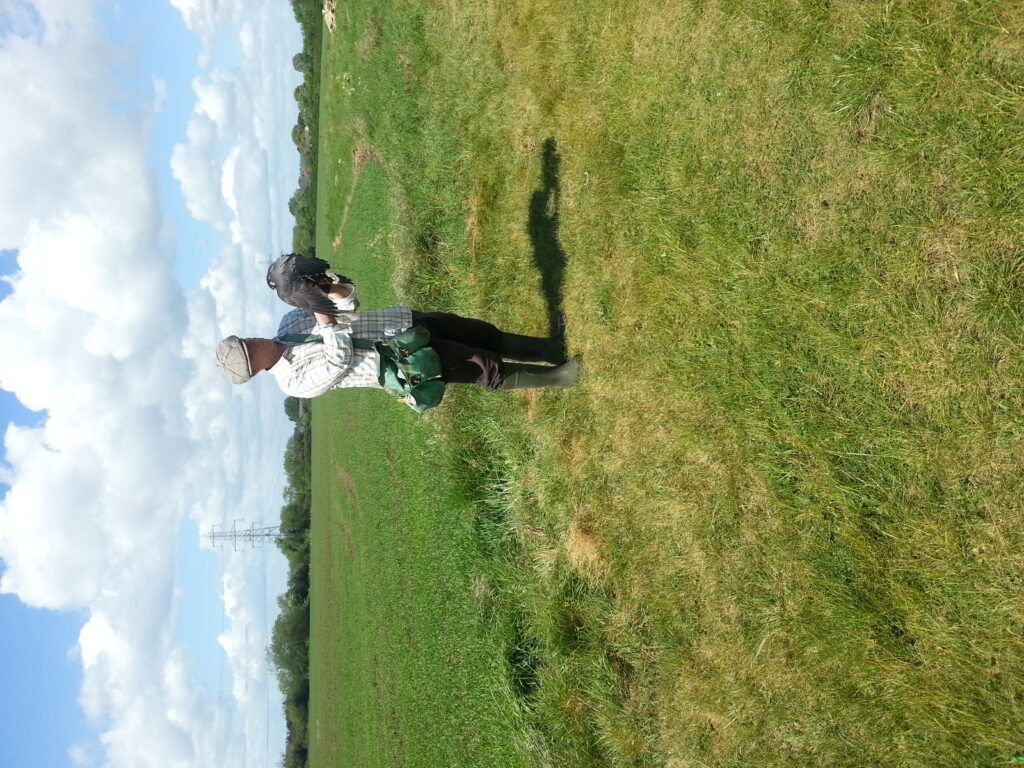
Worcester
We had a trip to Worcester on Saturday to see the John Singer Sergeant exhibition – his association and friendship with other artists in the area. We really enjoyed it – not too big – an hour of intensive viewing and reading. What a brilliant artist! then a bacon sandwich and then a good look round at the other exhibits – very interesting – and then we made our way to the cathedral.
It was raining quite hard and it vindicated not taking the sports car – that we are looking after – it is 36 years old and does not like the rain. We decided to take a tour of the cathedral which was so interesting. It reminded me of the book ‘The Pillars of the Earth’ by Ken Follet that I am currently reading. I noticed on looking up on the way in the shape of a peregrine falcon sitting up high on the tower – huddled like a little old man in the rain. At the end of our tour in the herb garden the sun was out and as I looked up a peregrine flew over head.
Worcester was a lovely city – never been there before – with the river, the race course and some lovely railway arches with many house martins hawking insects. It was race day and place was really vibrant despite the weather. In fact it helped because some race goers decided to stay in town and watch the racing from the various bars. It was Ladies day and the place was very colourful.
On our way home we went past the cathedral and Patricia took a short film on her phone of two peregrines chasing each other around. The female telling the male that the rain had stopped and to go hunting! Here is a still from the movie. The two dots upper centre right are the falcons! Subsequent to this posting I learnt that the falcons nested on a nearby Church and then returned to the Cathedral – where they had nested last year – once the chicks had fledged. This means that the two falcons in the picture could well have been youngsters having fun and chasing each other about.

And here is our own trained peregrine ‘Sprite’ taken after flying. He is peering down at the meat on my glove. As I say in book ‘Falconry – aspects of care of the trained falcon and hawk’ it is important that the hawk or falcon feeds properly on the fist – sitting the right way round and not snatching or trying to rob the fist of food.
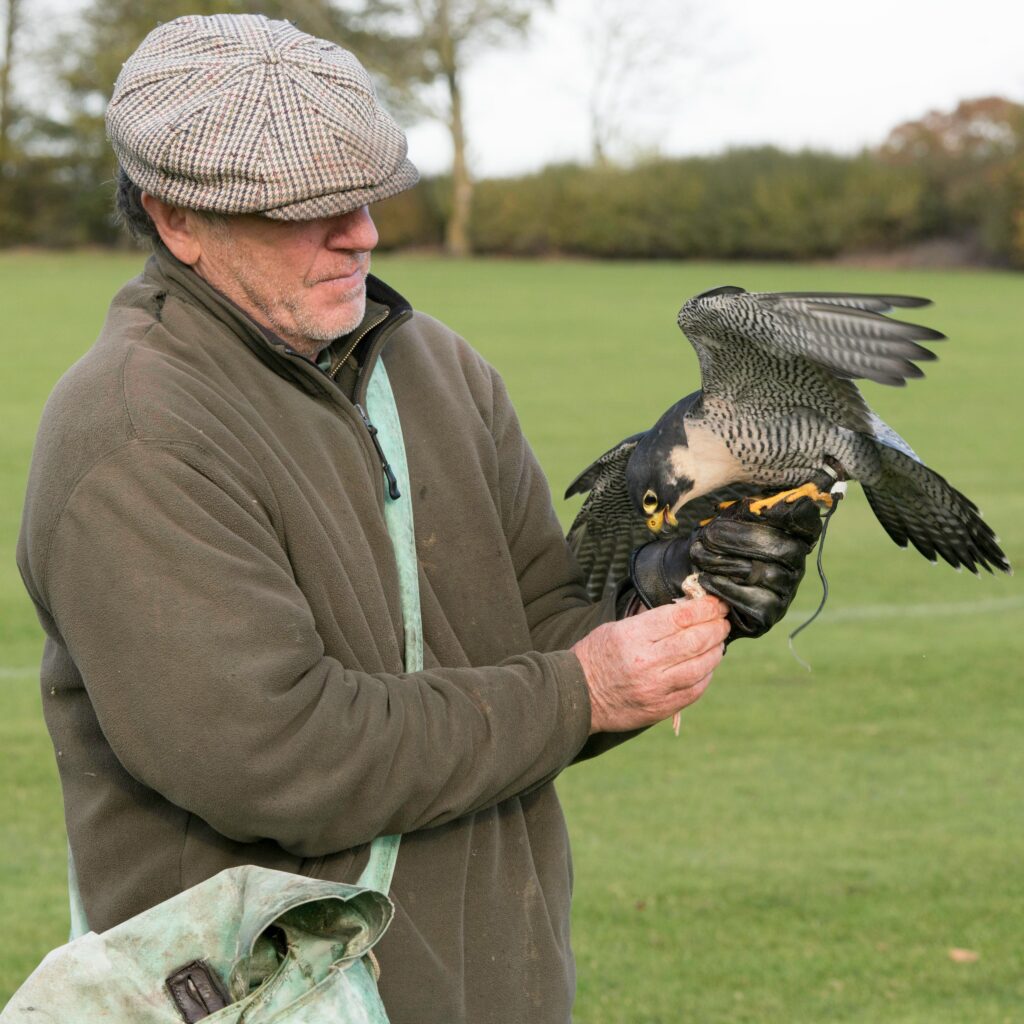
Bo
It has taken me a while to get over the passing of Bo our Indian Eagle Owl who we had for 38 years. A passing of an era – I thought at one moment she may outlive me. But her absence has left a big hole.
She was the most amazing demo bird and once I had got the hang of flying an owl – it took me several seasons – she went from strength to strength. Owls are not like hawks and falcons – they need a different method of training and I often used to say to guests that they are tamed rather than trained.
It is not quite true because food still has to be the motivation for them to do anything but since they are hand reared or imprinted from a young age they are excessively tame seeing their human companion almost as a parent.
They are sensitive to loud sounds – they have excellent hearing and with both eyes facing forward – in the facial disc – they have little peripheral vision and can panic on hearing on hearing a loud noise like a motorbike.
So introduction to shows is a slow and gentle process and building up to flying at a show takes time. Bo was coming to shows to sit on or in her canvas t-pee long before I started flying her.
But once I had the confidence she was flown almost everywhere and was always centre stage – people love owls. She would also chase the dummy rabbit. I wanted people to see owls as highly evolved hunters and not just as a cuddly toy.
She is in my book ‘Falconry – aspects of care…’ on the section on casting – not quite in keeping with the title but nonetheless useful to show that particular hold in the absence of an available Harris hawk.
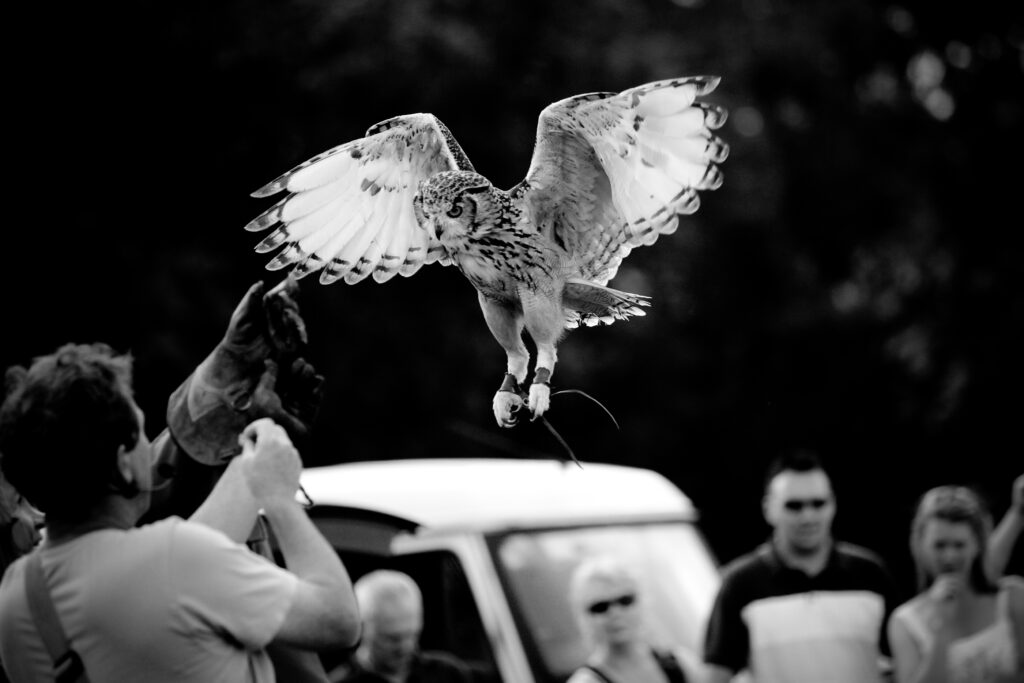
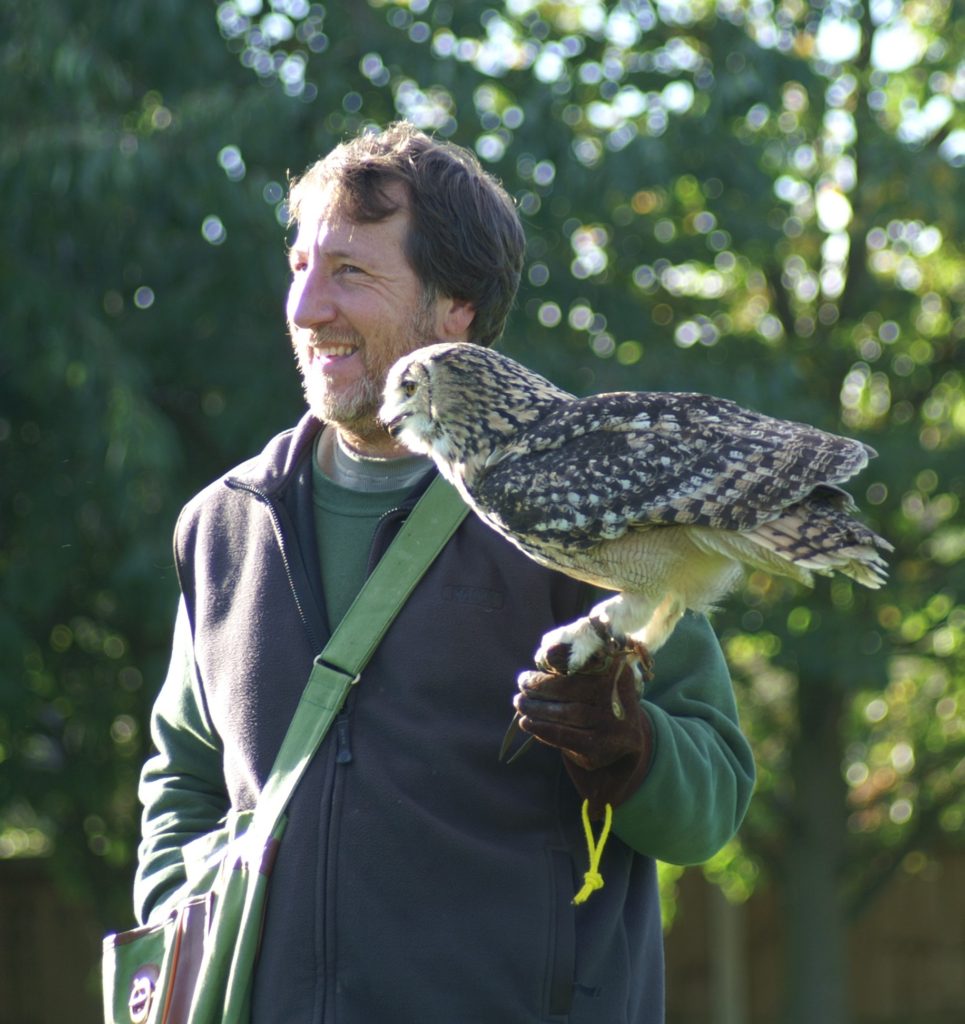
Here are some picture of Bo from down the years.
At Blenheim
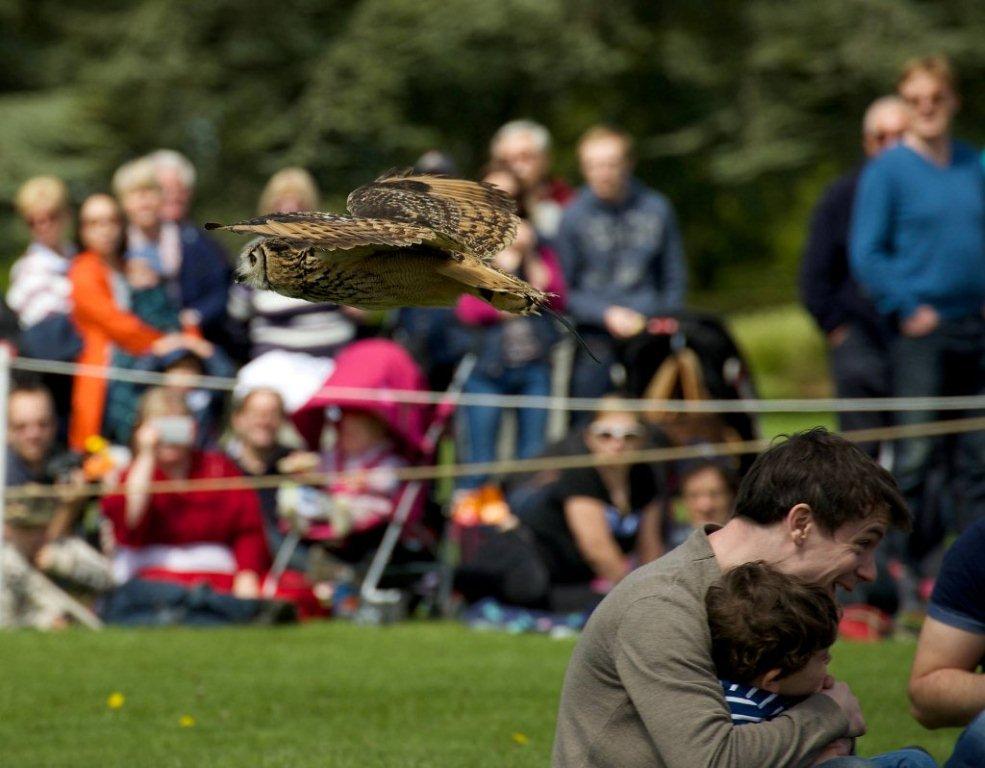
At an Army fun Day. Bo sitting relaxed in her t-pee

At a wedding – flying to a guest.
At home with me – many years ago!
June
Well June is here and I hear myself saying do not wish away May – we will have to wait another year for it to return. It is, however, the best month of the year along with the last two weeks of April. The weather in the last part of May has been very warm and for those that like the heat – just great!
Finally the House Martins have turned up and there are now several pairs in the village – in their usual spots. This is good news because I was lamenting their absence in an earlier blog. I counted 9 swifts the other night flying around the village – which again is good news and a wonderful watch.
Both the falcons are flying well. It looks like we are about to lose another flying ground to development – which is such a shame as it is a loss of a green community space absolutely packed with wildlife. Lets hope the pressure group – that is to be formed – can have some effect on the planning outcome of this valuable space. The thought of football pitches being dug up for an industrial park is unbearable and unacceptable.
In this green space this morning we saw our first Hobby of the year. Frank the lanneret was on the lure and he started calling looking skyward. Initially I could see nothing. I thought it was either a kestrel or a peregrine – more likely the later but I was delighted to see – after a while – the distinctive shape of a hobby. I left Frank on the lure hoping it would draw the hobby in. It came over our heads and suddenly closed up and with great pace stooped at some swallows hawking insects along a high hedge. It was so exciting. Seconds later the hobby appeared empty footed – I have yet to see a hobby catch a swallow – after having seen several attempts – but they must be able to do it.
The hobby disappeared to continue hunting no doubt – hopefully we will see again it over the summer. A few minutes later a male Sparrowhawk appeared carrying prey – it made its way – straight lining it – to some distant nest to present it to the female.
It reflects a busy time of year. Last night from our front room we saw a peregrine – a male or tiercel – carrying heavy quarry into a stiff breeze – again on a journey to a distant nest site. He was flapping wildly under the burden but still making headway. It may have been a pigeon.
Our own falcons Sprite and Frank are both flying well. Both are featured in my book ‘Falconry – aspects of care of the trained falcon and hawk’ which is available at all good outlets including Waterstones, Amazon and Coch-Y-Bonddu books. I am honoured by those people who have bought the book and I hope they have found it useful in the daily care, training and housing of their birds.
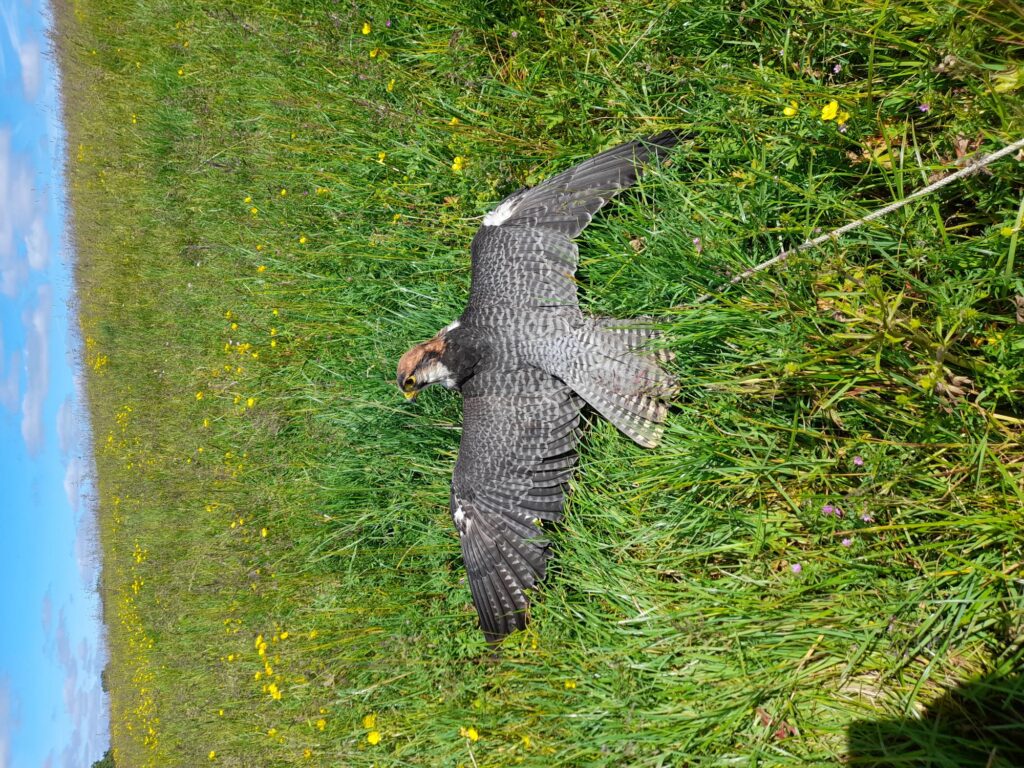
I sign off with a picture of Frank on the lure on a lovely sloping meadow.