Archive for June, 2025
Falconry books.
 June 25th, 2025 |
  Author:
 I have been thinking a lot recently about Major Charles Hawkins Fisher the famous Stroud falconer who died in the early part of the last century after an eventful life.
When we used to live in Woodchester I used to take the bus into Stroud and visit the little museum which had some of his old stuffed birds and falconry equipment. It was away of getting closer to falconry, I guess.
It wasn’t till many years later when I read his book ‘Reminiscences of a Falconer’ published in 1901 that I began to admire him for his forward thinking and lack of dogma – which has sadly plagued our sport. He was basically good at everything having been a champion archer of England and no doubt with his riding skills today he would have been a modern pentathlete. It was serious riding accident that prevented him following the hunt in the way he would have liked that no doubt pushed him to looking at other activities. He encountered falconry while in Norfolk in 1858 and for that point onwards he became an avid falconer. He was a Gentleman falconer and had a professional falconer to assist him. Apart from their escapades to Salisbury Plain for Spring rook hawking and trips to Scotland he flew peregrines contrary to doctrine in more enclosed countryside around where he lived. Clearly, he had a lot of fun – but there is always a high risk of losing peregrines this way. Peregrines was his thing, and he never was interested in flying goshawks or sparrowhawks possibly more suited to the terrain. He also foresaw the importance of bringing falconry to the attention of the public – and suggested keeping a mews at Alexandria Park in London in the 1870s for that purpose. The intention was to show that the sport was still alive and to educate those that persecuted birds of prey by shooting. If falconers lost a falcon, it would invariably be shot. Many a good bird was lost this way.
I do like the way his book conveys his enthusiasm and love for the sport – the joy it can bring and the flexibility of his approach. As I have said before he wrote the book at the end of his life when he was incapacitated and in much pain. His riding accident catching up with him no doubt. It was only through the encouragement of others that it was published, and we are still reading it today. I relate strongly to Fisher because due to my own illness there is that urge to leave something behind – a legacy if you like – hence my book ‘Falconry – aspects of care of the trained falcon and hawk’ and like Fisher through the encouragement and support of others it was published in 2024. Whether anybody will be reading it in a hundred years is anybody’s guess – sadly probably not. We are steadily hollowing out our society and things which I feel bring enrichment to life are being legislated out of existence. It is such a shame – because we need these things more than ever.
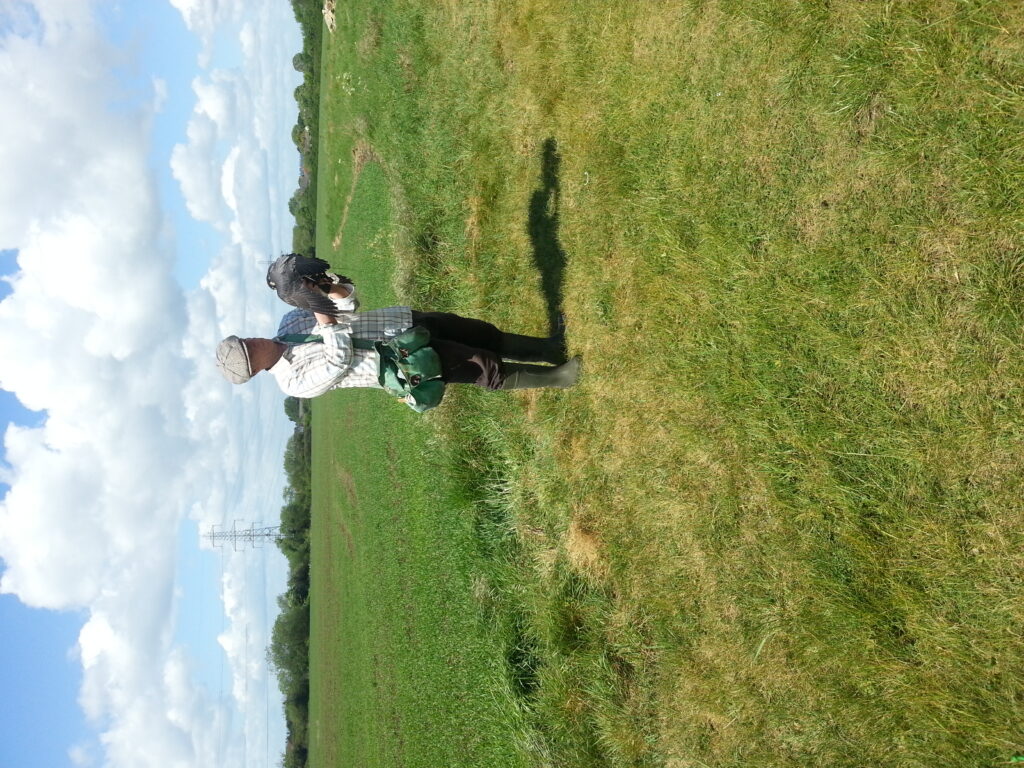
I will sign off with a picture of me and our peregrine Sprite after flying him down at the Knowle a few years ago.
 Posted in
The Three Counties Show 2025
Another lovely morning – a warm day and hay making around here has started. Although as I said in a previous blog the hay is quite straggly – like common land grass– because of the Spring drought. The hay contains, many of the less productive herbage grasses which seemed to have done better than rye grass in these dry conditions. One good thing is the number of butterflies around. Quite astonishing compared to previous years – it just goes to show how damaging a wet Spring can be. On the other hand, some of the later sown crops are struggling to germinate. So, winners and losers but nonetheless great to see butterflies.
Well as the title suggests we visited on Sunday the last day of the Three Counties Show – again the weather was fab. Our purpose apart from visiting the Show was to see our friend Graham Watkins from Gamegoer Gundogs who was performing in the Countryside Arena. It was great to see him and catch up on news of our little world. Graham kindly wrote the foreword to my book ‘Falconry – aspects of care of the trained falcon and hawk’ by me Michael Davie. Graham is such a master of his craft and so I was honoured when he agreed to write the foreword.
We are all getting older! But Graham despite semi-retirement did a wonderful arena display – which was much appreciated by the audience. He is a real Spaniel man but is good with all dogs.
Of course, now that I have retired – or had to retire – I no longer have to worry about doing falconry displays but can watch others doing it with no pangs of regret – in fact some relief because it is hard work being a falconer. And I should know with 35 years of professional falconry behind me.
On this occasion we watched Alistair from ‘Hawkeye Falconry’ doing the falconry display in the Countryside Arena. He does a good job and should be commended for the care of his birds and the excellence of his display. His falcons – my interest – fly well.
Even at the highest-level unexpected things can happen particularly with another falconer watching! And one of Alistair’s finest falcons decided to go up on a thermal – it was a warm day. I did not think anything was unusual in this behaviour – I did not know the bird. The falcon a gyr/lanner cross went up a couple of hundred feet and looked like at any moment it would bring the house down by stooping back into the arena. It started to fold up as if it were earthward bound and then maintained height and went on the wind over the top of the arena. I thought it was going to stoop back into the breeze – which is an easier way of doing it but instead it just kept going and slowly drifted off.
This is a nightmare for the falconer because a decision has to be made about getting another bird out and continuing the display. Which Alistair did. But he had technology on his side with the GPS tracking hybrid transmitter – the bird’s location being shown on a smart phone map. Amazing! At one point the falcon was soaring at 1500 feet!
So, Alistair continued the display knowing the falcon was some way off and would not return to the arena in the middle of flying another bird. I have been in these situations before – it is not nice because you are entirely compromised.
Anyway, when Alistair had finished the display, the bird had stopped moving. I suggested he go and get it before it moved again and possibly go a lot further. The signal even with this system was dropping out suggesting the bird may have been in a dip or on the ground.
I said I would go with him, and we borrowed a car from a show organiser – a very kind gesture otherwise he would not have been able to get out – and giving ourselves an hour we drove off to find the falcon. It was extraordinary we just drove to where it was which was probably just over a mile away – as the crow flies. You always need luck on your side and conveniently the bird was sitting on a pylon next to a farm track. When it saw Alistair with the lure it flew straight down. The bird ‘Todd’ was delighted to see him.
As I have said in my book it is easy to lose a bird again after first finding it. They can be very easily spooked particularly if it is a parent reared bird. Thankfully this bird was an imprinted falcon and was delighted to see Alistair. In no time we were back at the Show ground and Alistair would be able to do his final display without worrying about his lost falcon.
The bird could have been found with a traditional non satellite telemetry system but nowhere near as quickly as the GPS system. I was amazed. The two drawbacks to the GPS system are firstly the cost – which is high and secondly the system is very energy draining and so there is a relatively short window of time in which the bird must be found before the transmitter runs out of power. The hybrid transmitter does allow the system to be used in a non-satellite way. I have read there is energy saving software on the system – for example at night – but I am not an expert.
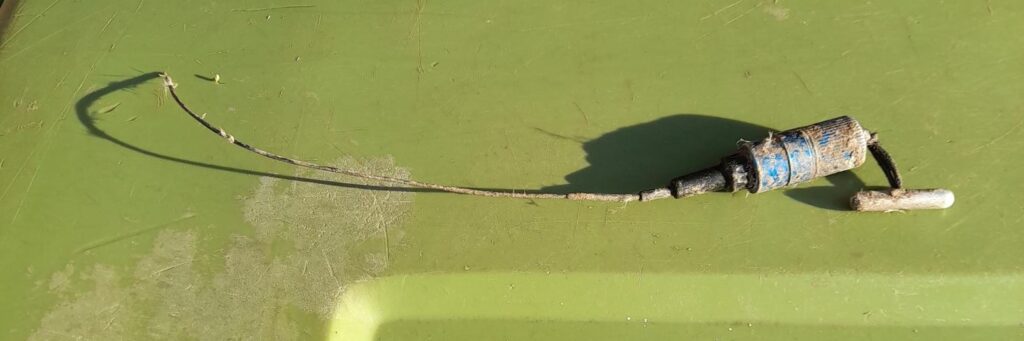
The peregrine I picked up earlier in the year on the chicken – see the blog ‘lost birds February 7th 2025’– was wearing a GPS tracker that had gone down – showing that any system is not fool proof. Further all systems seem to struggle when the bird is on the ground. The peregrine above was picked up on the ground. Alistair’s falcon interestingly had also been on the ground as its feet were muddy. But the system did work.
It was a great day, and we left at about 3.00pm to beat the traffic. It was nice to see everybody, and I am glad Alistair got his bird back.
I will sign off with a picture of a muddy GPS transmitter that I took off the peregrine I picked in Cheltenham on the chicken. It was put outside the house just in case the transmitter was still working – this is always advised.
Friday
It has been an interesting week. I say in my book ‘Falconry – aspects of care of the trained falcon and hawk’ the importance of daily flying of falcons to build up fitness. Apart from staying longer in the air the falconer is able to develop the bird by rewarding it for good a manoeuvre like a vertical stoop or for gaining height. This a skill and good lure swinging can help. It is similar to a wild falcon learning to hunt and as Phillip Glasier would say “learn how to stick out a foot sideways”. Some birds that are fit seem to keep a residual fitness even after a rest others lose condition very quickly and the whole process of getting fit needs to start again.
There never seems to be a perfect day for flying. It is too windy or something and of course each bird is different. It is only by flying a bird in all weathers and not shying away that you really get to know a bird and its potential. Many years ago and I mean many! I had male lugger falcon called ‘Waqar’ that I would fly. He would just go through the motions – as it were. Then at a Show he flew incredibly well. The wind and location was just right and thereafter he became when of the best birds we ever had. He was fast and manoeuvrable and he could surf the breeze in a way that only luggers can. It was just a sudden quantum leap forward and can only happen if you chance your arm. Of course as professional falconer – or at least I did – you would always fly if possible. But I have said in the book the falconer but not be too ‘gung ho’ when deciding where and when to fly and risk losing the bird.
It has been a good here – recently – for wild peregrines sightings. I have seen – no doubt it is the same bird – two occasions a peregrine carrying prey – straight lining it back no doubt to the nest site and then another hunting where I fly my own birds. So wonderful to see. Often I don’t see peregrines for several weeks and then I will see one everyday for a week. It depends on where they are are hunting and if I am looking in the right direction! As a falconer you become very good at picking things up visually be it a wild falcon or a rabbit feeding in the grass. It goes with the job.
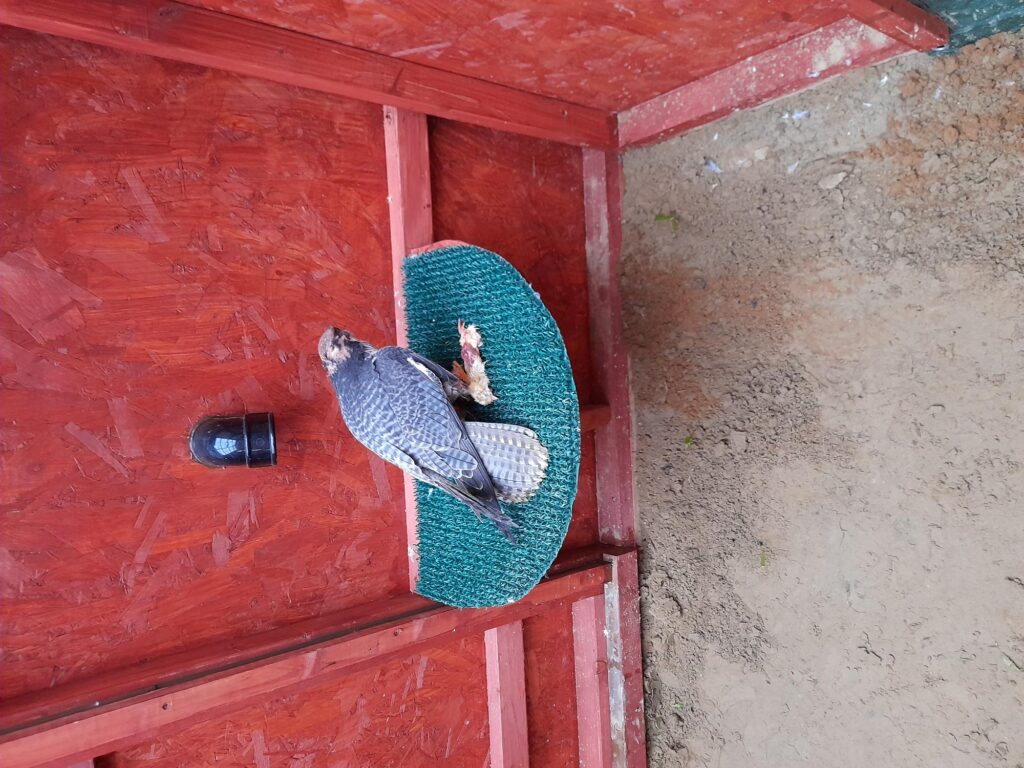
Well back at home I have been doing some maintenance – staining the loft that my son and I built for the book in the step by step guide. I am ‘if you like’ following my own guidelines and doing it a little bit at a time. The loft itself is now 2 years old and still looking brand new. I will sign off with a picture of the loft inside with a lanneret feeding on the food platform.
A lovely Summers Evening.
Before I start my news blog I must talk about my book ‘Falconry – aspects of care of the trained falcon and hawk’ by me Michael Davie. I have had another good review which is gratifying but what I am pleased about is that Julian – the reviewer – got to hear about my book by reading my blog. So, thank you Julian for reading my news blog and buying my book.
I will not go into how the book came about – that is old news as it were – but after reading through the book again – it does I believe – offer as Julian says something different – and good, I hope.
Well tonight is a wonderful summers evening.
Many years ago, it would have been a perfect evening to take a hawk down to Red Marley in Gloucestershire rabbit hawking. As a young falconer I had my happiest evenings down there. I hope the book conveys the joy falconry can bring. We should not forget that – the mobile phone generation hopefully will wake up one day.
Talking of the young generation I have started to read the book ‘The Noble Hawks’ by Ursula Moray Williams in an attempt to discover why I loved the book so much when I was 14 or so. I will report back on that one. But I am enjoying it.
That buzzard that stooped at me and Sprite the peregrine last Sunday morning has not repeated the performance, but it was today watching me from a nearby tree – which was rather unsettling!
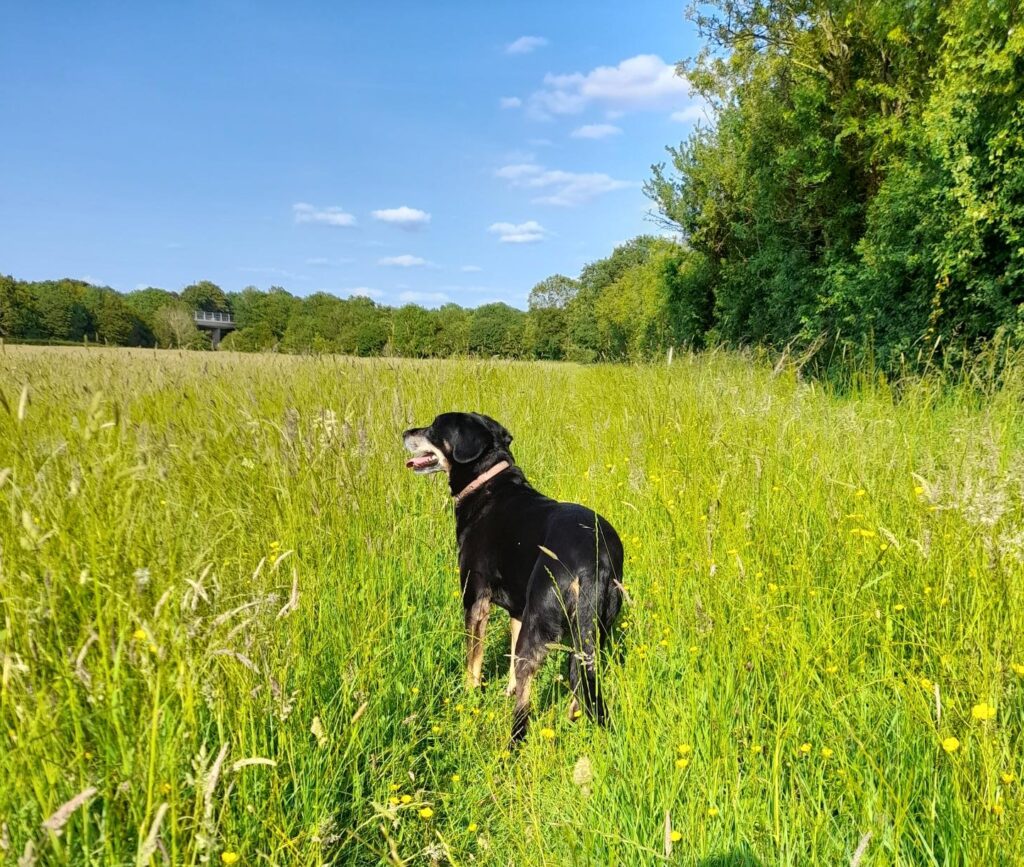
I will sign off with a picture of a lovely meadow where I have been with our dog tonight. Loads of butterflies and orchids and of course the dog. What could be better?
Meadowland
I think we are all partial to meadows particularly those that are permanent pastureland – grassland older than 5 years. I did a lot of work on grassland when I was a student and was quite good at identifying many species of grass – not so good now!
This Spring has been a strange one with drought conditions. After ‘I may say’ continuous rain for many months.
This has made the grassland for hay making very thin favouring many of the traditional herbage grasses over the rye grasses. It does produce grassland ideal for rabbit hawking. It allows them to sit out feeling protected away from cover but also allows the falconer to ‘walk them up’ hawk held high ready for a slip. The only problem with this is that there are no rabbits at the moment. This is a great shame and a strategy. I have discussed the reasons for this is an earlier blog. Needless to say it has nothing to do with the field sport community.
But the grassland this spring is unique with drought conditions playing a huge part. Yesterday -see photo below- I noticed the first common orchids of the year which is great – they have done so well in recent years. In the background you can see red clover and a diverse sward of differing grass types.

This week I managed to get a hold of a book that I read when I was a young falconer. I used to borrow from the library. It is called ‘The Noble Hawks’ and was written by Ursula Moray Williams in 1959. I could not remember the title but by chance I found it on an American website under a different name. Once I knew the original name I tracked it back to the UK and a bought a copy. I will report back when I have read it for the first time in 50 years.
I continue to fly my 3 birds Jarvis and Frank the 2 lannerets and Sprite the peregrine. It keeps me active which is very important and the love for the sport is still there.
In fact I flew the birds this morning and ended with Sprite by which time any pigeons in the area are long gone – hopefully – because he will chase them. I stooped him to the lure and when he was on the lure on the ground after the catch he started to get very agitated and started to ‘heck’ loudly looking skyward. There was a buzzard above us at some height but it was making Sprite nervous – particularly sitting on the ground. I could not believe what happened next because the buzzard started stooping at us! with me there. Anyway I felt that “discretion was the better part of valor” and we made our way to a narrow strip of woodland. We could see the buzzard circling above the tree tops trying to find us. I fed Sprite up and hooded him before we ventured out. The buzzard was no where to be seen but out of the corner of my eye I saw it land in a tree around the back of the wooded strip.
You hear of buzzards attacking members of the public – runners and so on – this is the first time I had experienced it myself. I fly my birds there everyday and we have three breeding pairs of buzzards nearby – they are so common now. Up to now we have all rubbed along just fine and this is the first interaction we have had.
Years ago we had an eagle owl bowled over by a wild buzzard at a corporate event. Unknown to us there were a pair of wild buzzards nesting in wood and they simply were protecting their patch from a dangerous intruder they had not seen before. I say in my book ‘Falconry – aspects of care of the trained falcon and hawk’ – available on Amazon and other outlets – that falconers should stay away from areas adjacent to where wild raptors are nesting as quite rightly they will not tolerate it.
But today – because we are such a familiar sight – was quite extraordinary. We will see what happens over the coming days. We do not want is a rogue buzzard! I will report back.
Another Wet Morning.
We need the rain, so I won’t complain.
People have said to me in the past wild birds fly in the rain why can’t yours? That is a good question and one I will try to answer. Most wild raptors will take a ‘rain check’ if the weather is poor. They will literally sit it out and wait for the rain to stop. Wet plumage will affect the efficiency of the hunting raptor thereby wasting energy in fruitless hunting expeditions where many prey items are also hiding somewhere keeping dry.
There will be some point where hunger in the raptor will reach a tipping point, and the bird must venture out in the rain to hunt. Mature birds will be used to having to hunt in bad weather however reluctant they may be to get wet. Young birds that are recently independent from their parents can run into trouble very quickly if the weather is poor. They can lose condition and basically give up. Like all young birds they need a lucky break or a series of lucky breaks to get then through these periods of bad weather.
Birds do have weather protection on their plumage – from an oil gland on the rump which birds preen into their feathers – but not to the extent that ducks do. So, while hunting in the rain the body feathers get wet first followed by the wing and tail feathers.
Some species of trained raptors have less weather protection than others and can get wet very quickly. Notably desert species like Harris hawks. This is not surprising considering the environment they live in. On the other hand, peregrines, a native species to the UK have significantly more weather protection which is needed in our climate.
With trained raptors – I am no longer a professional and so it does not matter – if it is more than a light drizzle at home, I would give the birds a day off and feed them on the fist in the hawk room. With young birds that have less weather protection – due to less dense plumage – you do not want them to get wet. They can get wet from grass if sitting on the lure on the ground or a hawk by diving into cover. You do not want to leave the bird wet on a block or bow perch to spend the rest of the day drying out particularly in the winter with dusk never far away. There is a risk of the bird getting chilled or getting wing tip oedema.
With young birds therefore if it is raining, I do not fly them. With older birds in light rain then it is OK. At a show the falconer is more inclined to fly the birds because this is what is expected by the client. But if the rain is heavy or it is very windy, the falconer may rightly decide not to fly the birds or at least suggest waiting for the weather to clear.
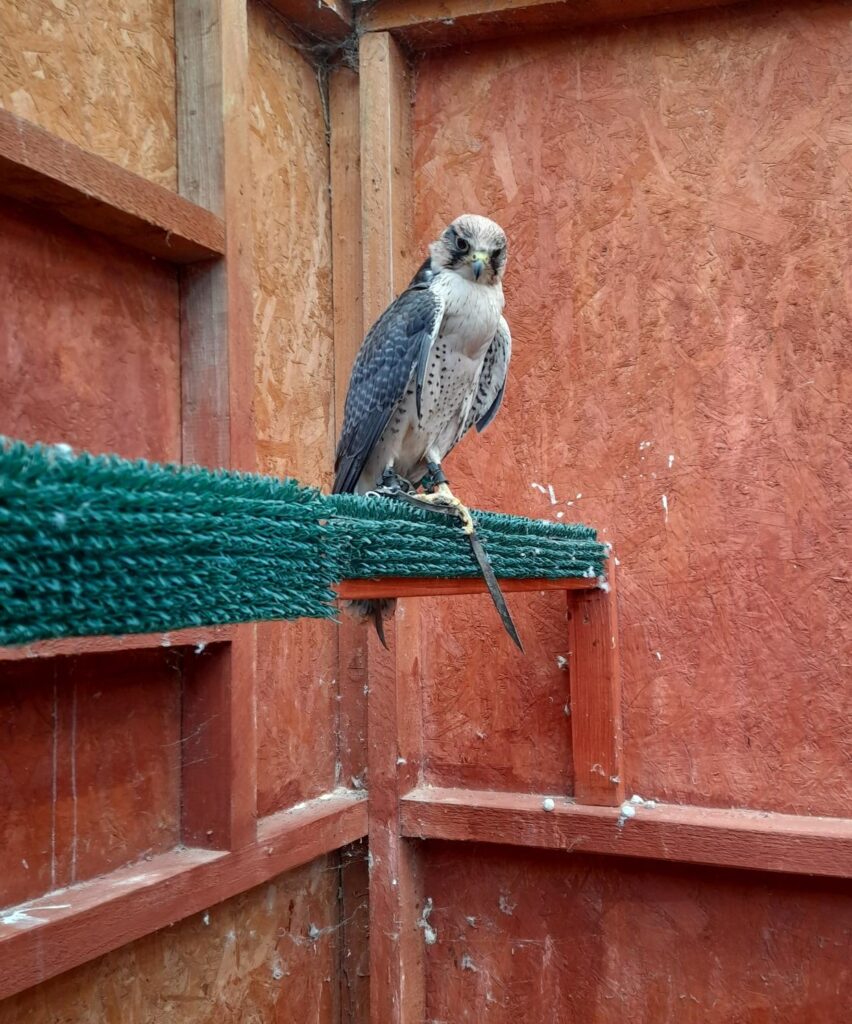
Below is a picture of Jarvis in a loft. If he were damp, then this is a better place to dry than on a perch. This is one of our older lofts and over the years it has been used for everything from a Barn owl to a female Harris hawk.
The weathering loft which is a dual-purpose structure can be used both as a weathering and a loft and is a central theme to my book ‘Falconry – the care of the trained falcon and hawk’. The loft below has been in use for 30 years, and as I say in my book you are building a structure for a long-lived hawk or falcon, and it is worth planning and making a good job of it. I emphasise the importance of having something ready before the new bird arrives. The book is pretty much for sale everywhere on the internet including Amazon, Blackwells, Waterstones and many other outlets but physically on the shelf at Cochy-y-Bonddu Books.
Here is Jarvis the lanneret from earlier today.
Cornish Kestrel
It has been a wet morning here and quite windy so I did not fly the birds but instead fed them on the fist in the Hawkroom. When I had finished it had stopped raining – typical! But I made good use of the time and ended up coping the talons of the birds starting with the peregrine.
As I have said previously the section in my book ‘Falconry – aspects of care of the trained falcon and hawk’ on foot care is the one I am most proud of. It is the most useful in terms of care of the bird at home. Prevention of bumblefoot is so important. Regular checking of the underside of the feet, coping if necessary and the use of astroturf as a perching surface will do much to protect the bird from this debilitating condition.
Everybody knows how fond I am of kestrels and I can watch them for hours as they quarter back and forth, periodically hovering as they search the grassland below for a beetle or vole. They have such mastery of the technique in all weathers from a still day to a blustery one – keeping perfectly still.
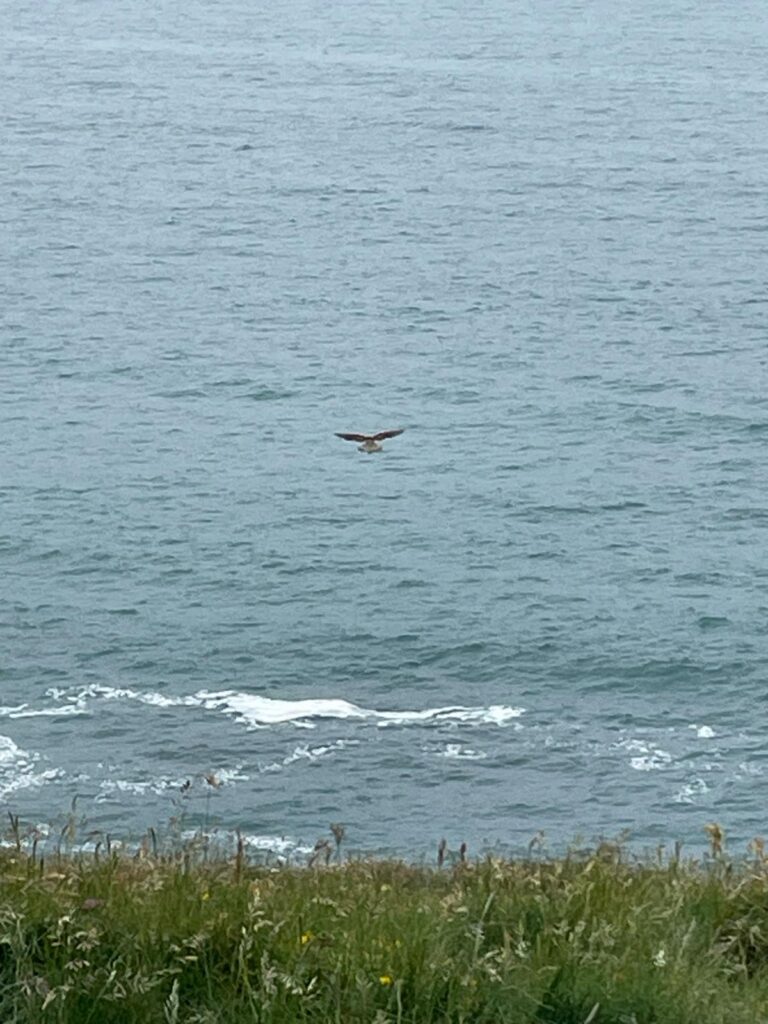
Below is a photo of a hovering kestrel taken by my sister on her mobile phone near Mullion on the Lizard Peninsula. Costal Kestrels have a timeless quality and seem immune from what’s going on in the rest of the world. The costal habitat one would like to think is also timeless but sadly not. Grassland needs management – grazing or mowing – otherwise it will be grassland no longer.
I will sign off with a the picture. I can just make out from its tail that this is a male kestrel hunting – no doubt for a family of young kestrels nearby. Wonderful.