Archive for April, 2025
A supplement to Section 6 ‘The hood’ of the book ‘Falconry – aspects of care of the trained falcon and hawk’.
 April 29th, 2025 |
  Author:
 Originally, I was going to include anecdotes to illustrate certain points in the book sourced from my news blogs, my diaries and from memory. The format would have made the book unwieldy and so I opted for a format that concentrated on technique and process supported by nearly 600 hundred photographs. I tried to keep the word count to a minimum and make the format as close as possible to a large Hamlyn paperback. The word count reflects my admiration for those authors who can say things simply in short sentences. Of course, when you are not feeling well sentences tend to be short with no energy for endless qualification. I think that sums up my intent and of course it is for other to judge its effectiveness.
So, I think I will use this news blog at times to offer supplement to the main text of the book. I have already been doing this, but I think the blog now fully reflects my transition from a working falconer to what is a series of articles about the things I see ‘out and about’ thoughts that I have and the maintenance of the birds that I am still flying. I have learned a lot from this process.
In the Section 6 on ‘The hood’ and I quote ‘Sometimes the hood is taken off and the falcon is gently cast off in one movement. It is very important that the plume of the hood with which you hold is not worn and likely to come off leaving the hood on the falcon. This would be a disaster’.
With my own words ringing in my ears, I noticed on the Anglo-Indian hood that I use on ‘Frank’ a lanneret the plume was becoming worn and in need of replacing. I do not like undoing other people’s work but to change the plume some deconstruction was necessary as shown below.
The damaged plume – about to break and so needs to be replaced.

Pulling back and removing the hood makers badge to get to the base of the old plume.

Old plume removed – a new strip of leather is inserted to form the new plume.

New leather strip in place ready for the next step.
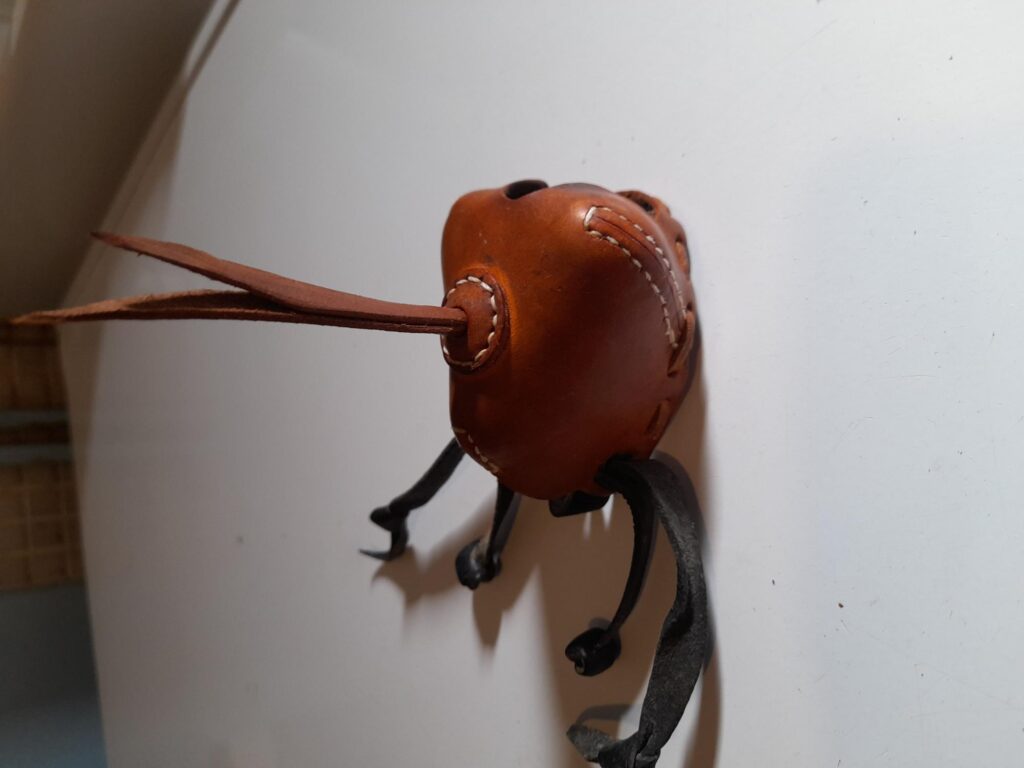
The two ends of the leather strip are pulled through a decorative bead which will hold the plume in place.
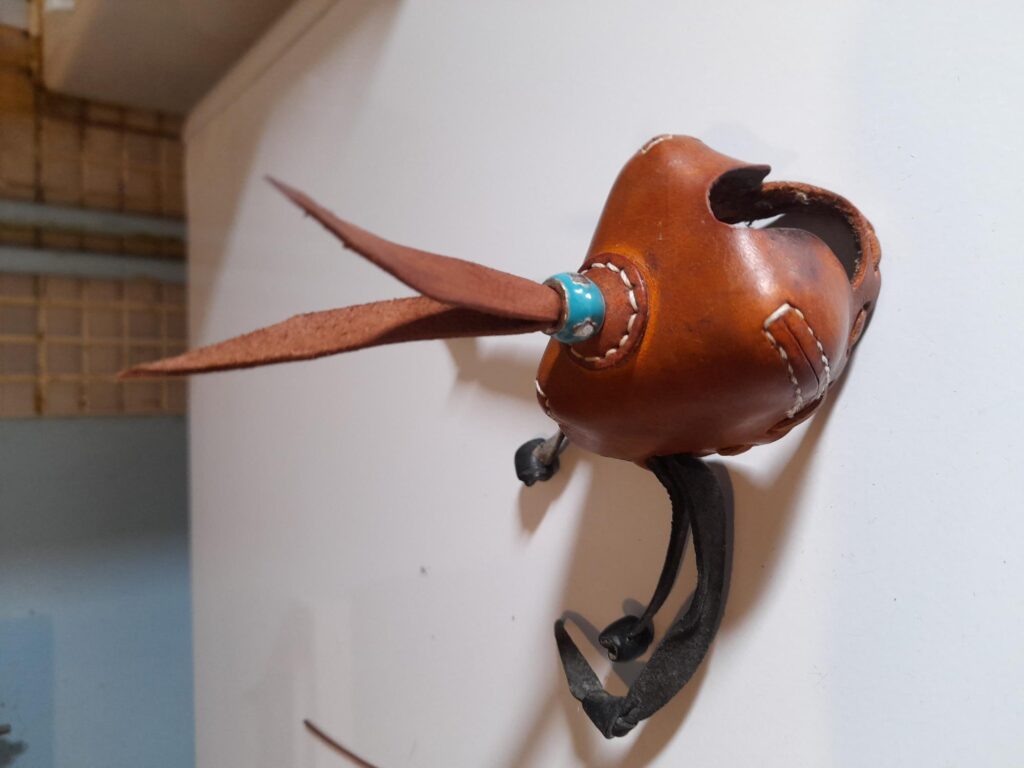
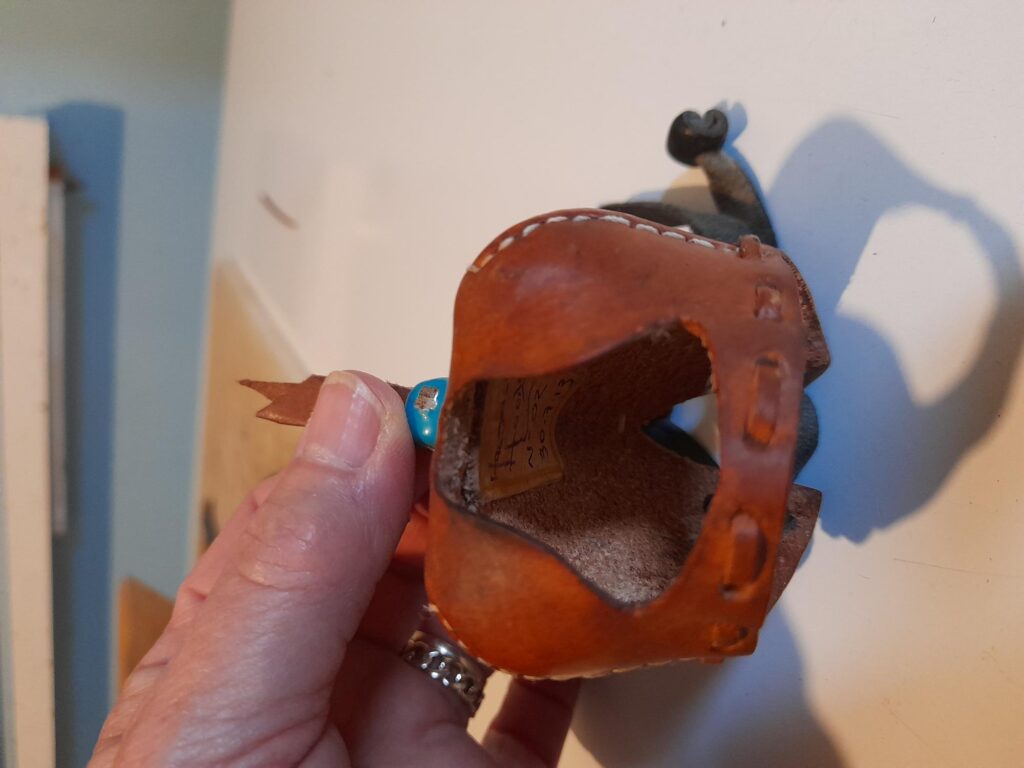
Gluing the hood makers badge back in place. This will obscure base of the plume inside the hood.

All done and the hood hung up on a peg ready for the morning. This a very simple plume. They can be far more ornate and decorative in some hoods.
 Posted in
Sunday morning.
I had noticed on Sprite our peregrine that his ID tag was a little tight on his leg. As I have said in my book ‘Falconry – aspects of care of the trained falcon and hawk’ it is important that bells and ID tags can fully rotate on the birds leg – on their leather bewits.
Birds legs can thicken during their first year – notably in Harris hawks – so regular checks of equipment including anklets should be made. Leather can harden and shrink overtime particularly if the birds are taking regular baths. Peregrines love bathing!
Anyway I felt the ID tag should be taken off and a fresh leather bewit be made for reattachment – which is what we did before flying him. Patricia my wife held him on the fist while the job was done.
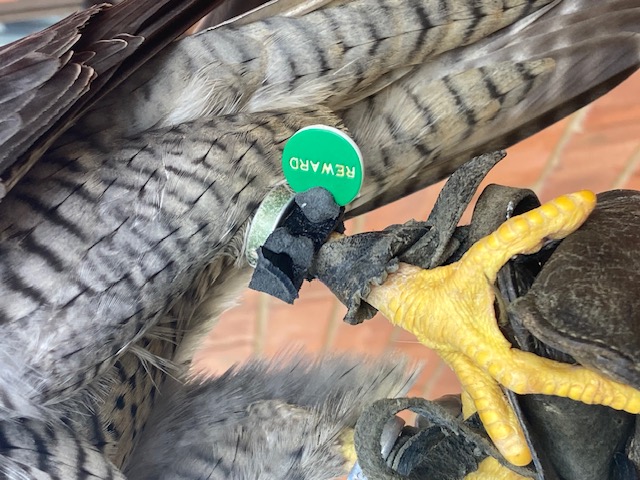
I am a great believer in the use of ID tags because it will ensure the speedy return of a lost bird should they be picked up by a third party. One phone call and the bird is back. Birds can be traced through their ring numbers and can also be registered with the IBR (Independent Bird Registration) but outside falconry circles this information is not widely known. So the tag is straightforward. I put the word reward on the one side as an added incentive to make that call. As I say in my book a small donation – often to a wildlife sanctuary where they often end up – is a small price to pay for the return of your bird.
Anyway it was done and I took the birds out to fly them. Jarvis the lanneret who I trained for the diary in my book has made a quantum leap forward in his flying – which is wonderful. I will continue to fly him through the summer which means flying him through he moult. He is in an excellent feather condition and so there is no need to rest him. He will moult but like a wild falcon which will be slower than a rest in a moulting aviary with plenty of food. This is recommended for the first year bird as the first moult will allow damaged first year feathers to be replaced. It is also a major transition from juvenile to adult plumage. This rest period will allow the young raptor to bulk and mature.
Sprite flew very well. He is typical peregrine fast and persistent and I really enjoy flying him. There are lot more swallows down the flying field and it is so nice to them back this year. The third week of April is a big week for arrivals.
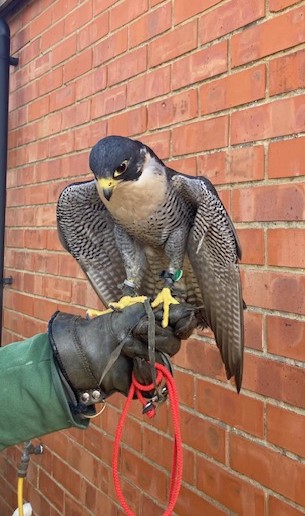
Here is Sprite.
Showing the ID tag that I had just fitted.
Another a picture of him peering down at the hawking bag.
My book ‘Falconry – aspects of care of the trained falcon and hawk’ by me Michael Davie can be found not only on Amazon but also Waterstones, Blackwells, Ebay and Coch-y-Bonddu Books. The later of which is a specialist supplier of countryside books. We had another nice review of the book on Amazon which is gratifying. Hopefully it will encourage others to have a look at it.
Wet Morning.
We woke up to a wet morning. This is Easter Bank Holiday Monday and years ago or actually just three years ago I would likely be away today doing a show. These days far from worrying about the weather I can just feed the birds on the fist in the Hawk Room and get on with my day.
I am now an amateur falconer again and like Graham Watkins who kindly wrote the foreword to my book ‘Falconry – aspects of care of the trained falcon and hawk’ he similarly has also been through some major changes to the point of semi-retirement. We both found we love what we do. For me birds and for Graham dogs.
So, instead of all my birds going – because of my illness – which was the plan – I now find the ones I kept back due to their age or not been able to find the right home has reminded me of my passion for birds of prey and falconry.
I am so pleased about that and the notion that I could just leave it all behind and move on was I think a little naïve. On the other hand, my primary motivation to make sure the birds were found good homes while I still had time to do it. I did do that – as I have discussed in a previous news blog.
Tomorrow looks like a better day and hopefully the birds will be flying again. I will not complain about the weather because we do need the rain.
Talking about my book I have had another nice review – which is lovely. I am pleased that the book is proving useful. It has a long way to go and hopefully at some point it will become widely read. Although with any technical book you are appealing to a niche community with lots of other books on the topic available. I hope it may break out and be useful to others involved in animal care.
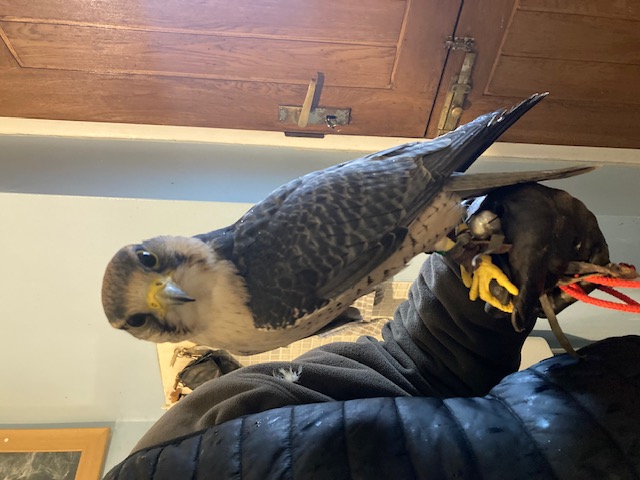
I will sign off with a picture of ‘Frank’ a lovely lanneret in the Hawk Room from this morning.
Wild encounters.
In the section on lost birds and telemetry in my book ‘Falconry – aspects of care of the trained falcon and hawk’ I included a few notes on encounters with wild raptors and other birds.
These days with the buzzards almost everywhere and kites not far behind the meeting of trained and wild raptors is inevitable.
At one time the only buzzard that could be seen around here was mine! Wild buzzards were very rarely if ever seen. Now they are very much ‘common buzzards’ again. Which is great to see. They keep the rat population under control, we have at least 4 pairs of buzzards nesting locally. Trained birds now grow up with these wild birds around and generally get used to them.
Although understandably if a trained falcon is sitting on the ground on the lure, it is a little unsettling having a buzzard or kite flying or circling overhead. The falcons tend to make a ‘hecking’ noise of alarm. The falconer should ‘make in’ as quickly as possible and pick the bird up or at least with the falconers company to make it feel less exposed. There is the fear that the bird may just panic and bolt leaving the lure on the ground. We had this happen with a female lugger falcon many years ago. I got her back a week later! Through her ID tag – which underlines their value – she was picked up and taken to an animal rescue centre and I got the call.
Last week I was flying ‘Sprite’ our peregrine and I noticed that he went very quiet and crouched down while sitting on the lure. He was looking upwards. I followed his line of sight and noticed there was a wild falcon circling just above us. It looked like a young female peregrine – still in juvenile plumage – from last year. She would be too young to breed this year. It can be quite difficult to sex a single peregrine in flight but when both sexes are seen together the female is visibly bigger and bulkier. Our peregrine I am pretty sure was a female.
She was a lovely looking falcon with quite a long tail and showing all the curiosity and bemusement of a wild falcon stumbling upon a trained counterpart. She circled for some time and dropped quite low to have a good look. We, Sprite and I were just awe struck. The wild falcon then deciding she had seen everything she wanted to see – gained height – and drifted away and snapped back into hunting mode.
It was a benign encounter. This is typical. Falcons can be drawn in to investigate a trained falcon stooping to the lure. Hunters are very curious.
As I say in my book be prepared to call your bird down if a wild falcon shows up. Just in case. Sometimes it is the other way around and a trained bird can be drawn away by a wild falcon or kestrel as happened most famously at Blenheim Palace when ‘Slick’ another peregrine – see an earlier blog – joined a kestrel on a thermal and drifted away.
It shows just how much you can see and learn about the natural world while out with a falcon or hawk.
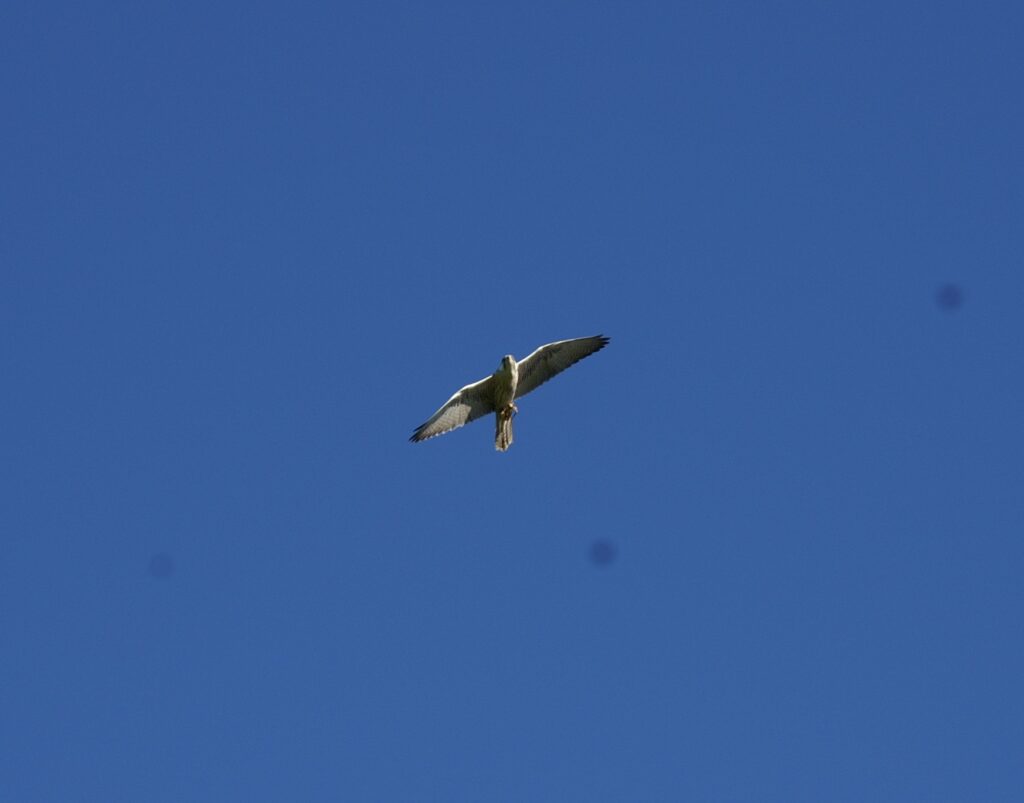
I will sign off with a picture of ‘Peggy’ a lanner-lugger falcon waiting on. She was not only an incredibly beautiful falcon but an amazingly versatile and brilliant flier. She was the first hybrid of her type. Her mother was a lugger falcon from Pakistan and her father a lanneret from the middle east. She lived for 25 years. Anyway, here she is.
KONICA MINOLTA DIGITAL CAMERA
Conditioning.
Conditioning is the technique we use to train a falcon or hawk or indeed any bird of prey. We monitor the condition of the bird by weighing it. The weight will indicate the hunger level of the bird and from previous records how it is likely to fly. As my book says the falconer will try to find a happy medium – a balance if you like – where the bird is both independent and responsive.
If the bird is in too high a condition it may indicate trouble ahead. For example, if a hawk is not particularly hungry – in high condition – it is likely to sit in a tree and not want to come down. It is doing its own thing. Similarly, a falcon may go off on a thermal.
For a bird that has been used for hunting there is a chance it will just go off self-hunting and not bother about the falconer. To remedy this the falconer will need to reduce the bird’s condition or it will soon be lost. This reduction will show up when the bird is weighed. It may take a few days with a small reduction in daily ration to achieve the desired effect that is weight loss accompanied with a better response time.
Passage falcons flown in the Spring at rooks on Salisbury plain could easily be lost. In the nineteenth century this flight was followed on horseback. The flight could last several miles, and it was key that the falconer was there at the end of the flight. If the falcon was unsuccessful and the falconer was not there to call it in to the lure it would likely go off self-hunting. Falcons in those days were wild first year peregrines caught on migration – on passage – and were already proficient hunters.
In fact, the demise of classic rook hawking was due to fencing the Plain making riding after the flight impossible. The number of lost falcons would be very high. According to Captain Charles Hawkins Fisher – the famous Stroud falconer – you could ride for twenty miles on Salisbury Plain in those days without encountering a fence. With passage falcons there was no room for error because these birds were not tame and therefore correct conditioning was critical. They did not weigh birds in those days but made a mental record of the bird’s behaviour and how much it was fed the previous day. In those days professional falconers were employed by Gentlemen falconers to train and fly the falcons – and they knew what they were doing. They could assess the condition of the bird by feeling along the breast or keel bone.
As a falconer of 55 years, I have never mastered the technique and do not believe it is sensitive enough to be accurate beyond saying this bird feels thin or fat. Every bird is made differently. Thank goodness for the weighing machine – 20 grams either way can make a huge difference. How could anybody feel the loss of 20 grams? Maybe it is just me!
But the point is that a subtle adjustment in flying weight can make a significant behavioural difference in a trained falcon or hawk.
If a young hawk is not chasing quarry because it knows the nearest food station is in the falconers hawking bag. The bird will need to have its weight increased so it looks less towards the falconer for food. Birds in the wild do not wait until they are very hungry to start hunting – they are nowhere near this stage. In fact, wild birds that are very thin and very hungry tend to just give up. So, there is no advantage in having a bird over keen or underweight. As the Old Falconers would say when you cast a bird off you want it to fly away from you and not swing back round looking for food.
Once a trained hawk has started to catch things then it is difficult to put the genie back in the bottle. A ‘made’ hawk will always be looking for opportunities to hunt and the falconers main concern is to make sure the bird is at the right weight or hungry enough to come out of a tree when you call it.
When stooping young falcons to the lure to develop fitness they need to be flown in the highest condition possible. So, you are flying on a knife edge particularly when the hunting instinct kicks in as fitness is gained. A bird’s condition can drift up in warm weather and it can lose the edge to its appetite. The scales will indicate this to the falconer this and a decision will have to be made whether to fly the bird and potentially risk losing it. A lot of falconers would take the risk – that is the nature of the falconer – just to see what would happen and the possibility to learn something new about the bird even increasing it flying weight.
My book ‘Falconry – aspects of care of the trained falcon and hawk’ by me Michael Davie is for sale through a wide variety of outlets. It was published in November 2024 by the Choir press, Gloucester.
I will sign off with a picture of a male Harris hawk on a flood light. Will he come down? Actually, he was one of my hawks and yes he did come down.
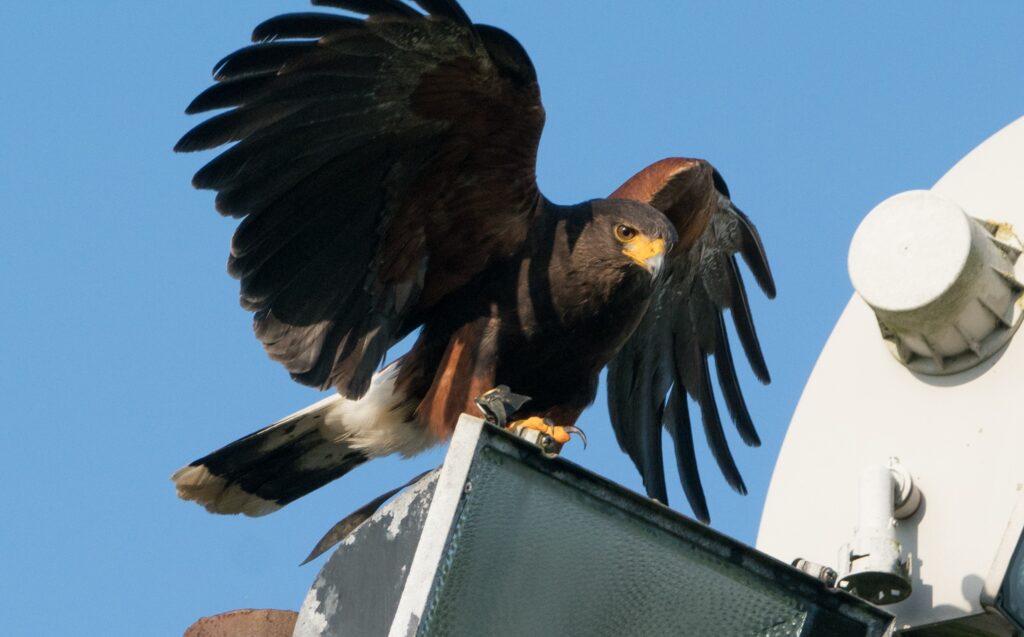
Wales – beginning of April 2025.
We have just come back from Wales after a short break to St. Davids, and the surrounding area. We love the Preseli Hills, and we retraced our steps of a previous walk in 2019. Thankfully for me it was not too taxing. We were surrounded by larks and pipits as we progressed across the moor which was wonderful. We also saw a ring ouzel which is a kind of upland blackbird that has a white chest. It had just arrived back after migrating from Southern Europe or North Africa. Its white front was quite striking, so it was a male bird. We came across a common toad on a pathway in the middle of the moor. Which was rather strange.
We saw an early swallow making its way across the moor to some distant farm and the following day we also saw a sand martin – rarer because they tend to be embankment nesters. They used to nest down at the River Severn where we live but like other similar species swallows, swifts and house martins they have all declined in recent years. I say this with much sadness. It mirrors a decline in insect numbers that these birds rely on. Hopefully numbers might pick up again in the future through active management schemes. As I have said in a previous blog I would much rather that wildlife be just out there living amongst us. Unfortunately, this is no longer the case – so many of our farmland birds have declined or gone. We must find ways to encourage them back. Various conservation efforts have shown that this is possible in ways that does not exclude food production – the latter point I personally feel is very important.
On our previous Preseli Walk we took a wonderful picture of a buzzard sitting on one of the many rocky outcrops. Of course, the blue stones for Stonehenge came from the Preseli mountains and so spiritually this is a very special place. We did see a buzzard and a kite but not one sitting conveniently on a rock. There were also plenty of ravens about and, we saw a flock of golden plover.
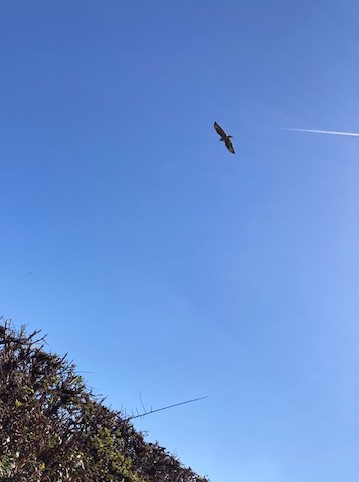
We did see a lovely buzzard on our way down to Poppit Sands a few days later. It was hunting from a roadside telegraph pole and was watching something very intently. It hardly noticed us trying to manoeuvre the car to get a photograph while looking out for traffic. We managed to get a couple of shots as it took flight, and I will post one at the end of this blog.
Before we left home my birds were all lofted and my son came back for the week to look after them along with the dog. He fed the birds each day down feeding chutes. This underlines the usefulness of the lofting system as shown in my book ‘Falconry – aspects of care of the trained falcon and hawk’. Lofting as my book suggest does allow the birds to be fed by a non-specialist carer when the falconer is away.
I was particularly pleased that Jarvis the lanneret – the falcon I trained for the book allowed me to take him out of the loft without fuss after not seeing me for a week. We shall start flying them again on Monday.
Here is that Welsh buzzard. Notice the exhaust from a human flying machine to one side. We had a great time the weather was fantastic.