Archive for November, 2025
Wild peregrine.
 November 27th, 2025 |
  Author:
 Today was much milder with a very fine occasional drizzle but OK to fly the two lanners. Sprite our peregrine is getting closer to actually completing his moult though he dropped the final outer primary feather on one side yesterday! so one to go on the other wing. So he will stay lofted for a while longer to complete the process.
We saw three wild birds of prey this morning. A lovely Kestrel down at the flying field working a ditch along the edge of a recently planted corn field. The light made him look a lot bigger. I wonder if J A Baker had this problem when he claims to have seen peregrines hovering. Peregrines do not routinely hover – I once saw one hover briefly over St Marys Church in Thornbury – but that is it.
Frank the lanneret start calling to the Kestrel – I had not seen it in the background – a recognition call to another falcon – nearly of its own kind. I did not fly him a second time just in case he wandered over. No sooner had a I blinked and the Kestrel had gone and there was no sight of him when I flew Jarvis.
Talking about falcons I saw a lovely wild peregrine while out walking the dog. Some magpies made a hasty retreat to a high hawthorn hedge and as I looked up the majestic shape of a female peregrine swished over my head at about 200ft – her operating height. She looked magnificent, powerful as she held herself in the wind while she considered her options – and then peeled away to continue her hunting trip and disappeared into the distance. I have found a couple of peregrine kills including a gull in an adjacent field so maybe this is one of her favoured hunting routes.
I include a picture of Sprite our current peregrine down at the flying field last summer – he reminds me of a Spitfire! same sort of shape or I should say a Spitfire reminds of a peregrine falcon!

We found some old pictures including this one of a Harris hawk – I think it is Arizona.
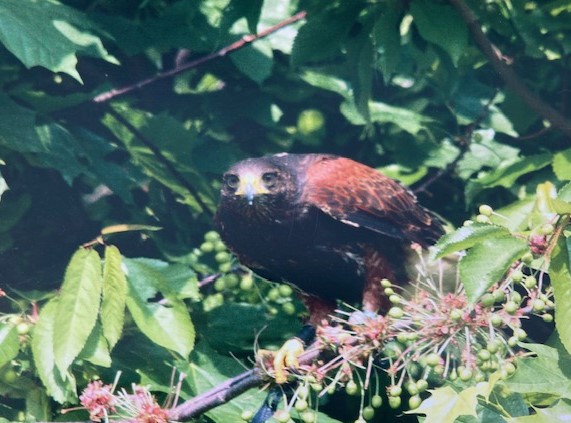
He is sitting in a tree watching me below. This is how we hunt many hawks including buzzards out of trees – they can ‘still’ hunt where we let them get on with it – nothing better in the summer with plenty of rabbits about or alternatively we could try and flush something for him like a pheasant or we could just be walking with the hawk ‘following on’. Every so often he would be called down to the fist for some food – to add value to the process. A gateway to food. A really smart hawk will fly on ahead and wait for you to flush quarry towards it. A lot of the flying shots in my book ‘Falconry – aspects of care of the trained falcon and hawk’ in section 5 ‘The development of the hawk including buzzards’ are of Arizona but much later ones than the picture above. Just before I forget the other raptor we saw was a buzzard – in flight surrounded mobbing crows.
 Posted in
Monday
I flew both the lannerets this morning. Frank below on the sock lure after flying.
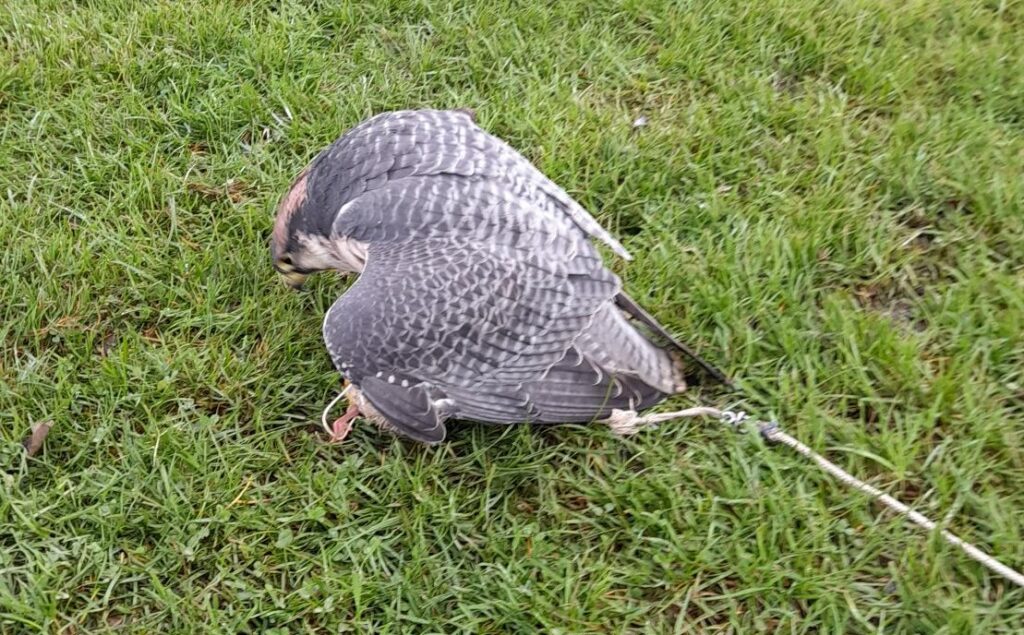
He has actually done quite a number of events when I was still working and had the promise of being a really fine demonstration falcon. Several years later I can confirm he a really lovely bird – easy to handle and hood and with a lovely flying style. I have developed him in the way I suggest in my book ‘Falconry-aspects of care of the trained falcon and hawk’ by positive reinforcement and it has worked. He flies well in any conditions including in a stiff breeze where he cuts into the wind using his momentum to climb. He is a lanner falcon and even Phillip Glasier called them charming birds.
Our other lanner is Jarvis and he or I think I should say she – I am fairly sure is not a lanneret now. Flying at 1.6 he can’t be. I think he is more likely to be small female rather than a large male. He too is flying well and at times he puts in a noteworthy performance showing signs he is learning – he is not at all afraid of stooping vertically. He is quite fit and this was the problem I had with him when I was training him for the book. We started quite late and he was not fit or had little endurance fitness by the Autumn. So a few days off for poor weather and we were back to square one. His hooding is much improved and I can hood him with confidence after flying – which can be tricky with some birds. But with patience and possible conditioning changes it is worth persevering with.
Changing the subject before I sign off I am currently reading the book ‘in Answer to the Cry’ by Dorothy Yglesias. It is about the wild bird sanctuary at Mousehole in Cornwall that they set up in 1928. I remember visiting the sanctuary in 1975 while on holiday in Cornwall on the hill road outside Mousehole.
Cornwall has a special place for me because my father went to school in Camborne and then spent the last 25 years of his life working as an artist in his rural retreat of Newbridge outside Penzance until his death in 2012. Anyway the book is of great interest the sisters who ran the sanctuary were themselves from a well known artistic family and ‘Pog’ one of the sisters was a fine sculptor mainly in wood. It is beautifully written and covers such topics as the Torrey Canyon disaster of 1967 where thousands of seabirds were oiled up – many died – but the sisters and helpers dealt with huge numbers – cleaning them up and finding them sanctuary – as far away as Slimbridge – until well enough to be released. A charming book which I will continue to read.
Cold Weather – ceramic bulbs and lofting and my book.
As I said in a previous news blog the 16th November is the one year anniversary of my book Falconry – aspects of care of the trained falcon and hawk‘ known just as ‘Aspects’. It was published by the Gloucester based Choir Press.
I have learnt much about the book business in the last twelve months. Had I known then what I know now the book may have been different possibly shorter with a simplified title to make it less expensive. That would have changed it from what it was intended to be – a legacy project containing much of my working knowledge from the last 55 years. Anyway this is just navel gazing because it is too late now.
But when I read it – occasionally in the Hawk room when feeding a bird on a wet morning – actually I am happy with it and feel it would be a useful addition to any falconers book shelf.
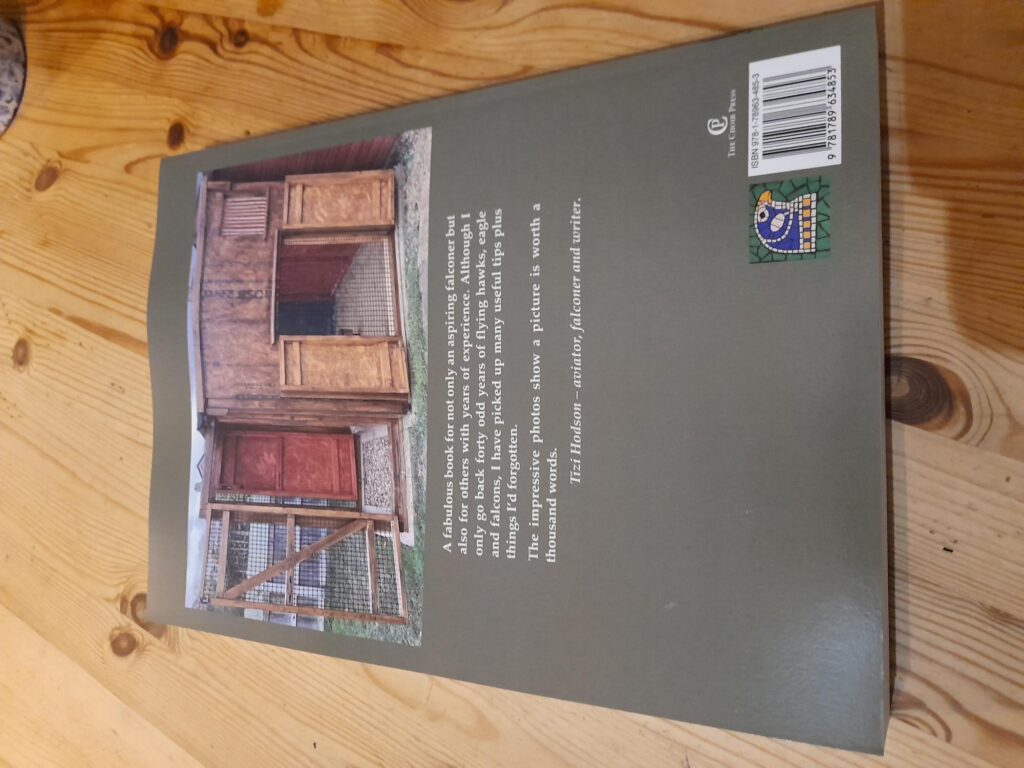
The weathering loft is my contribution to falconry. It represents a synthesis of construction techniques that I have developed over the years. Many falconers will of course make their own version – but I think it underlines the point of providing a nice home for your hawk sited often in the urban setting of a back garden. Of course when the bird is not at home it is being flown – which is what it is all about.
So the book stands. This is the back cover showing the weathering loft with a nice review from Tizi Hodson – I see it as a peer review because she is such a fine falconer.
What prompted this news blog today is the weather. It is turning much colder with temperatures down to -3c forecast for the next 2 nights. This presents a significant challenge to the first year bird because of danger of wing tip oedema.
The option is to either loft the bird – to rest it in high condition for the winter months or if a loft is not available then to use artificial heat to prevent the bird getting chilled. I recommend ceramic heating bulbs to keep the frost off. But there are other ways of doing it. In an emergency with no other options available the bird can be brought into the house and put in a night quarters. This is OK for short term use but boxing birds overnight for welfare reasons is not a good idea. They can end up spending too much time in them. Ideally the falconer should have planned for this eventuality before getting the bird. Some birds are more vulnerable to WTO notably and importantly Harris hawks.
Once you get through the first year then WTO becomes much less of a problem as the bird will have hardened off making it less vulnerable to this condition.
For example I am flying Jarvis – the lanner falcon – that I trained for the book through the winter. He is in his 3rd year now – so he should be fine. But for his own comfort – I do have the ceramic bulb option available – he has gone into a loft. In fact into an older weathering loft I made some 30 years. Frank our other lanneret has gone into the weathering loft we constructed for the book. photographs below.
Jarvis at the window of an older weathering loft.
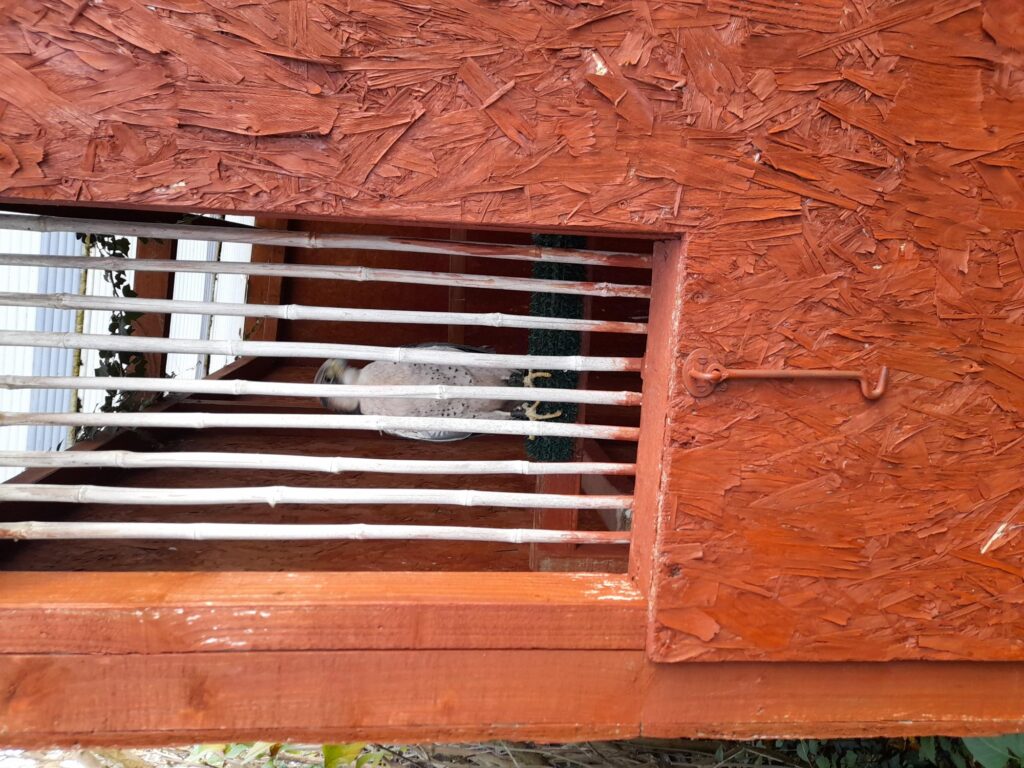
Frank in the new weathering loft – built two years ago.
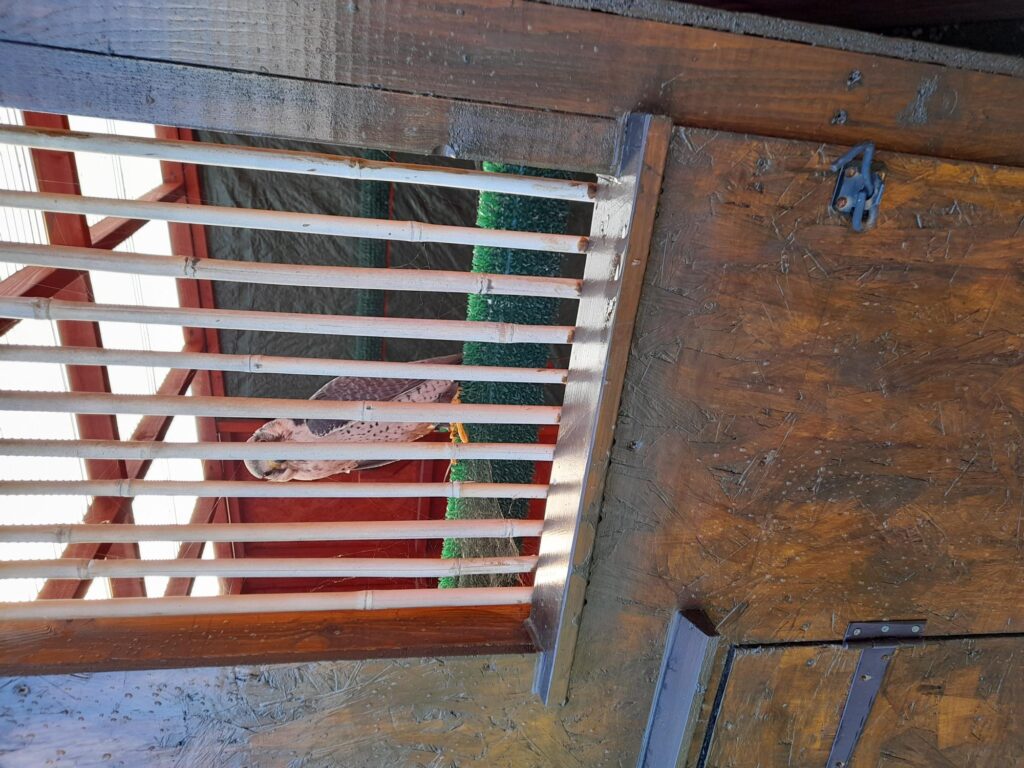
I discussed in the book that parent reared birds have a habit of becoming increasingly difficult to get out of the loft to be flown- if this happens as a contingency they can go back into a weathering under a ceramic bulb. The option of course if the weather is bad to rest the bird in the comfort of the loft and wait for it to improve.
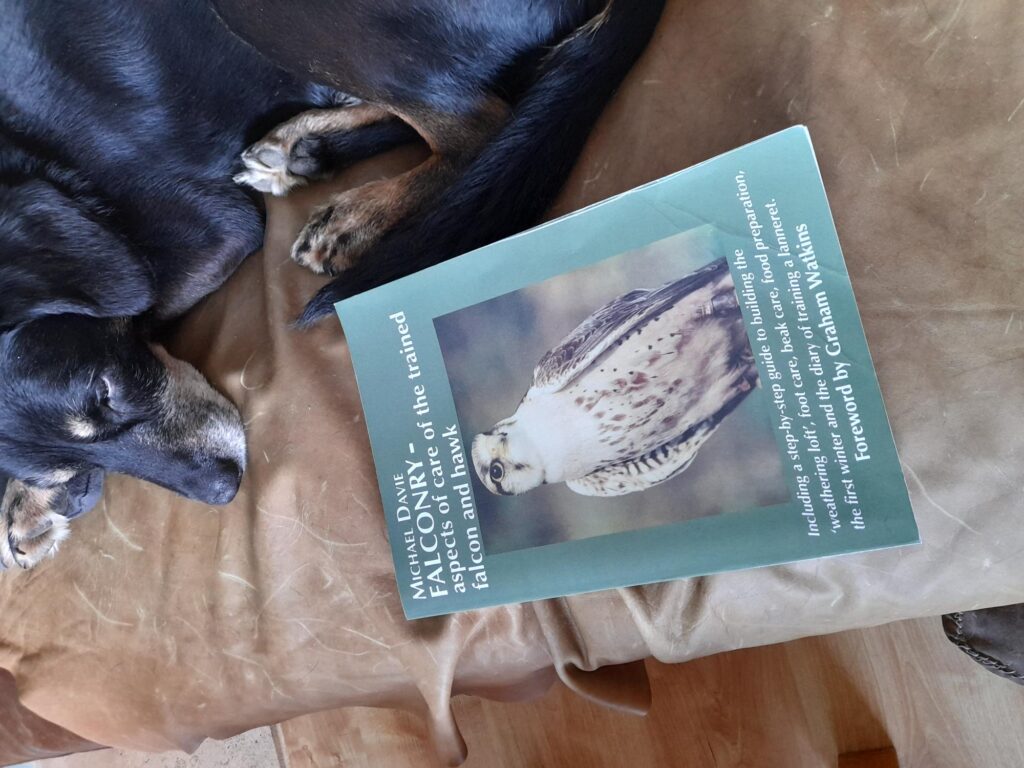
My book front cover shown above – this is my copy. The book can be purchased through Amazon, Waterstones and affiliates including Blackwells along with other outlets at a RRP of £30. Coch-Y-Bonddu Books actually stock it in their shop if anybody in the area wanted to have a look at it. It would make a good Christmas present.
Rain, rain and rain.
Its amazing the vulnerability we all feel when it now rains in terms of flooding. The worry of huge amount of rain in a short period overloading the system. But today the rain is ‘all day’ as we are on the edge of storm Claudia. Sadly, the weather forecast has been right. It settled down around lunchtime but revved up again in the afternoon with torrential rain – and it is now getting dark. So, I will report back on any flooding issues in the lofts and weatherings – if not elsewhere.
The stream which was dry a few weeks ago from the summer drought is now flowing again with some vigour and no doubt tomorrow it will be in flood – how things change. Below is a photo from this morning when I was out with the dog.
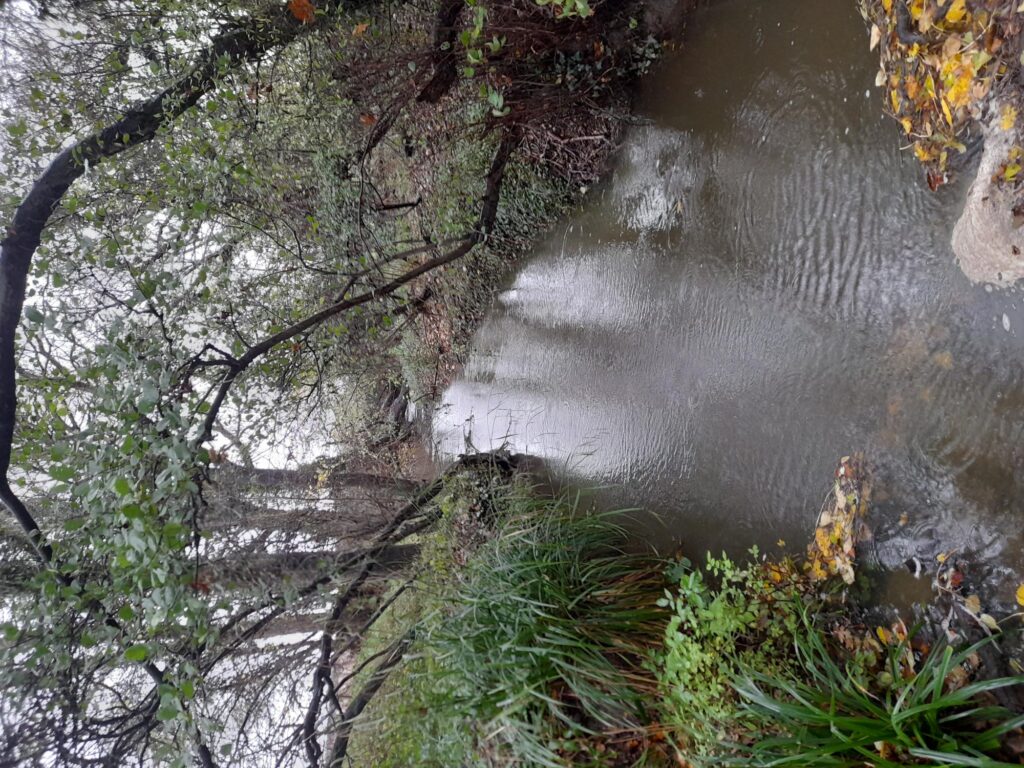
The siting of the loft or weathering is critical for many factors – I speak in my book ‘Falconry – aspects of care of the trained falcon and hawk’ about the possible disturbance of the bird in a poorly positioned loft from neighbours. The importance of giving the bird a decent view form the loft window. Something I did not mention is the best place to avoid flooding which is becoming more of an issue every year. At least with the weathering loft you can release your bird, so it is not near the ground if the water comes in. There are other things that can be done in terms of the height of the foundations, so water must work harder to get in.
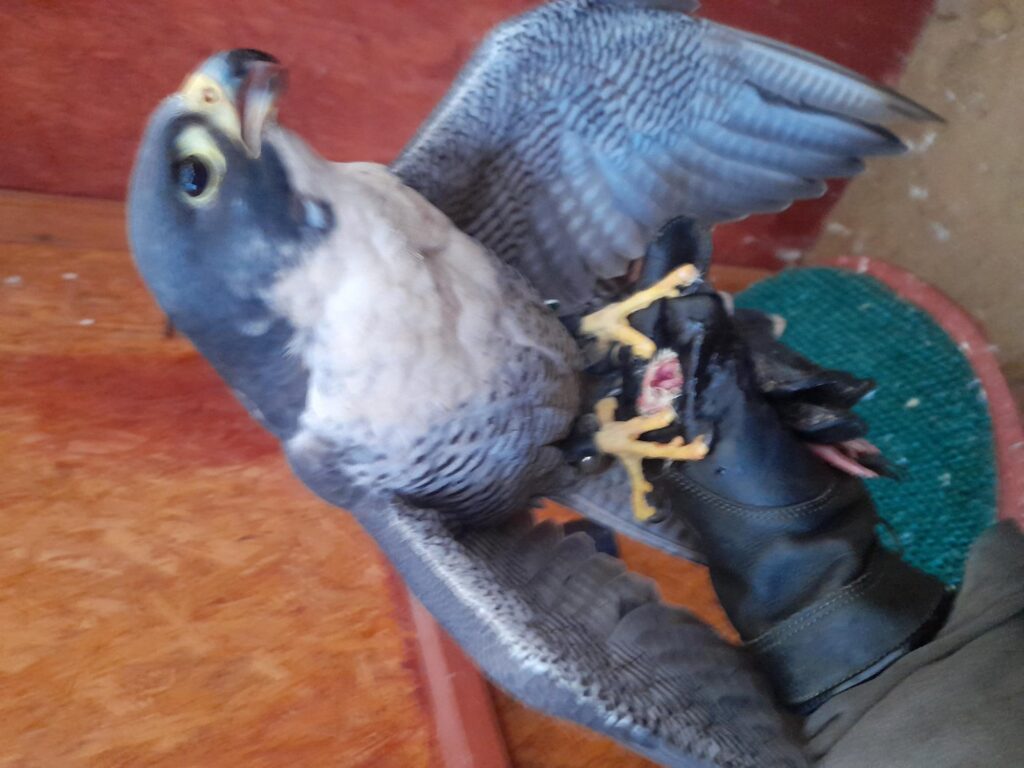
As I said in a previous blog ‘Sprite’ our peregrine started moulting very heavily – after been flown through the summer – when we were away on holiday. So, I decided to feed him up and rest him for a couple of months – giving him time with plenty of food to finish it off. I have been going in each morning and giving him in a chick on the fist – to keep him tame and check him over – and then the rest of the ration on the feeding platform in the loft and just leave him to get on with it. This is the example of the loft system working well for a parent reared bird. Of course, with the ‘weathering loft’ you have the weathering option available if needed. I include a photo from today – taken with one hand – of me feeding Sprite. You can see he still have the outer primary to moult on both wings. He is 11-year-old now and a real character.
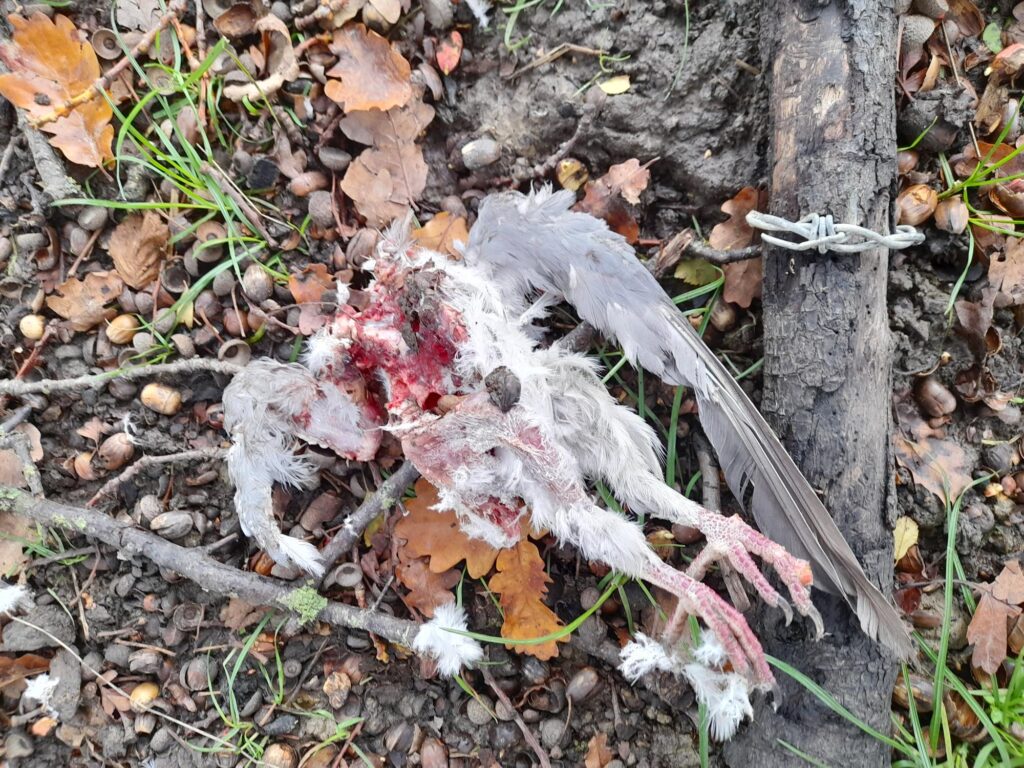
When I walk the dog I am always on the look out for interesting things – so is she. I found another pigeon kill. Shown below. You can never be sure, but I think this is a Sparrowhawk kill as only one side of the breast has been eaten. They are relatively birds with a limited appetite but ambitious hunters. A peregrine or buzzard would have eaten the whole lot.
The moult – an interesting perspective – only for falconers!
I was lucky this morning and managed to fly the two lannerets before the rain came. Both are flying well.
I had no such luck later with the dog – we both got soaked and cold. I thoroughly dried her off and then jumped into the shower to warm up.
I read an interesting article the other day in a falconry club magazine regarding the moulting process. Of course, I write about moulting in my book ‘Falconry – aspects of care of the trained falcon and hawk’ and I am always interested in what others have to say.
This falconer moults his game hawks – peregrines and peregrines/gyrs in open top aviaries and feeds them the most natural diet possible – that his birds caught the previous season. He substitutes quail where necessary and, in an emergency, will feed chicks. Apparently using this method, he has never had to cope any beaks. That is apart from taking the tip off – which is coping – but the point is they maintain their shape. The open top aviaries allow his birds natural sunlight and of course exposure to natural photoperiods which are key to stimulating the moult. The open top aviaries allow exposure to the weather which he suggests is also a natural stimulant to the moulting process. With avian flu now endemic future aviaries will probably need to be covered.
With grouse hawking the key is to get a falcon clean moulted by August 12th – the start of the season. With experienced falcons you can practically just get up and go but intermewed birds – those after their first moult – will need a process of retraining which means the birds should be cleaned moulted by the beginning of August to start this.
This is the holy grail because peregrines are notoriously slow moulters and many will be nowhere near the end of the moult by the 12th of August and will have to be picked up while still in moult so as not to miss the beginning of the season. If the birds are in good feather condition this should not be a problem. Game hawks can be flown in high condition because they love the sport. With first year birds who may be in poor feather condition you do not want to pick up a falcon that is still deep in moult – hence the story that follows.
The writer claims with an early hatch bird – I assume a first clutch eyass – getting a bird clean moulted by the 12th of August is possible using his method and cites a well known falconer who wanted a second clutch bird or late hatch bird – for whatever reason – and found that the bird was nowhere near ready the following year it in fact lost most of its season due to the lateness of the moult. Apparently, the early clutch birds were ready to go.
There is an interesting point i.e. does hatch date effect the start of the moult the following year or if it is stimulated by photoperiod or day length and by other factors like food intake, weather or the date of putting the bird down to moult.
One has often wondered with very late season Harris hawks whether the are late birds of the year or early birds of the following year. There must be a cross over period where one year ends and another starts in the hormonal cycle.
Jarvis the lanneret – trained for the book – was a second clutch or late first clutch bird. He started to moult pretty much as I had expected and almost identical to our other lanneret Frank. Both finished at the same time in early November. They were flown through the moult and even in high condition you can see that the moult was still protracted – you could argue moulting like a wild falcon.
Our own peregrine ‘Sprite’ flown through the summer has moulted very slowly. Once he had a rest with increased rations when we were away on holiday, he practically eclipse moulted. Hence as I reported in a previous blog, I decided to stop flying him for a couple of months.
I think his tail feathers will all be new – as far as I can tell but his two major outer primaries on each wing remain in place. I would not be surprised if they remain so till next year where he will pick up where he left off. So, his moult this year may be incomplete. I flew a peregrine as an employed falconer that had a couple of flight feathers half grown in blood through the winter – without continuing to grow at all – as if waiting for Spring – when they did indeed start growing again.
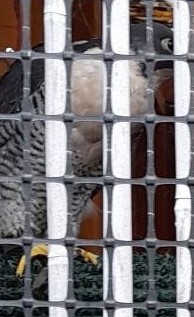
Sprite this morning. He does not like is photo taken. He was about to shuffle out of sight.
Whether hatch date effects the start of the moult given all the other variables is difficult to say. If you have hawks sitting in an aviary or loft at fat weight from the end of the grouse hawking season on December 10th till August 12th the following year, then you are better placed with all other variables being constant to make these observations. The falconer was able to predict under these circumstances – with some consistency – that the last primary would be fully down 100 days after the hatch date of a particular bird the following year.
So given a peregrine may be expected to lay its first egg at the end of march and then another 10 days or so before incubation starts when the eggs are set – then another 32 days till hatching which will be around the 10th of May. Add another 100 days or 14 weeks to this then the completion of the moult the following year will be on August 18th. So, it would be possible using his assertions – give or take – to get a peregrine fully moulted through by August 12th
Perhaps he has cracked it! As historically one reads from other authors that peregrines are rarely clean moulted at the start of the grouse hawking season.
This falconer says birds moult more slowly on a block perch than lofted birds postulating that it may be due to stress. My take on that is loose birds can also be disturbed when lofts are badly sited.
More likely a blocked falcon which can be fed on the fist each day will have a smaller ration than a lofted bird because it will need to eat its ration in one sitting rather than the tendency to pour more food into a loft where the bird has all day to eat it.
In fact, he does this and feeds in sittings throughout the day by placing food on various perches so the birds must take exercise to get to it. A sort of in loft fitness programme with some aviary enrichment. Of course, the falconer needs to be on site to do this, so it is labour intensive.
It is possible to feed birds on an astroturf mat in a weathering and leave the bird to get on with it, but I think the sight of fly blown food waiting around to be eaten would be unbearable for most falconers. Far better to feed the bird on the fist each day and keep it well manned. He mentions the risk of bumblefoot on the block perch but with the use of astroturf and regular checking and coping of the feet as described in my book will minimise the risk of this condition. Birds can get foot problems anywhere including while being lofted – again it is down to the design on the loft and unforeseen circumstances.
In short, a wide-ranging interesting article.
Mild day – hunting buzzard
Considering we are in early November we are having an incredibly mild spell of weather and today without any wind it felt quite balmy. I am not complaining with the continued fall of leaves the overriding feeling was one of the beauty of nature.
As I drove down to where I fly the two lannerets I saw a lovely buzzard perched on a very spindly small tree – a feat in itself. It was clearly hunting and it had the usual entourage of crows and magpies hanging around – waiting for a piece of the action. The buzzard was a splendid looking bird – I stopped for a moment in the van and I took a photo through the window.
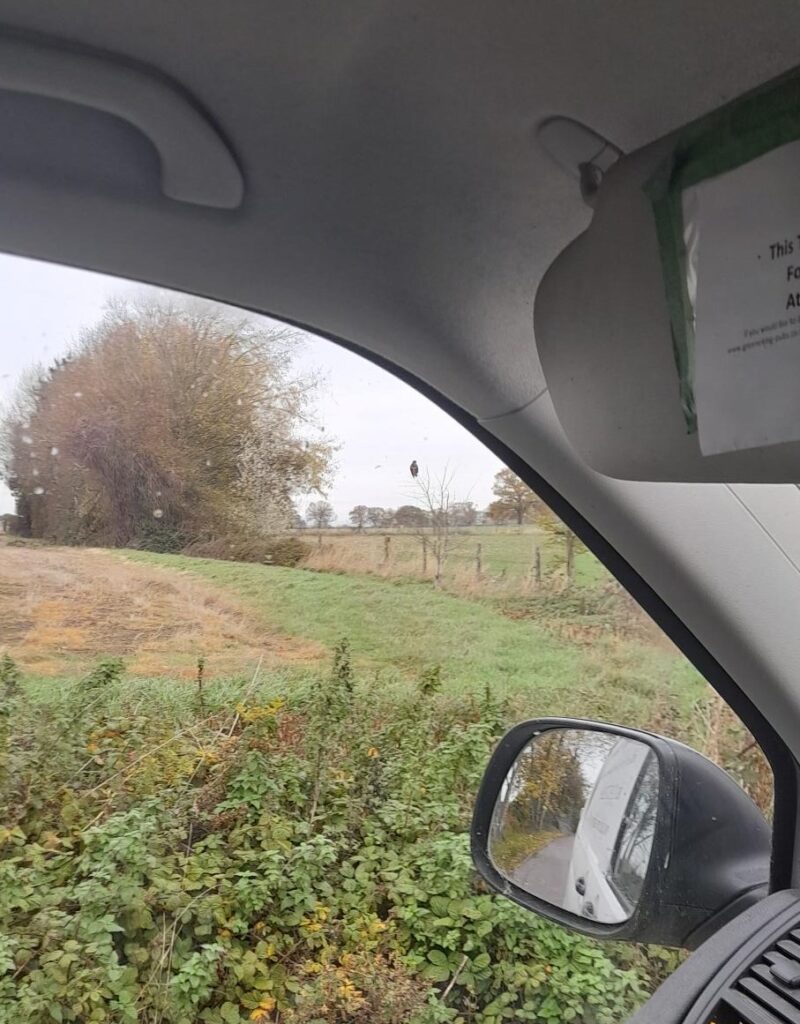
Usual mobile phone camera limitations but you can make it out. I was moved on by a car behind me so I could not linger.
When I flew ‘Frank’ I noticed the buzzard had gone – or so I thought – and out of the corner of my eye I noticed a buzzard stall in mid flight and make a sharp stoop into the grass and caught something. I could see it grappling with something in the grass. It then flew with its prey hanging out of its talons – a vole I assumed – into a tree. It did not eat it on the ground. Crows and magpies followed.
In the meantime I fed Frank on the fist after his flying – he had not see the buzzard – and so was unaware of it and did not make a fuss – or panic. However when I flew ‘Jarvis’ the buzzard suddenly appeared in the grass along a fence on our side. I could see it trying to foot something unseen under the grass – but was not successful and after a while it flew back up into a tree. Moments later it appeared to have dived down and got something in the stubbles – possibly a small rat feeding on grain spill. This time it eat it on the ground suggesting something bigger.
As I concentrated on Jarvis I lost sight of him. Anyhow I noticed a buzzard flying up the tree line of this hedge and I thought it was moving on. Then there was another buzzard following on behind and I just assumed it was the buzzard I had been watching.
As I left the flying field and turned back I saw a buzzard still sitting in a tree along the hedge line. This was clearly the original buzzard that I had seen first and the two others were just passi9ng through. So three buzzards!
Of course it reminded me of my old buzzard ‘Ted’ that I had for three seasons before releasing him in the knowledge that he was well able to look after himself. I can remember the astonishment on his face when he caught his first rabbit – he could not quite believe it nor could I – but it was the making of him. He was great fun to fly and I flew him at weekends through the winter.
I refer to him in my book ‘Falconry – aspects of care of the trained falcon and hawk’ when I talk about buzzards. Sometimes I forget that I flew a male red tail buzzard/hawk for a number of seasons. I used him in my demo work but even though he was something different to show he did not quite make the grade in that department. In the hunting department he was prolific and he would soar out from the hill and stoop vertically at rabbits – amazing! he was successful in all terrains and caught a lot of ‘end of season’ partridge for the owner and good friend I passed him onto. I mentored him and he did an excellent job with the red-tail and flew him successfully for several more seasons. Red-tail hawks are very strong and I show in the book a different way to cast such a powerful bird for tail belling or coping – through the legs allowing the bird to flop back to be gathered up and placed under the arm. This is easier than the cast across the shoulders where the bird can wrestle its way out.
Anyway to conclude for today. It was a lovely day – lots of wildlife and the lannerets flew well.