Archive for February, 2026
Spring?
 February 24th, 2026 |
  Author:
 There is definitely a feel of Spring in the air with the grass now growing and the willow trees down at the flying field showing signs of life. We have had such a wet period since Christmas and today with mild air and blue sky it feels quite uplifting. As I have said in a previous blog wild birds pairing up was well underway weeks ago. This morning buzzards were up, soaring and patrolling their territories. I always imagine they were hunting at first light before any humans were up and had already breakfasted.
So no news on Jarvis and barring a miracle I now consider her lost. I am just waiting for a new transmitter before I start flying our peregrine Sprite again because I lost a transmitter on Jarvis. As I have also said the system worked well but I could not get Jarvis down. With Sprite we have been through the process of losing him – he went chasing – but I managed to get him back. Once you have been through the process after reclaiming your lost bird – both parties the bird and the falconer will be better for it. I have had issues with Sprite but – chasing usually – but no problem after the first instance of getting him back. As soon as he sees me he comes dashing back and I have had him 12 years. Of course I used to fly him for guests at Thornbury Castle.
I reread my own chapter on lost birds in my book ‘Falconry – aspects of care of the trained falcon and hawk’ by me Michael Davie – in view of what recently has happened. Apart from not getting the bird back I really cannot add to it.
I am going to increase the price of my book in America because I am now within less than 2 years after publication not receiving any royalties. They have been consumed by increased coats. Clearly I do not want to do that but there is a principle involved that writers/artists should get paid for their work so in consultation with the publisher the price will go up a little. I am thrilled of course when anybody buys my book and I hope very much they find it useful.
We took the sports car we are looking after and drove over to Boddington and Barrow Hill at the weekend. It was very much a trip down memory lane for me as I used to roam the fields and woods with my friends. There were some young Sparrowhawks in the main wood one year. We could hear them calling in the canopy but not see them – they were branchers and recently left the nest.
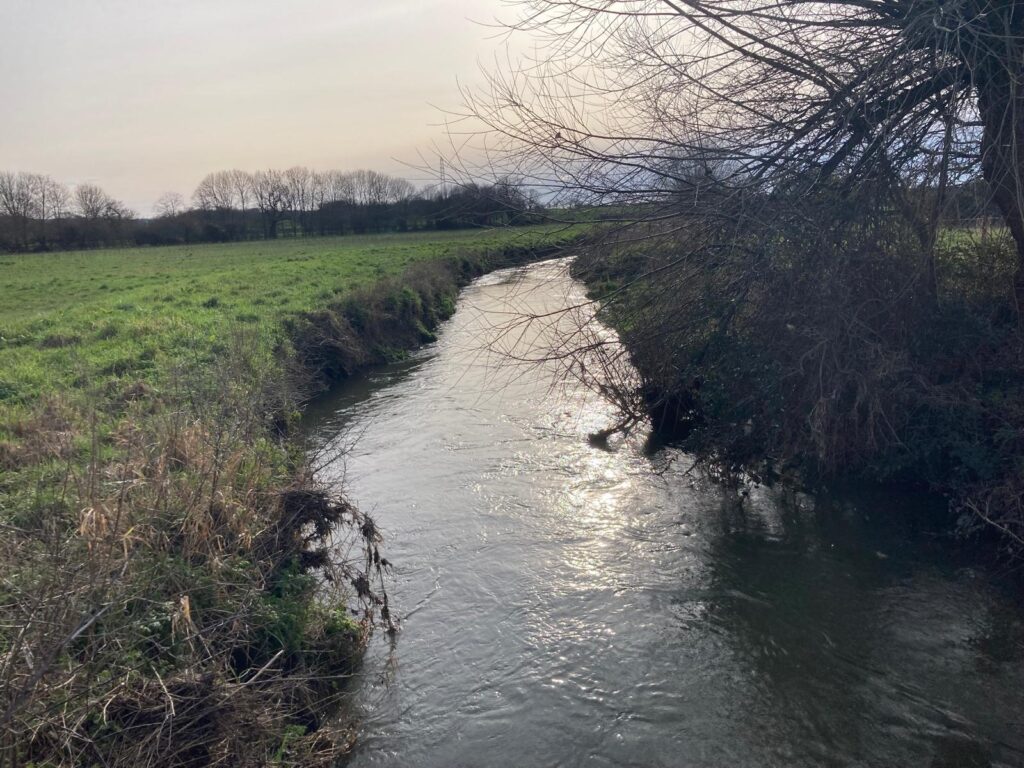
I remember a couple of years later flushing a teal off the River Chelt which runs through the land and wishing I had my own Sparrowhawk ‘Meg’ with me. Phillip Glasier once told me it was the ultimate challenge!
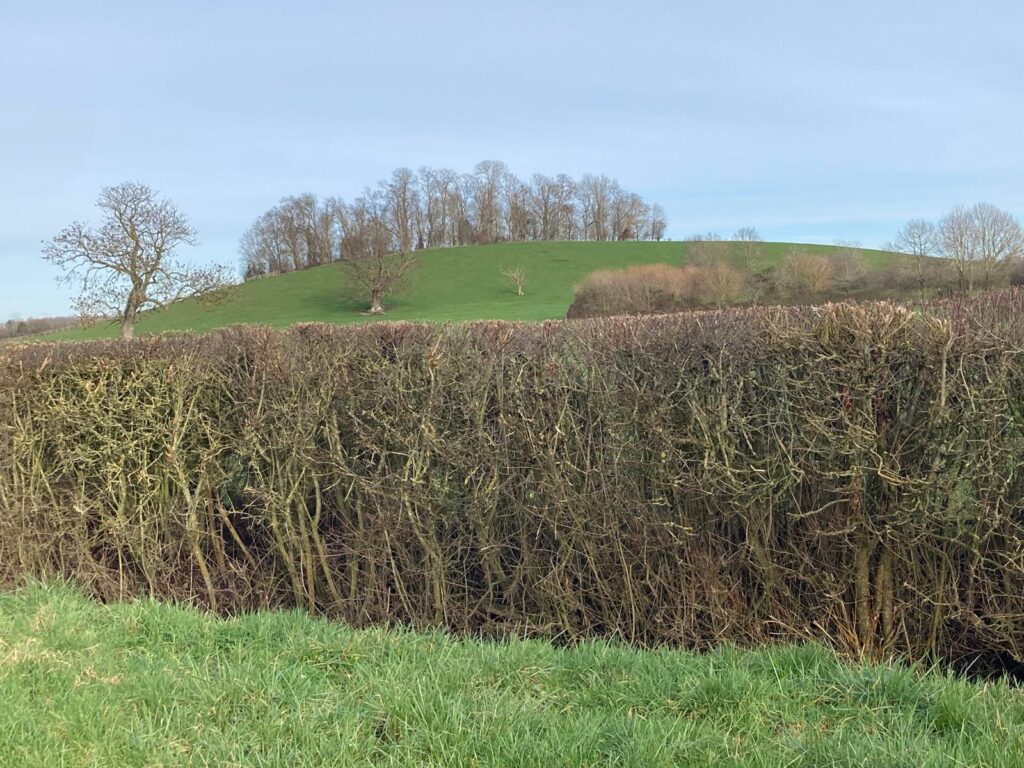
Anyway will sign off with a picture of Barrow Hill at Boddington and the River Chelt exactly where I flushed that teal half a century ago!
 Posted in
More rain
We woke up to rain and I was rather hoping that by the time I flew Frank – our lanneret – it may have stopped. It seemed to relent and I jumped in the van and went down to the flying field. At the field a pulse of rain came through. As I sat in the vehicle I realised it was set in so I cut my losses drove home and fed Frank on the fist in the Hawk Room while hoping for a better day tomorrow.
I still look out for Jarvis hoping she may be waiting for me in the field – making a miraculous return. As I say in my book ‘Falconry – aspects of care of the trained falcon and hawk’ if you lose a bird and are lucky enough to get it back try and work out what went wrong. As I have also said it is easy to lose confidence but it is important not to do this as ultimately the falconer will start using excuses not to fly the bird. By all means have a break and have a cautious return. The bird may need some conditioning changes – often there are warning signs that you are close to losing a bird and if you ignore these the inevitable will happen. But we all learn from our mistakes and losing the bird will often throw light on the preceding days to the loss. Try to make sure it does not happen again.
But as I have said losing a bird can just happen – out of the blue when you least expect it. Like with Jarvis. I realised I was in trouble because I had a similar incident many years ago with ‘Pippa’ one of my best falcons. After a couple of hours out she was totally spooked by the experience and eventually I had to wind her up with the creance as she sat unapproachable on the lure. After that incident I never had another problem with her. It is a question of getting the conditioning right and building up resilience in the bird by flying her in different places, in differing weather conditions and in her case ‘Pippa’ as a demo falcon building up her event portfolio in the right way.
On reviewing the loss of Jarvis I now believe on reflection that her condition was too high – although I had no signs that I was about to lose her – no close calls. Secondly I should have responded more quickly seeing that she was struggling to get through the tree and to come into the lure by jumping over the fence and walking around to reach her on the other side – which would have meant calling her down onto recently planted field of corn – which I did not want to do. I now believe she left the other side of the tree to go chasing and encountered some very irate crows. She may have initially chased one of them. Once she was spooked, in high condition and finding herself in a war zone the writing was on the wall.
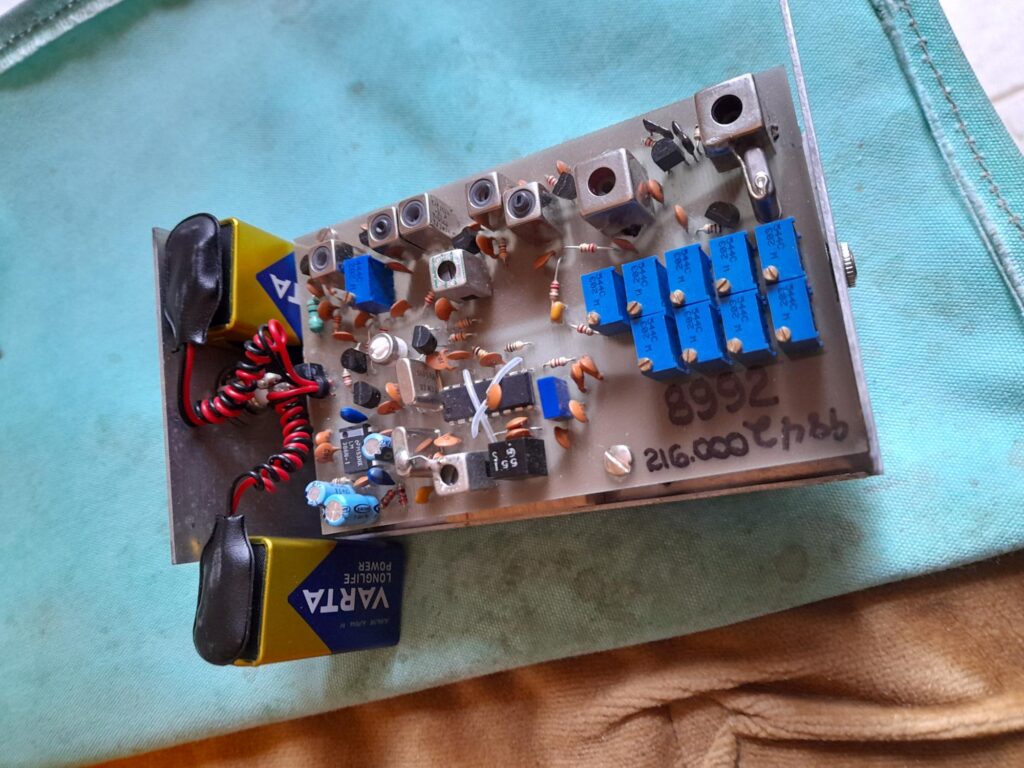
The telemetry was used for four days – successfully at first but the bird would not come down – so I have now changed the batteries on my set – the receiver end – as shown below. This is an old Luksander non satellite set – not GPS. The set worked well – they are all limited to how well the transmitter is working. I have picked up a peregrine with a GPS tag on that was not working. On the other hand I have seen these systems working well – they are very effective. The downside to these GPS systems is the cost. The non satellite sets I suggest in my book are a cost effective option for the would be falconer starting off with all the other expenses involved. I suggest buying a second hand system and then purchasing a new transmitter to keep the costs down.
News blog
No sign of Jarvis sadly and it is doubtful I will get her back now, but stranger things have happened.
Of course, it has put a dampener on the spirits and as I say in my book ‘Falconry – aspects of care of the trained falcon and hawk’ it is quite easy to lose your confidence. I had a break for a couple of weeks while I searched for Jarvis, thought about what happened and awaited any news. The weather which has been so poor has not helped.
But now I am flying Frank again and he is doing really well which is uplifting. He is a bird that would not think twice about returning to the swung lure – in fact he did last year when he went pigeon chasing and I ended up bumping into him on the edge of the local airfield. As soon as he saw me, he came dashing back.
Had I got Jarvis back She/I would have learnt from the whole episode and the falcon would have been mentally far more resilient if it were to happen again. Sadly, it looks like we are not going to get a second chance.
Well, the wild birds are pairing up now. Groups of buzzards circling together and display flying as they pair up. So Spring is very much in the air.
We saw a falcon barrelling along at great pace on a hunting flight. I assume it was a peregrine, but it was so fast I thought for a moment it may have been a merlin. But they tend to have a more undulating stoop. Kestrels can motor and Sparrowhawks can have a falcon look to them in flight at times, but I think from the disarray it caused in birds skying up in its pathway it was likely to have been a peregrine. It was a fantastic show of speed whatever it was.
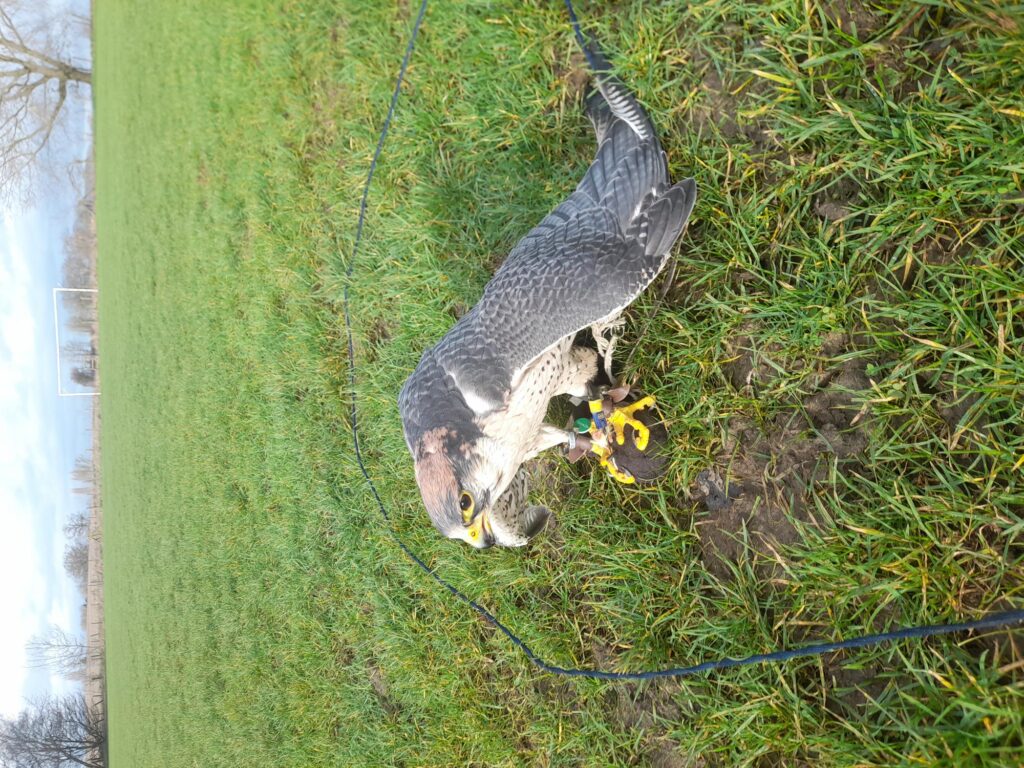
I will sign off with a picture of Frank from yesterday.
My book ‘Falconry – aspects of care of the trained falcon and hawk’ is widely for sale….
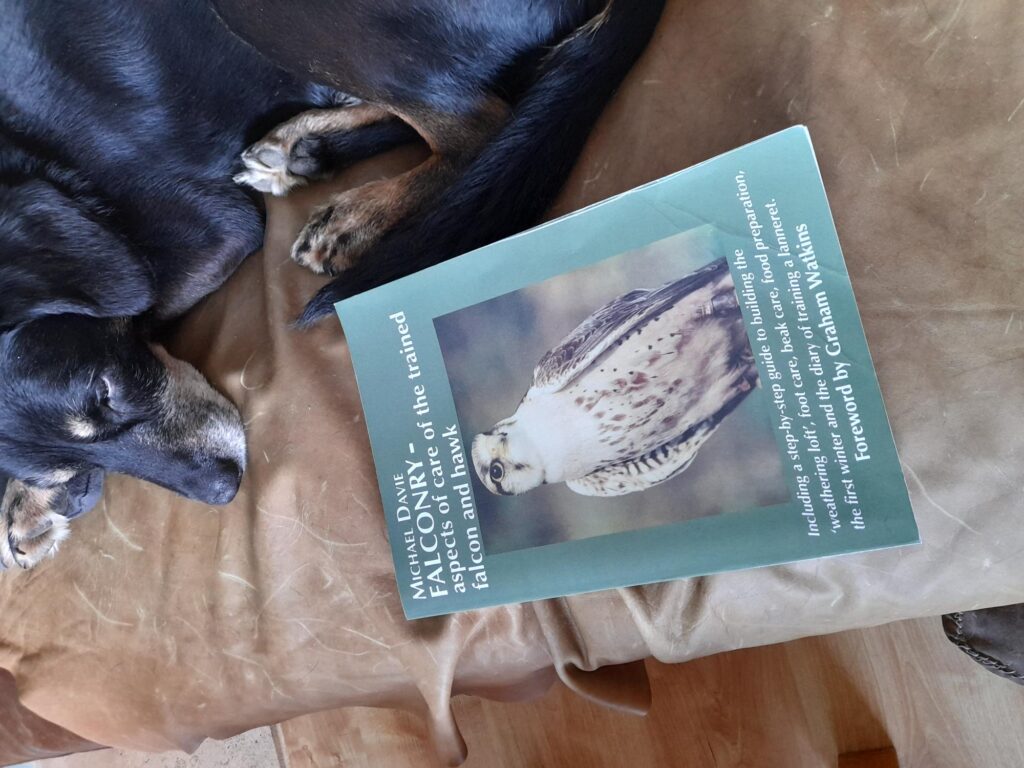
It is very much the lived experience from the last 50 years – which I am still having! Hopefully for those folk who have kindly bought the book have found it useful. I hope it paints an all-round picture of the care of the trained falcon and hawk and the joy and anguish it can bring.
Molly Burkett.
I was sad to read this week that Molly Burkett had died at the age of 93. She was a writer and wildlife rehabilitator who played a significant part in my young life. Reading her obituary, she did many other things in her life, but it is the recollection of my mother – who is of her age – reading Molly’s wonderful book ‘High Fly’ to me which is the standout memory.
Her writings inspired I think a love of the natural world, birds of prey and falconry that has remained with me for life. The story of their first bird a kestrel called ‘Cully’ inspired me and many others too. Of course, kestrels have played a huge part in the lives of falconers of my generation. They remain my favourite bird.
One always responds to passion and great story telling and Molly Burkett did both so well. One must not forget that she was a part of a team with her husband John Burkett a was a well-known falconer in his own right. A falconry colleague once told of the joy of meeting John Burkett at a British Falconers Club meeting. He had read ‘High Fly’ too at a similar age as me!
John’s Goshawk described in ‘High Fly’ was used in David Cobham’s1968 film ‘The Goshawk’ based on the book by T H white to provide the flying shots of a hunting hawk. Below is an adult female Goshawk from the Falconry Centre back in the 1970s.

I recently re-read ‘High Fly’ and thoroughly enjoyed it. I once read a review of the book by the British Falconers Club, and the feeling was that there were too many mistakes in it. I think that is fair comment, but Molly’s technical knowledge should not be underestimated, and I found myself nodding along as I read it. I think the basis of my knowledge has in some way come from this book. It was so impressionable in a good way. Many of my friends also read it. Borrowing it in my case from the local library.
T H White was an interesting character – a very well known writer of ‘Arthurian’ novels and later films. I did not realise it at the time that he had been a schoolteacher at Stowe School – Buckinghamshire – where I used to provide falconry displays for OISE foreign language students for several years during the summer.
I came across this when I read it in either Helen MacDonald’s book ‘H is for Hawk’ or ‘Looking for the Goshawk’ by Conor Mark Jameson – they both mention White. Nor did I realise he was living in a nearby cottage possibly in the grounds of the school when he acquired his goshawk to train. It is a small world!
We had a visit to see the new film ‘H is for Hawk’ based on Helen’s book. Claire Foy played Helen and it was a marvellous bit of casting. She did a great job of learning to handle the goshawks in a fairly short period of time.
I wanted to see the film ‘having read the book’ but also because I worked with Helen for a short time in the late 1990s when we were both at the National Birds of Prey Centre, Newent, Gloucestershire. I must admit I had forgotten all about it until I read her book which contained the account of the release of a wild goshawk into the local woods after a period of rehabilitation that I realised that I was there! and then remembered Helen.
The goshawk had been chicken raiding in the Forest of Dean and had managed to get herself caught in the chicken coup. She as I recall had sustained some minor wire damage and was put into the quarantine section at the Centre and allowed to recover. She was a fine-looking bird – similar to the adult female above, and it was something of a celebration when we released her into Newent Woods. As staff we all got on well together including Helen.
On release the goshawk flew strongly away up into a tall tree – she suddenly looked small against the background of the dense woodland – but she was back home. Of course, this was some years before Helen got her own goshawk Mabel. So that is my claim to fame!
In fact, one of my first encounters of falconry was with a goshawk a passage male and I will never forget how striking the bird looked. Of course, the goshawks used in the film were likely to be what is known as social imprints – a process where a young goshawk is reared in a busy household environment ideally with dogs around, so they habituate to these sights and sounds from an early age so reducing stress including during filming. This is important consideration for a nervous bird like a goshawk. This makes them less at risk from aspergillosis – an in-part stress related disease. Moreover, the falconer can fly an imprinted hawk in a higher condition than a parent reared bird because they are tamer. Mabel Helen’s goshawk which was a parent reared bird and in its first-year plumage would have looked that this parent reared goshawk in first year plumage in the photo below. This a male though and would have looked smaller than Helen’s hawk.

I touch on the process of imprinting in my own book ‘Falconry – aspects of care of the trained falcon and hawk’. Otherwise, the book is mainly about the care of parent reared falcons and hawks.
I am very keen to talk about Dorothy Yglesias two books ‘The Cry of the Bird’ 1964 and her follow up book ‘In Answer to the Cry’ 1978 about the running with her sister ‘Pog’ The Mousehole Hospital and Sanctuary for Wild Birds. It is a fascinating read and no doubt Molly Burkett, and the two sisters would had have a lot in common. I will talk about these two books in a future blog.
J9 Buzzard
Sadly no news of my missing falcon Jarvis. It is now 2 weeks since she was lost and I am still waiting for the phone call saying ‘please come and get your falcon’. Of course as the days go by I increasingly doubt whether we will see her again. Having said that one year I lost a Sparrowhawk just before Christmas and I picked it up at Cheltenham Race Course at Easter and amazingly it still came into the lure – but would not let me pick her up. Instead I grabbed her off a branch in the dead of night while she was roosting. The whole story is recorded in an earlier blog. So with Jarvis one lives in hope rather than expectation.
Of course the whole way round I was remembering my own words from my book ‘Falconry – aspects of care of the trained falcon and hawk’ and wondering whether I would need to update it from my latest experience – but I think not. It states both the challenges of getting a lost bird back – trying not to lose it in the first place – what to do if you get the bird back ( learning from it) and of course the anguish and heart ache involved and not to lose confidence. Jarvis is the first bird I have lost since 2019 when we lost Brian a really top quality lanneret at a Show in Windsor – the pain does not get any less.
Anyway today I have started flying Frank my lanneret again which I really found uplifting. Of course not only did we lose Jarvis but the transmitter she was wearing – this will need to be replaced when we start flying ‘Sprite’ our peregrine again in a couple of weeks. I saw a beautiful wild female peregrine above our house on Saturday – she was magnificent.
I used a smaller 2 stage Merlin transmitter on Frank. I tested out how long it would run on new batteries and it was about 3/4 days. I was disappointed with the performance of the transmitter on Jarvis as it seems to run down very quickly on barely used batteries – maybe in its defence it got wet – the falcon may have spent part of the night on the ground in a flooded corn field – or it just got wet anyway because it rained all night. This is not an excuse because I found Jarvis 5 or 6 times with the system – before she ranged away – I just could not call her down. One of the problems of flying a bird in very high condition when something goes wrong – as it clearly did in this case.
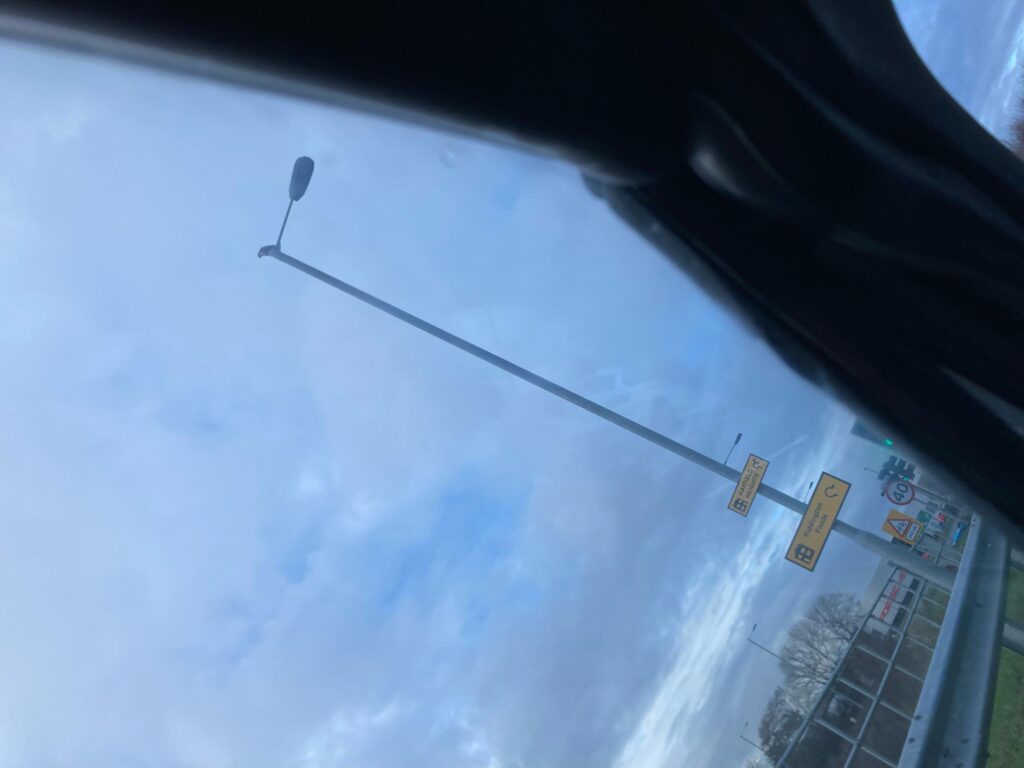
We are minding a old sports car at the moment and driving it a couple of times a week – in the dry – just to keep it running while its owner is away. We took it up to Tewkesbury and as we left the M5 at junction 11 we saw a buzzard hunting from a motorway overhead light. We managed to get a photo of it from a funny angle – it underlines how successful they have become catching anything from earthworms to seagulls as the mood takes them. We have even had them hunting in our back gardens and they well deserve their original name because of their ubiquitous nature of Common Buzzard. Anyway here is the photo.