Archive for May, 2026
The last of the 4 Amigos ‘Bo’.
 May 26th, 2026 |
  Author:
 It is with sadness that I report the passing peacefully of our old Eagle Owl ‘Bo’ who was 38 years old.
She was held in such reverence in the family as she predates my marriage and my children – she has always been there.
She was a wonderful flier and will always be remembered in the arena at Blenheim Palace gliding over the heads of children sitting on each side of the jousting rail. A flight of some 50 yards. It was difficult with children running everywhere! after being sent into the arena by their parents – but it was worth it.
Bo was flown almost everywhere and did many many corporate days and even more at Thornbury Castle Hotel – for guests – which was like a second home to her. She would gladly fly to any body and so was a wonderful asset to have. She did her share of weddings as the ring bearer and particularly memorable was her flight in St Mary’s Church, Thornbury where she flew from a release box down the long aisle and up onto a stage at the end to my fist carrying a ring. It was a vowel renewal for a Canadian Couple and complete surprise for the wife and their children!
She was one of my earliest birds and I bought her from Langley Mill, Nottingham in 1988 with my late brother Tim who drove me up in his mini. I flew Bo right up until 2022 when her powers began to fail – her last 4 years she spent at home in her aviary. She was still laying an egg or two every Spring until a couple of years ago.
She as the title suggests was the last of the 4 Amigos with Peggy a ‘lanner-lugger falcon’ Duke a lanneret and Red a Harris hawk all living into their twenties. They were a superb team and were strengthened a few years later with Waqar a male lugger falcon and together we did many hundreds of events across the whole of the UK.
Bo was a wonderful bird and already much missed. Here she is flying at Blenheim Palace in her prime.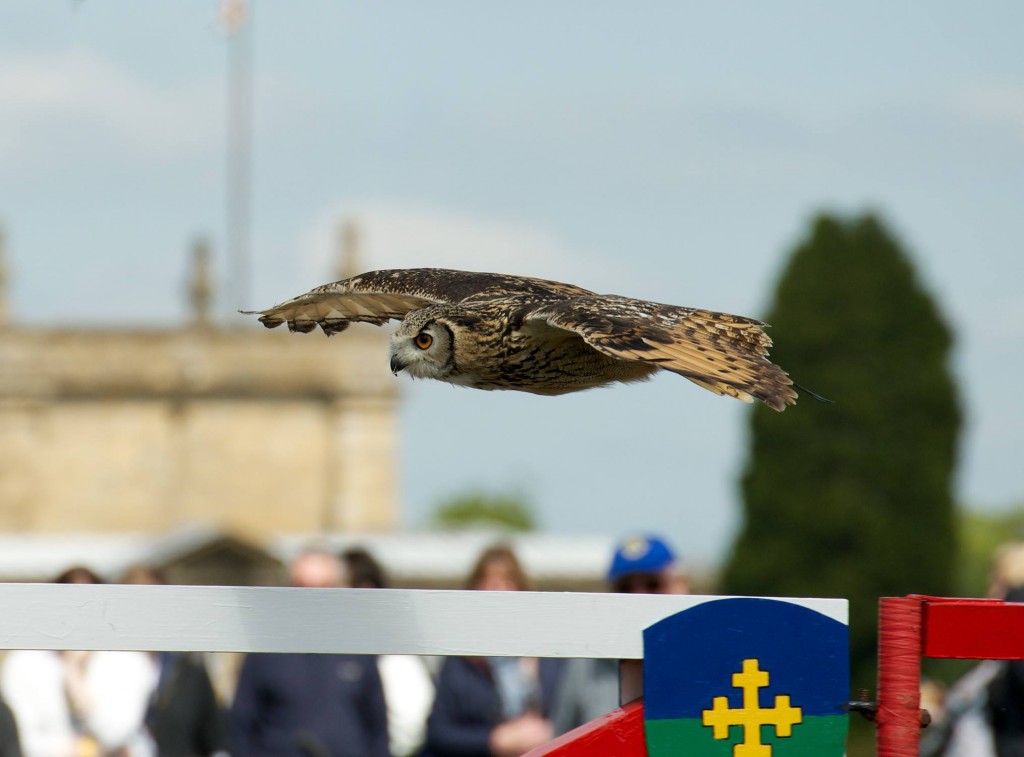
And a picture of her beautiful face.

 Posted in
Wild Peregrine
I have been fretting about the lack of House martins and swifts this year. Only having seen one House martin so far. It is a worry – I forlornly hope they are late back. It is almost the same for swifts although they are always the last to arrive.
Swinging back round to falconry Sprite our peregrine falcon excelled himself today and flew really well – wind was just perfect for him. After he had caught the lure I noticed him looking skywards – looking in the same direction I noticed a wild peregrine coming towards us – having been drawn in by a fellow member of the brethren stooping to the lure. The wild falcon got quite close and slowed right up to almost a standstill by dropping his legs – to act as an additional brake. He stayed around for about 10 minutes which was wonderful to see and slowly slid away to carry on hunting.
I mention this is my book ‘Falconry – aspects of care of the trained falcon and hawk’ where wild falcons can often be quite curious. I also say I have never had one join in and stoop to the lure! Most instances pass off without incident but the falconer must have the mindset to call the bird down – just in case.
Changing the subject. Earlier in the week I was asked to help a friend with his Harris hawk. Apparently the bird – an adult female – had been scratching with its talon the underside of its beak – the chin and neck area – and had removed quite a lot of small feathers. The area also extended to the area above the beak and onto the head.
Harris hawks – again a topic in my book- can do some very odd things – including feather plucking. This including the above can be included in the list of perplexing problems.
I coped its beak and feet and looked for mites while the bird was cast- another possibility – and then sprayed the bird with Johnsons anti mite spray for mites and other parasites.
It is important if this is a behavioural problem to change the management of the bird to jolt it out of its behaviour. To this end my friend has put the hawk back onto a bow perch and during the day it is brought out into the garden for a complete change of scenery and placed on a high ring perch. I also advised a change of diet in the sense that if you are feeding rats and quail you do not need a vitamin supplement and I would go as far to suggest to reduce the richness of the food when the bird is being rested and for a while feed only deyolked day old chicks. This can help to reduce the octane in the bird. Of course if a Harris hawk is in good feather there is no reason not to fly it all year round.
It is early days – too soon to say – lets hope it helps with a change of manage and spraying for parasites.
The next step would be a veterinary visit and have a scrape taken to check for a fungal condition or something else.
On a lighter note here is a picture of Sprite when I first got him in early 2015. He came from another falconer who had partially trained him. First year birds were called ‘red hawks’ by trappers in bygone days – you can see from his colouration why. Of course Sprite is a captive bred falcon
May.
Well May has arrived and the first half at least are the best 2 weeks of the year. I saw a party of 4 swifts yesterday – on their way to somewhere – it was wonderful to see them. In the evening we took the ‘on loan’ sports car down to Wainlodes on the River Severn and were delighted to see so many Sand Martins.
In fact a couple of years ago a pair nested in the lock gates where the River Chelt enters the main river. Today I saw our first House Martins of the year back in the village. They nest under the eves of the village pub. Their – sadly – numbers have greatly diminished over the years and to see that they have returned for another year is uplifting. It is lack of insects which I feel is their main problem – we can help with nesting sites but the lack of insects is a culmination of many factors affecting them here and across their entire range.
At this time of year as a schoolboy I used to ride out to the Falconry Centre in the hope of going out hawking in the evening with Paul the head falconer. The were the best days and we had some wonderful hawking. It was worth the long ride home in the dark stopping off in Newent to buy fish and chips – what could be better! I learnt so much and was lucky enough to have my own birds at home to practise on.
And this is what my book shows – ‘Falconry – aspects of care of the trained falcon and hawk‘ 50 years of knowledge and joy. Of that 35 years as a professional falconer and now that I am retired as an amateur again. My friend Graham Watkins the gundog trainer who kindly wrote the introduction to my book is similar to me in that we both have a love of what we do which goes beyond retirement. With my book I hope the reader can use it to enjoy their falconry and create their own stories..
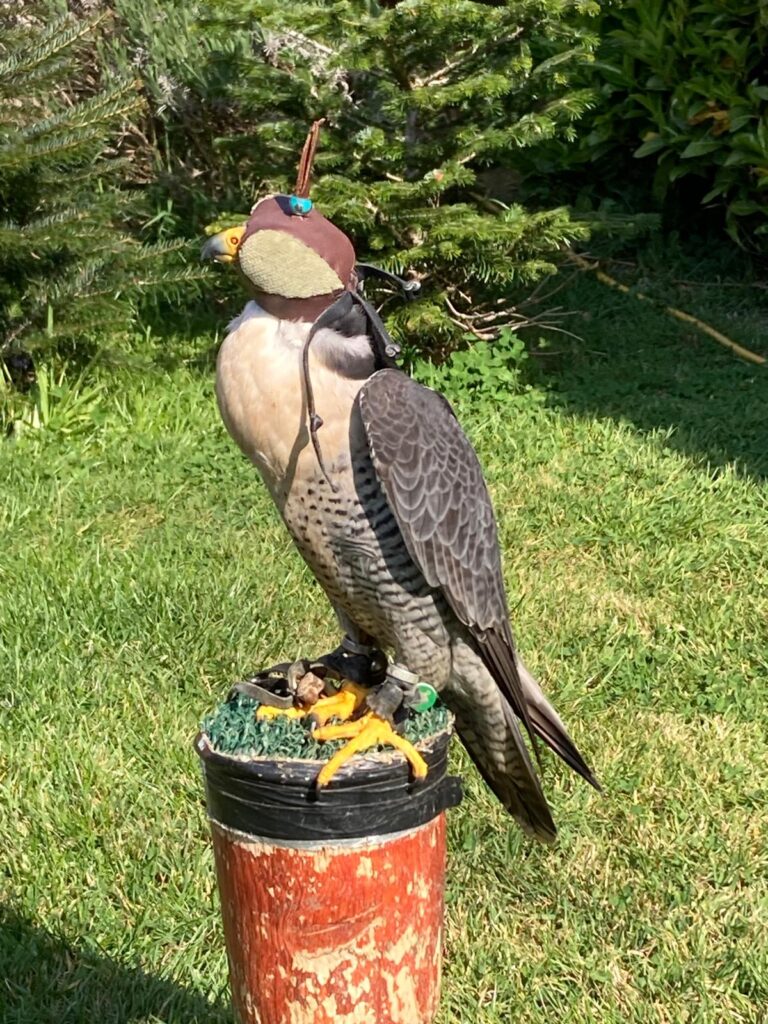
Below is a picture of Sprite our peregrine falcon still hooded after flying – while I changed his bath water and further below from earlier in the week Frank our lanneret on the sock lure after flying. I flew him in a different place today and he was just amazing – really stylish. As I have said before it is a good thing for trained birds to be familiar with flying in different places. This is essential for display work but also if any bird is lost it will not be disorientated and fazed by finding itself in an unfamiliar setting. It will be much easier for the falconer to call it down. Anyway here are those photos.