Archive for February, 2025
Blue Sky!
 February 24th, 2025 |
  Author:
 After many days of continuous cloud this afternoon we had the wonderful spectacle of a blue sky. I can hear the wild birds pairing up and see others building nests. A real feeling that the winter may be coming to an end and Spring about to start. An upbeat feeling of hope.
Animal duties of course continue and a period of nice bright weather with a gentle breeze is very much desired. The perfect day for flying falcons is a rare occurrence and the birds have to learn to fly in all but the harshest of conditions. I do not have that pressure these days as I am no longer a professional falconer.
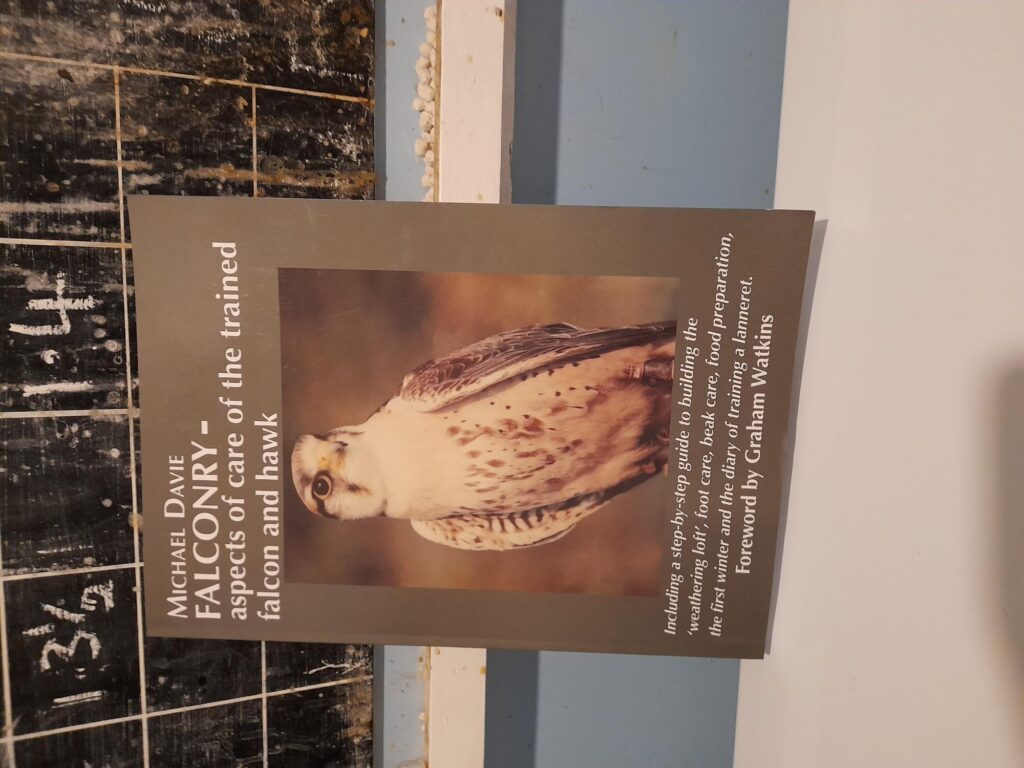
The energy I reserved for that occupation I have transferred to write a book called ‘Falconry – aspects of care of the trained falcon and hawk’ which is a technical book which I hope the falconry community or those aspiring to fly a bird may find useful.
The hood has a section on its own in the book reflecting its importance. It is an object of much curiosity and the book discusses why it is used and some problems that may occur as the bird matures. Gentle perseverance with some lateral thinking during this tricky period is required.
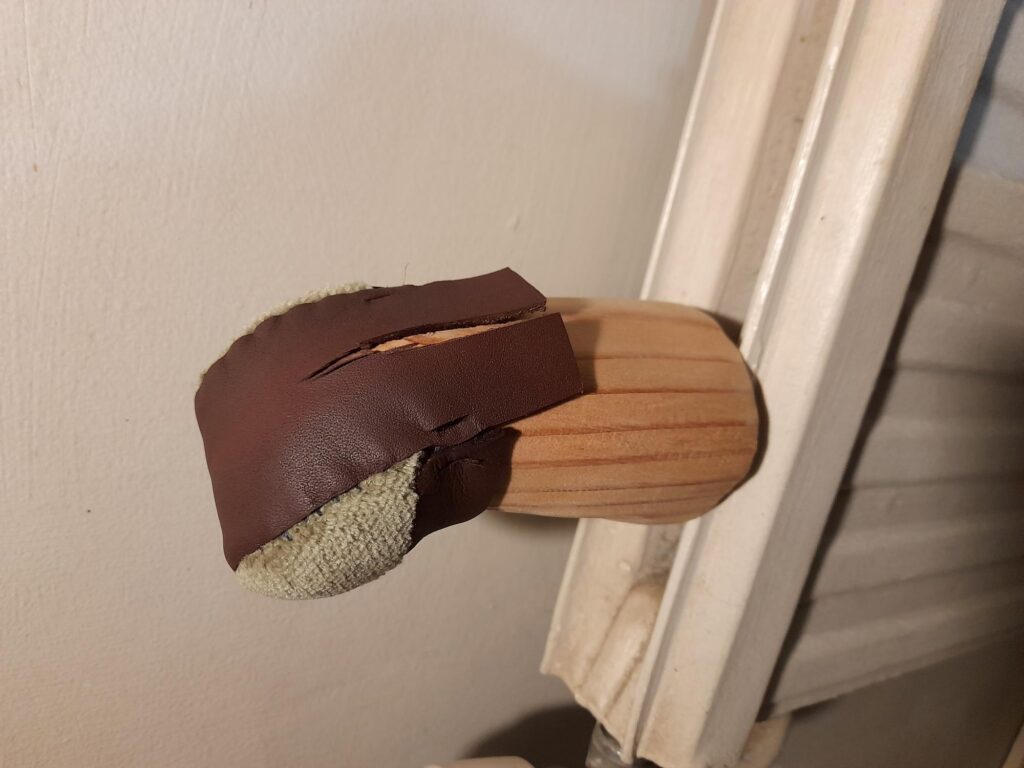
There are different types of hoods and I have shown these in the section on hoods. However the hoods I tend to use I have not explained in the specific hood section because I make them myself – they are not ones you can buy. They are known as the ‘Falconry Centre’ hood developed by Phillip Glasier. They are also known as the Syrio-Dutch hood which is a mixture of the two hood types. Essentially they are a blocked hood like a Dutch hood but a simpler version. Like the Dutch hood proper they are sewn inside out then soaked in warm water and turned to be gently stretched over a wooden hood block – shaped like a falcons head – and then left to dry. The resulting hood fits the falcon very well – they cannot get them off easily – and this is particularly important when they are sitting next to other falcons on a cadge waiting to be flown.
The Falconry Centre hoods that I make are incredibly versatile in terms of usage. A peregrine tiercel hood will not only fit the aforementioned bird but also both sexes of lanner and lugger falcons along with male Harris hawks and male goshawks. They are all roughly the same size and before specific hoods came along it was a case of one size fits all. I make my own hoods because it is something I have always done. As I have said in the book the modern hood maker is in a different class in terms of design, build quality and finish. This has necessitated new hood patterns specifically for each type and sex of bird.
I will sign off with a picture of a Falconry Centre hood under construction ready to be soaked and turned to dry on a timber hood block.
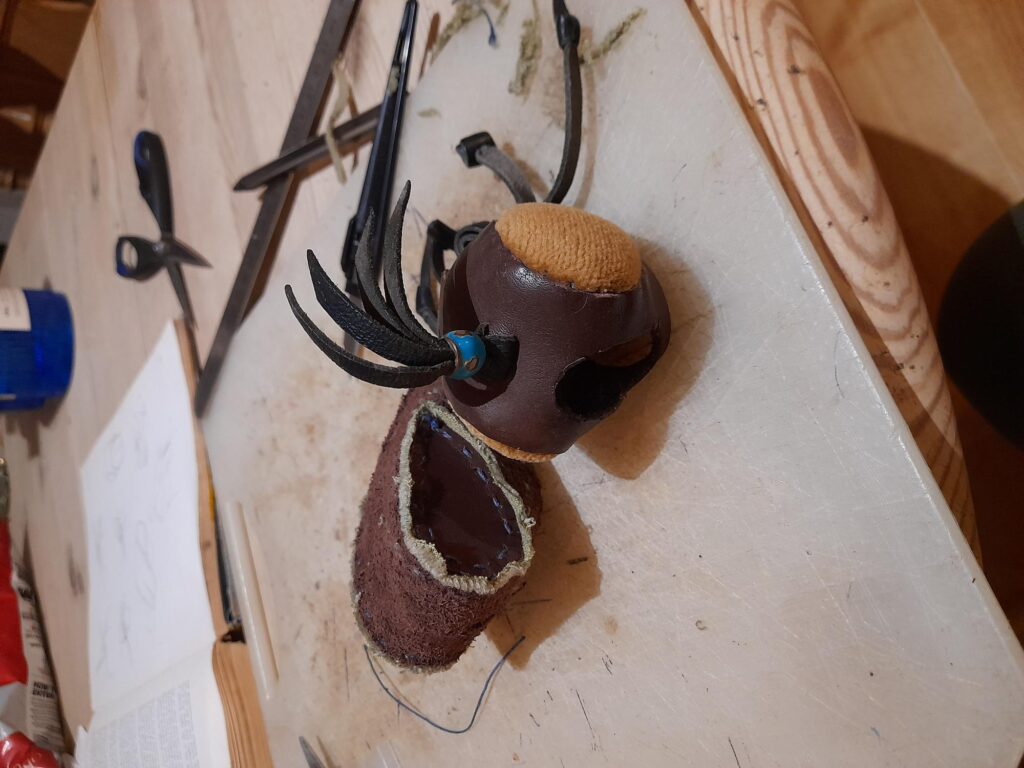
Below drying on radiator.
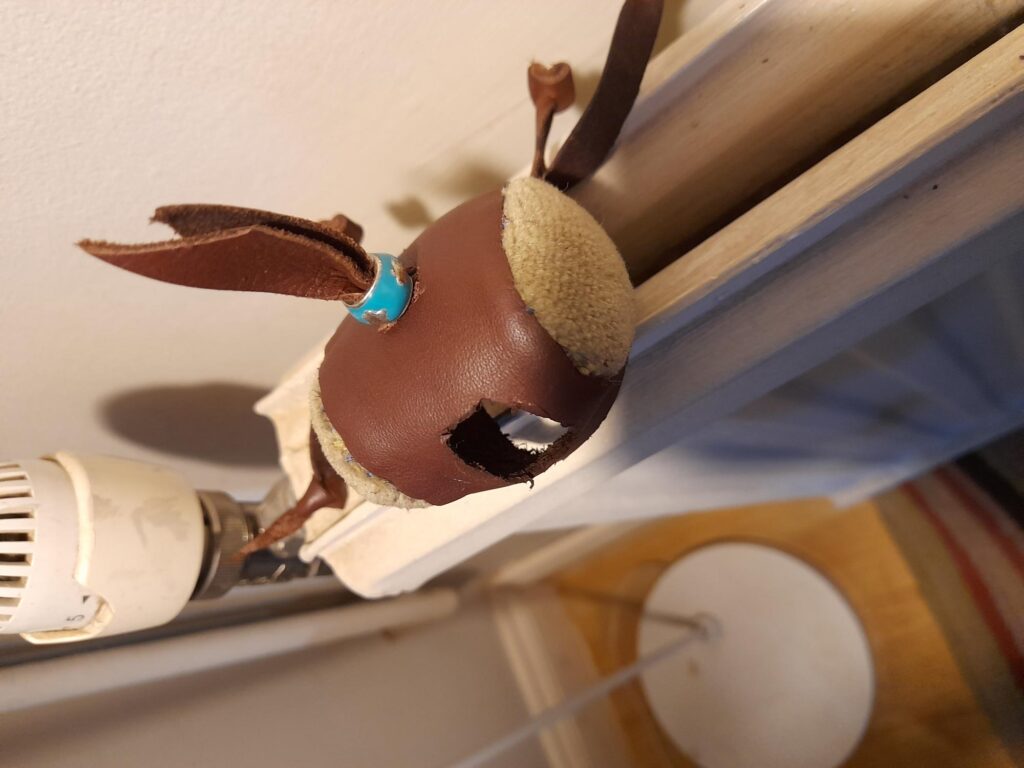
Below finished hood cut to length with plume and braces. The beak opening may need further modification when trying out the hood on the bird to get it right.
 Posted in
Jarvis today.
If you have managed to navigate to my news page then I am sorry to say due to medical leave I will not be doing any displays this year – 2025. I am sorry to say this.
During my leave I have managed to write a book on falconry called ‘Falconry – aspects of care of the trained falcon and hawk’. It was published by the Choir Press Gloucester last November and is widely available online and stocked by Coch-Y-Bonddu Books.
One of the main characters in the book is Jarvis the lanneret who I bought specifically to present a training diary in the book. I tried to cover both things that went well and things that did not, the challenges and some frustrations particularly regarding the weather. I wanted it to be an honest account ‘warts and all’ if you like.
Since the book was published Jarvis is well into his second season and with a mixture of the loft and ceramic heating bulb we have kept him flying through the winter. The dilemma about his sex continues because he is flying at the weight of a female (who are larger) although he looks like a male. Unless he were to go into a breeding aviary this not a problem – it is not matter.
What does matter is his flying which is greatly improved in his second season – which you would expect. Even so he is a class act and set to get even better. The way he uses the wind, how he climbs is exciting. Also the fundamentals are much better – the pick on the lure is perfect and hooding after flying which I have discussed in the book is much better.
Talking the weather it is too windy to fly today! and so here I am writing this news blog. I did however take a photograph of him in the hawk room this morning (with the camera held in the other hand) before weighing him and feeding him on the fist. He looks very smart after his moult and his feet has lost bluey look of a youngest. anyway here he is.

Update on my book ‘FALCONRY – aspects of care of the trained falcon and hawk’.
As I have said in an earlier blog I am not an author and writing a book on falconry is something I never envisaged doing. It was only during treatment for an illness that it occurred to me perhaps I should record my falconry methodology for posterity. Mainly for my family and friends but for anybody else who might be interested.
I think to have had ‘my own’ book would have been helpful earlier in my career – to have it spread out when I wanted to cope a beak or imp a feather – with photographs to help me navigate the process. I have copied the soft back cover and book size that I like so much in a series of plant identification books by Hamlyn. It encourages the book to be used. The picture below is the book in my Hawk Room. Not everyone has a hawk room but the book should be kept handy for the falconer to use or refer to.
The picture on the front is of Duke a lanneret I had for many years. He was a falcon of a lifetime and it is right he adorns the cover of my book.
Apart from the section on food preparation which I wrote many years ago as a teaching aid the rest of the book is new and evolved into its current form while it was being written.
I must thank the Choir Press for their help in bringing the book to life. They took on board my concern to get the book out there. The weather which was good while the book was being written which was so helpful! Also thanks to Churchill Hospital Oxford for keeping me alive during the process. Also thanks to my family who are my greatest critics and my falconry friends who have helped so much.
So the book was published last November and is widely available. I am hoping like all authors of technical books that it will be found and used. So far so good.
It is available online in the US and UK from Amazon, and then in the UK from Waterstones, Blackwells and ebay.
It is also available from Coch -Y-Bonddu Books www.anglebooks.com whose specialise in books ‘old and new’ on countryside pursuits including falconry. They are not only an online outlet but also have books in store ready for collection.
The Choir Press Gloucester can be contacted directly by retailers regarding sales.
Sprite our peregrine.
As I said in my last post I picked up a lost peregrine falcon a couple of weeks ago sitting on a chicken. As it happened she turned out to be a female albeit a small falcon. She was a mixture of a northern European peregrine – ours and a tropical peregrine known as a Barbary falcon. She was not a hybrid because both her parents were races of peregrines. As a general biological rule the more northern the species the bigger they tend to be. The largest peregrine is the Peale’s peregrine with is found typically in northern Canada and Alaska. There are many races of peregrine – they are a global falcon whereas the lanner falcon is a more of a continental falcon found mainly in Africa. They are both large bird catching falcons – occupying the same ecological niche – and interestingly peregrines are quite rare in Africa.
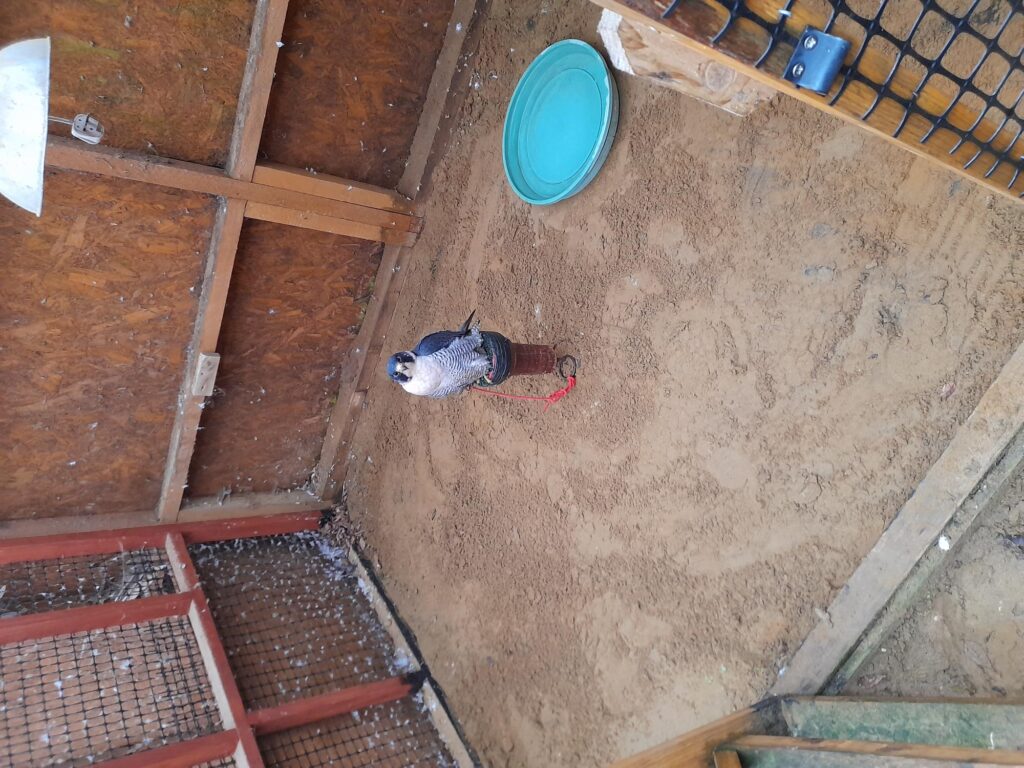
Sprite our peregrine is a homebred peregrine whose ancestry would have been from our shores so he is a northern European peregrine known as Falco peregrinus. He is 11 years old. When ‘I was working’ I would fly him down at Thornbury Castle Hotel. I was their falconer for over 30 years. Sprite was loved by the Hotel guests. We would fly in the bottom field outside the Castle where he could show his true pace – which peregrines are celebrated for. Our other peregrine ‘Slick’ when we had him did some film work down there for the historical series ‘She Wolves’. He would stoop vertically and was sensational!
Sprite at the moment is out of his loft so it can be deep cleaned and rested and so he is back on block perch for a while in the weathering. He is such a stunning bird. Actually along with Slick he is featured in my book ‘Falconry – aspects of care of the trained falcon and hawk’.
I will sign off with a picture of him from the other day.
Lost birds.
I am still waiting for my website to be updated with the news that I will not be doing any displays this year – 2025. i have been on medical leave. So sorry about that.
As I have said my treatment period has at least allowed me to write a book on falconry called ‘Falconry – aspects of care of the trained falcon and hawk’. I hope it will be useful as a resource for the falconry community. I do wonder how I have managed to do it – but it kept me mentally stimulated. My family and friends supported me throughout which of course was important. I must also thank The Choir Press – Gloucester – who published the book for me. They took on board the need to get it out there. In normal circumstances I would have held the book back for longer before clearing it for publication.
As the title of this news blog suggests one of the sections in my book is on lost hawks. This can happen in variety of ways but if you fly a bird it will happen at some stage. Even if the bird is out of sight just for a few seconds it is worrying. The main thing is not to panic – of course easier said than done especially for a novice falconer.
It is recommended that for bird welfare reasons they are now flown with telemetry on,
Telemetry itself has developed over the years and now there are lightweight GPS transmitters available. This should make finding a lost bird a lot easier. Its position being shown on a smart phone map. These systems are expensive but to keep costs down falconers can still use non satellite systems. There are a lot of theses second hand systems around which you can buy new transmitters for.
The whole book is based on affordability and this includes the building of the ‘weathering loft’ and in this news blog the buying of second hand telemetry systems. The older systems are durable and work well. Of course they have their limitations but in most cases with practised usage they will get your bird back – normally after a lot of effort! It is important that the batteries are changed regularly so if a bird ‘is out’ the transmitter will last at least several days hopefully a lot longer.
I am now going to recount my latest adventure.
Last Sunday morning at 6.45am I had a phone call. Calls on our land line are rare now. Anyhow as it turned out this guy in Cheltenham said that he had a peregrine falcon sitting on one of his chickens that it had killed the previous evening and then spent the whole night eating it – in the chicken run. He thought it might be my bird and wanted to ring me before it got light. I said to him it cannot be a peregrine because these commercial hybrid chickens are huge. It had to be a Harris hawk. He sent me a picture of the bird in the gloom. Amazingly it was a peregrine! sitting on the floor of the chicken run with an enormous crop! It clearly was a trained bird rather than a wild one – although I was once called out to a wild Sparrowhawk that was in comatose state after killing and eating a Jackdaw in a haystack. I could have picked it up but instead I rustled the hay and it suddenly came back to life and rapidly flew off. It was a very strange happening – it had gorged itself.
I managed to net the peregrine and it had both a bell and a GPS tracker on it. Of course with bird flu in the news I had to be very careful and on arrival at home the bird went into isolation. I now use because of the need for increased bio-security a foot bath before entering my property.
I then took the birds ring number and phoned the IBR which is an organisation set up to reunite lost birds with their owners. The bird had been reported lost. Then through a process of triangulation the relieved falconer rang me and said he would pick the bird up later that morning.
Several things come to mind that I discussed in my book – firstly because I am well known in the area the original call came to me. This underlines the point that when a bird is lost the falconer must inform not only the IBR but also wildlife rescue centres – birds often end up there, the RSPCA in the area, local farmers and anybody else who may help. If you make enough noise then someone may hear and you may get the important phone call you are hoping for. The second point is the advantage of having your own easily read ID tag on the bird. This means one phone call and the bird is back. It can be very difficult to trace a bird if it turns up from nowhere – particularly if it has not been reported to the IBR who offer a nationwide service.
I put the the peregrine’s transmitter in the front garden which is the recommended thing to do. The falconer may in the area looking for the bird and the transmitter may be still be working.
I thought the bird because of its size was a tiercel or male peregrine but apparently she was a female. She was a mixture of a peregrine – that we know – and a smaller tropical peregrine from Africa known as a Barbary falcon. She was only 2ozs heavier than my own tiercel hence my mistake. But once it was pointed out to me in terms of her colouration it was obvious. She was a lovely looking falcon.
Apparently she was lost doing bird clearance work – pest control – in Cheltenham when she wandered off. The GPS satellite transmitter stopped working shortly afterwards. They are apparently very high drain on batteries and therefore the recovery window is fairly short. On the other hand they are so accurate that this not be a problem. Clearly if a bird is very fit and active they can be everywhere at once and the batteries may be drained by the bird ‘holes up’ as I call it and stops moving. I am not an expert but I believe these GPS transmitters can also contain a non satellite tracking function which the falconer use if the GPS system is longer functional. It means it all has to work in field conditions working and the falconer learning to use the system. I once saw a falconer lose a falcon wearing a GPS transmitter – find it – but because the bird was not wearing a bell could not locate it in a clump of trees.
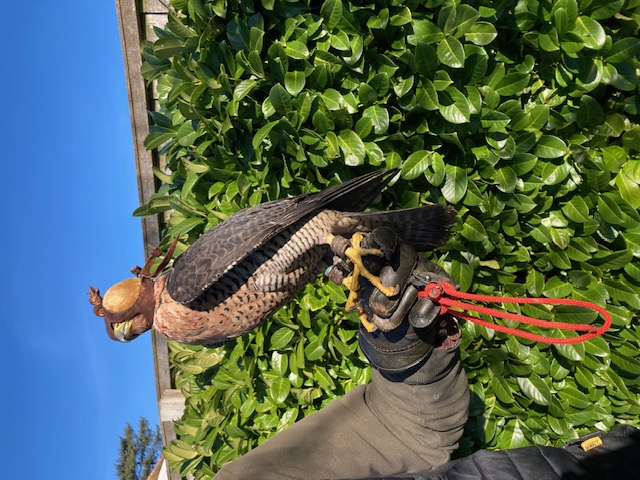
Anyhow all was well and the bird went home. She would need to go into isolation for a while just to make sure she had not picked up bird flu – although this is very unlikely but that is the Defra advisory at the moment – and this is what happened. Here are a couple of pictures of her from that day. Lovely blue sky behind!