Archive for August, 2026
Hood Making
 August 14th, 2026 |
  Author:
 I cover the topic hoods in my book ‘Falconry – aspects of care of the trained falcon and hawk’ from the perspective of usage and problems that can crop up with birds. I also discuss the different types of hoods and touch on their construction.
Many falconers will source a hood from an equipment maker and as I say in my book buy two hoods perhaps a Dutch hood and an Anglo-Indian hood. Of course it is useful to have a spare hood but may fit better than the other. In which case if you have bought the hood from a reputable hood maker they should take it back (if not damaged) and discuss its replacement.
Of course hoods – Dutch hoods – for many years hoods were supplied by the Mollen family from The Netherlands until the mid 1930s when production stopped. Thereafter falconers would have to learn to make their own hoods. Many of the homemade hoods afterwards looked rather crude – from what I have seen – and it was not until Phillip Glasier began making his own version of the Dutch hood using a set of Mollen hood blocks that things began to look more professional.
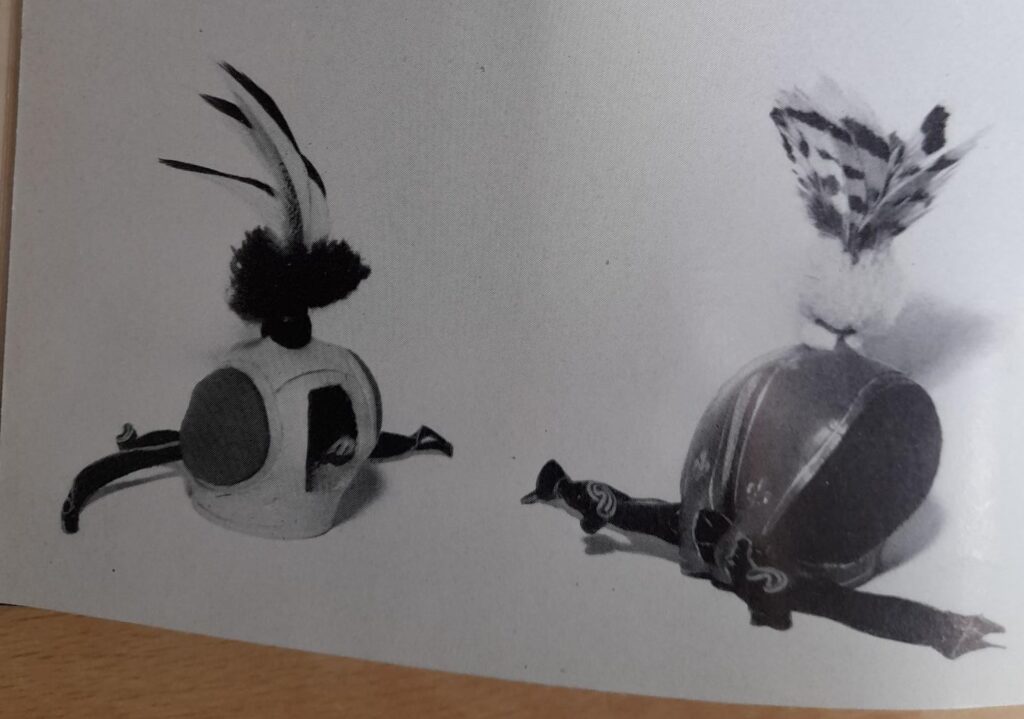
Above photo taken from the book ‘As The Falcon Her Bells’ Phillip Glasier 1963 of two Falconry Centre type hoods and they later became to be called. At the time the best hoods since the Dutch hoods.
In facts his hoods were quite ingenious in the the way there were made. They had all the qualities of the Dutch hood minus some complexities of construction. It was a hybrid hood between a Syrian hood and a Dutch hood proper. When I was an apprentice falconer at the Falconry Centre these hoods were used all the time. I remember Paul Bevan showing one that he had made. Even though they are simpler to make than the Dutch hood they are nonetheless still challenging.
The Anglo – Indian hood – another hybrid hood are relatively straight straight forward to make and usable for all birds. They are made from a single piece of leather and do not need to be blocked.
Phillip led the way but now hood making has changed again with modern modifications particularly around beak opening – more like an Anglo-Indian hood – and changes in construction technique with a generally a lighter very high quality build. Some of the modern hoods are works of art but they still have to fit well.
You can buy hoods that are made in Pakistan as cheap as chips. I am told they are made on machines – that needs to be verified – and their build quality is fantastic – but again they have to fit.
Like many falconers of old I like to make make my own hoods and I use Phillip’s patterns to make the Falconry Centre hood using my own hood block based on the Mollen design. We have to thank Phillip for providing the patterns for these hoods and guide on making them plus guides and patterns for gloves and hoods. They are used the world over. As a teacher of falconry he was second to none.
I have not made a hood for some time and I started to make one the other day. A journey of rediscovery if you like. I made a right mess of it getting the stitching tension wrong so the hood was lop sided. You can adjust when the hood is wetted and turned by stretching the one side down. But in the case the adjustment needed was too much and so I have binned it!
Here is a photograph from some time ago when I was making hood – actually that one was perfect and I use it everyday on Sprite the peregrine.
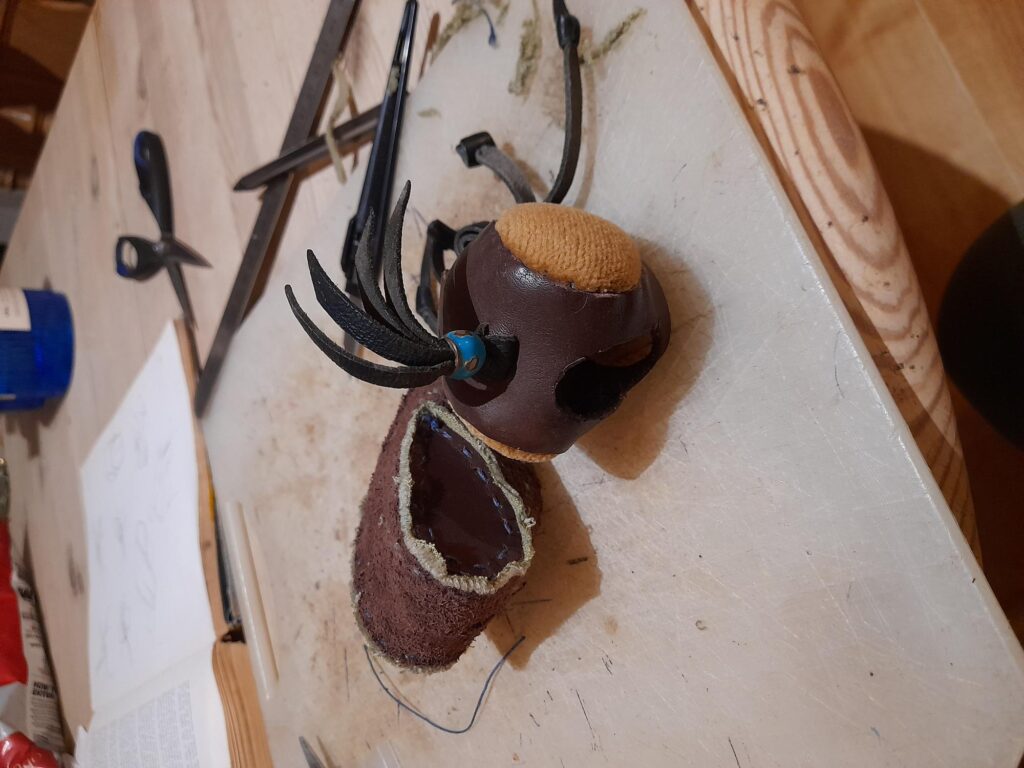
Many falconers just buy in all the kit they need but actually falconry is both an art and a craft and making your own equipment can be very much part of it.
My own book – with its own construction guide to the weathering loft with lots besides is still also very much on sale at Amazon, Coch Y Bonddu books, Waterstones and many other outlets.
 Posted in
Me now!
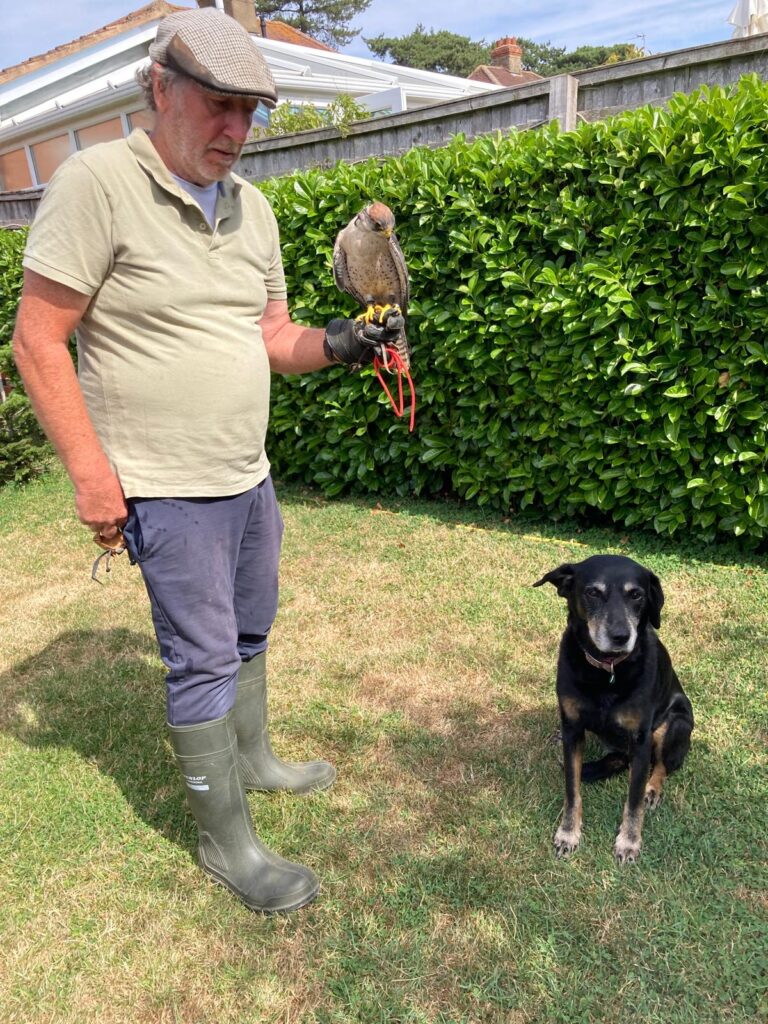
Taken the other day of an aging falconer and an old dog. The falcon is ‘Frank’ a lanneret – 7 years old -who for various reasons I kept back along with Sprite our peregrine. Frank is a typical lanner – lovely – easy to handle, hood and he flies well.
August.
Well the dry hot weather has continued into August and not since 1975 and 1976 have we had two very hot long summers back to back. In 1976 the River Severn was so low you could practically walk across it at Wainlodes in Gloucestershire. Now the water is much higher due to controlled release of water much further upstream.
Looking after animals in hot weather is always a challenge and in my book ‘Falconry – aspects of care of the trained falcon and hawk’ I have a separate section called Water (section 15) which underlines the importance of its availability at all times. It sounds like a no brainer but actually birds can exist without water – obtaining the moisture they need from their food. Nonetheless it is necessary particularly on hot days when birds can often be seen sipping from their bath water after flying and throughout the day or indeed while taking a bath.
In former times with different husbandry methods with nervous wild caught passage birds who were kept on a screen perch or when weathering out on the lawn were often too nervous to routinely hop up and down to sip from their bath water – signalling that it was not needed. We know better now. So I change the bath water every 2 days or more frequently if soiled.
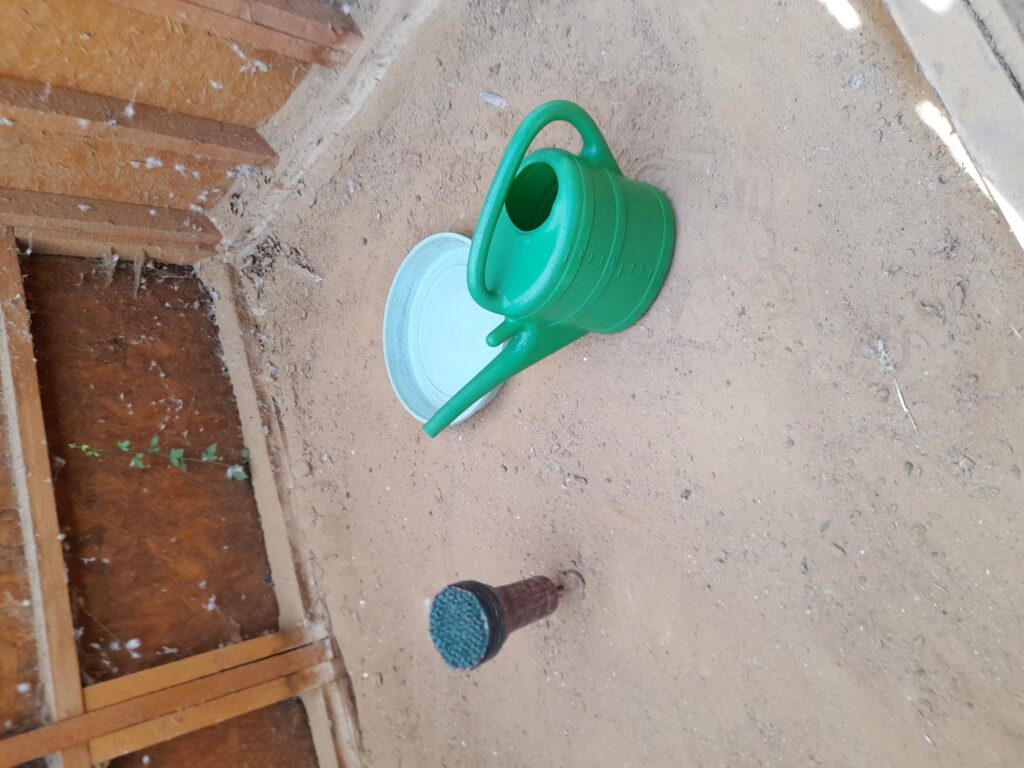

Husbandry of the trained raptor is something I discuss in great detail in my book. Indeed it prompted the section of the ‘weathering loft’ as I call it. A structure where a bird can either be tethered or free lofted. I wanted to make the point with many years of husbandry experience that many parent reared birds in flying condition unless exceptionally tame cannot be kept free lofted. They have have a habit of going wild in the loft and are practically impossible to get out of the loft for daily flying. Imprinted birds because they are imprinted on humans and very tame can in the main be kept lofted in flying condition. There is much confusion about lofting versus tethering and people postulating it should be possible for all birds. This is not so.
At other times however when the bird is not been flown – for moulting, a period of bad weather or the falconer is on holiday – then it can be safely lofted. You are not having to get it out everyday. Food can be dropped down a chute onto a feeding platform and the bird left to get on with it. The ‘Weathering Loft’ is two structures in one. Its construction is presented in my book in a step by step guide.
On to more local matters now. Since last winter – I may have mentioned it in a previous blog – I have seen on several occasions a rather ragged looking buzzard with most of its tail missing. At one point it was being chased about by other buzzards and one could speculate on what calamity had caused its feather damage. Anyway it has been quietly hanging around and has begun to moult. Each time I see it now it is looking more trim. Despite everything it managed to survive the winter and from the moulted broken tail feather – below – I can see it is young bird from last year.

I have seen the peregrine about fairly regularly – it may be more than one bird. It gets drawn at the sight of a falcon stooping to the lure and it hangs around and until it has seen enough. I have also seen a peregrine where I walk the dog always exciting to see.
Below is our peregrine Sprite on the lure after stooping to it. You can see how dry it has been this summer from the yellow grass.
