Archive for December, 2024
Out and about.
 December 30th, 2024 |
  Author:
 Just a reminder until my website is updated that I will not be providing falconry displays for 2025.
I have noticed down at the flying field – which is adjacent to farmland – flocks of migratory starlings feeding on the fields along with an equal number of fieldfares. Starling numbers have dropped over the years. At one time the sky would almost blacken with large flocks moving en masse to feed. Sadly no more. Perhaps my sightings over the last few days may indicate that the breeding season last Spring in northern Europe was a good one. Lets hope so.
I saw a pair of tree creepers yesterday. I have not see a pair around here since the 1970s and it was a double take moment – it was a real thrill. I think the loss of all the elm trees due to Dutch elm disease had an impact on many species including tree creepers.
In my book ‘Falconry – aspects of care of the trained falcon and hawk’ I mention in the introduction the abundance of game in the countryside when we were youngsters. The countryside was mixed – with established grassland for a diary herds and sheep, some arable land, apple and pear orchards, some abandoned scrubby areas and a stream running through the middle which contained many water voles, moorhens and in the winter snipe. This was greenbelt farmland and not exceptional. Sadly many of its wildlife inhabitants have now gone or are greatly reduced. Diary farming has completely disappeared. Large flocks of house sparrows have gone, skylarks once so common are completely absent along with yellowhammers and other small birds. But the list is endless including raptors like kestrels, barn owls and little owls. It is a familiar story throughout the land.
Nobody it quite sure what has happened. The lack of insects propping up the whole ecosystem – their absence – is something we all have noticed and this must be a key factor. People should be able to walk in their local countryside and see these once common farmland species. This is the attraction of the writings of J A Baker in that the peregrine existed with other species in large part on unexceptional farmland. Something we are all familiar with. Ironically his beloved peregrine is back but sadly not the other species to go with it.
I walk in the countryside everyday and sadly there are no youngsters playing in the countryside that were once building dens – having fun – away from the gaze of grownups – as we did.
Perhaps because of this it is more important than ever when planning for the new conurbations to come that ecological provision is made for wildlife – to live among us and enrich our lives. It has done that for me.
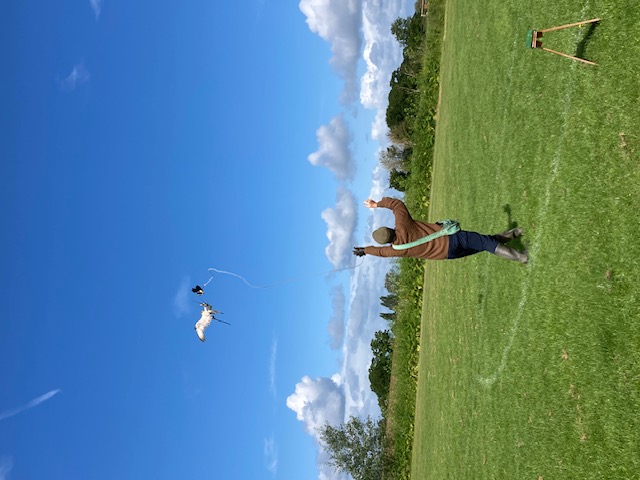
I sign off with a falcon called ‘Frank’ just about to catch the lure from last summer. The lure itself is the one I make in my book – known as the ‘sock lure’.
 Posted in
Christmas.
It is not too long ago that the Christmas period was a busy time for me. Working at various Country Hotels on Christmas Day, Boxing day and then into the New Year. I always enjoyed it – the main concern at this time of year is the weather. We did a display at the Cotswold House Hotel in 2010 with a foot of lying snow – it was -10c when we arrived. I find it hard to remember an occasion when we could not fly the birds during the festive season.
Christmas morning was always the most fun. I would peel the potatoes at home before going off to do the display. Coming back home was always lovely as the house had woken up and the cooking of the turkey was underway. Great! So working over the festive period as I explained to my neighbour was part of the job – that is when guests want to see me.
Sadly I no longer do this but even so habits die hard and I found myself on Christmas morning down at the field where I fly my birds with Jarvis the lanneret. He is of course the falcon I trained for my book ‘Falconry – aspects of care of the trained falcon and hawk’ by me Michael Davie.
I am determined to get him fit and this requires daily flying to build both muscle and cardiovascular fitness. This takes time but once once cardiovascular fitness is attained a residual fitness in the bird will always remain. Jarvis is doing well and flying way beyond the level he achieved in the book diary. Due to bad weather I was left frustrated at the end of his first season. As I explained in the book the primary concern with a first year hawk or falcon is to get the bird through its first winter and then beyond this to the first moult. In that sense things went well and I was very happy to pick Jarvis up after the moult. He looked very smart with his new mainly blue livery and was soon flying again.
When it it comes to comparing falcons – peregrines though a similar size to lanners visually are in fact quite a lot bigger. They are very compact muscular falcons and when you have one on your fist you are impressed by a feeling of density, weight and power.
I will finish this news blog with a picture of ‘Sprite’ our male peregrine falcon know as a ‘tiercel’. This word apparently means ‘roughly a third’ in ancient French signifying the size difference between the falcon – the female and the smaller male or tiercel. It is a fairly accurate.

Jarvis flying well
Just to repeat I will not be offering falconry flying displays for the 2025 season. Sorry about that. I have been concentrating on my book ‘Falconry – aspects of care of the trained falcon and hawk’.
As I have said in an earlier blog Jarvis is a 2024 lanneret that I bought at 11 weeks old. I present a diary of his training in the book. We lofted him for the first winter to protect him from wing tip oedema (WTO) and then during the warmer weather of spring I got him flying again and flew him to the beginning of his first moult at the end of April. During the first year we tried to loft him in flying condition. I did this in short periods. Birds in flying condition can get increasingly difficult to get out of the loft and it is important when signs of this is occurring to put the bird back on a block perch. Then later try again and keep going. As the bird tames loft time can increase until it becomes a permanent option. For some birds this is never attainable but still the loft is useful for rest periods when the bird is not in flying condition and therefore not taken out every day to be flown.
So, I made progress with Jarvis but as my diary entry said in the book I was frustrated by the weather and never had a good run of things when I could fly him every day and get him fit. Since then, he has moulted through and he is now flying well, and I am delighted with his progress.
One always reviews what one has written. I am not a writer, but I have tried to convey things in as few words as possible supported by instructional pictures. But it is important not to forget the sheer joy of training and flying a bird and the way it can enrich life. Falconry does have a magical property, and I guess I am one of those people where it has had its effect. Despite my illness it still has an enduring appeal.
Of course, I no longer do shows. Formerly Jarvis would have joined my event team and hopefully at some point he would have been flown at a show. This is a very big thing for a young falcon or hawk. But now I am flying Jarvis for fun and his development is still something that gives me great pleasure. Alongside this he is developing a personality as he matures, and I certainly won’t have things all my way. No doubt at some point I will lose him – hopefully temporarily. The learning curve when this happens is steep and overall beneficial in the development of the falconer.
So, I am happy with Jarvis.
I will sign off with a picture of Duke the best all round falcon I had over my long career. He adorns the front of my book. We had him for twenty-three years – he was a wonderful bird.

Pre-Christmas update.
Just to state again that I will not be providing falconry displays next year. This message is scheduled to appear on the front page of my website. Apologies for any inconvenience caused.
I have in the meantime been using my news blog page to announce the publication of my book ‘Falconry-aspects of care of the trained falcon and hawk’ which was published by the Choir Press on November 16th – just a month ago. I wrote it as a legacy project for my family and friends and hopefully for others it will overtime prove to be a useful resource.
It has had a less than modest start. I have had one five * review from an Italian reader. I am assured it is a verified purchaser and not a generated review. But who knows.
But the book is now a reality and now in its finished form. Hopefully it will be around for a very long time. But I am new to the world of publishing, and I was not sure what to expect. But we will see.
I notice the book ‘H is for Hawk’ by Helen MacDonald is being made into a film with the actress Claire Foy playing Helen – as a picture in the Daily Mail on November 10th shows. Clare Foy has a female goshawk on her fist. This is good for our sport to have someone with the eloquence and intelligence of Helen MacDonald as an advocate. Many years ago, when I was working at the International Centre for Birds of Prey for a short period I worked alongside Helen. As I have said before I remember her as a very nice friendly person. I was delighted many years later – like many others – to discover her book. It seems to have caught the mood of the time and has done really well. I look forward to the film.
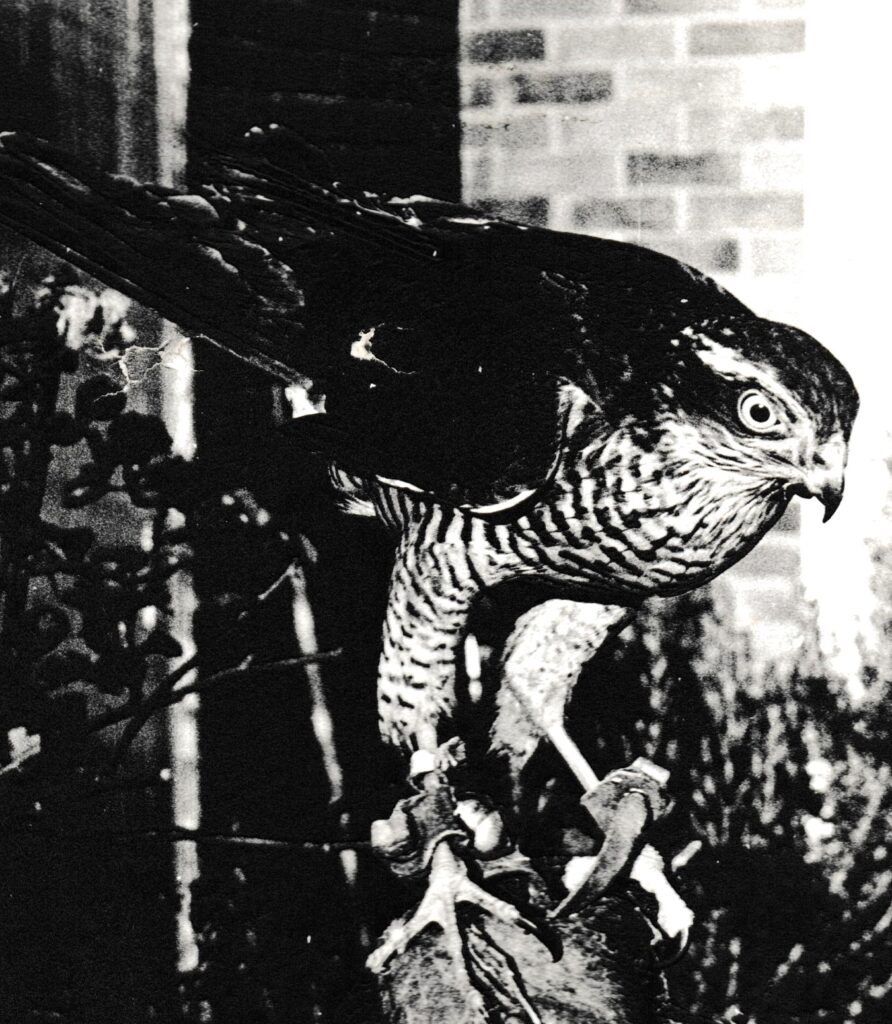
I sign off with a photograph of Meg my female Sparrowhawk taken in 1975. She is also pictured in my book. With a bird like this the learning curve is steep. Phillip Glasier once said to me that he rated the Sparrowhawk as the number one hawk for falconry. They are fantastic.
Jarvis the lanneret doing well.
As I have now said, sadly I am no longer involved in falconry displays. It came to a sudden halt when the frailness of my own mortality became apparent through illness. It is through that illness and the right decisions on treatment that I have been at least able to write my book ‘Falconry – aspects of care of the trained falcon and hawk’. Obviously, there is a legacy component to the work, but I am hoping it will be a useful resource for the falconry community once it has found its feet. There are many other works out there. My book does reflect a lifetime of connection with birds of prey with the last 35 years of which I have been occupied as a professional falconer.
Half of all animal husbandry work or more for a large collection is a wheelbarrow and a shovel. This along with the establishment of a routine that animals set their clocks to. From hawks and falcons to walking a dog or milking a cow. Through routine you get repetition and to make life easier all round you respond by honing your skills and perfecting your craft. I hope this is what my book shows.
I reflected while writing the book that if I had been flying birds for 300 years I would know more, and the book would be better. But 54 years will have to do, and I am of course carrying legacy skills from previous generations of falconers. One of which was Major Hawkins Fisher the Stroud falconer who died in 1901 at the age of 74. What follows is part of a news blog entry from me in 2018.
‘We made time just before Easter and went down to Stroud to find the grave of Major Charles Hawkins Fisher the noted Stroud falconer whose family home – a fine-looking property – was known as the Castle. He died in 1901, and I remember as a schoolboy in Stroud visiting the local museum to look at a few of his artefacts – some stuffed falcons including a merlin, a photograph of him, plus various bits and pieces of falconry furniture that at some point had been donated to the museum.
He was a remarkable character – a Victorian gentleman – who was Champion archer of England 3 times! and was a noted and brilliant falconer who left one of the best books on falconry ever written called ‘Reminiscences of a Falconer’. An anecdotal book of his falconry experiences, thoughts and observations. It is a timeless historical document.
He died in October 1901. Fisher’s long-time falconer, James Rutford attended his funeral in Stroud with a hooded falcon on his fist.
I did some research and visited what I thought would be the graveyard where he was most likely to be buried. We were most surprised to find not only his grave, but it also happened to his family grave – as they were a well-known family. It was a great moment, and we felt a real sense of history’.
I regret not mentioning him in my book because I admire him so much. He was such an adaptable falconer – challenged the rules – and was way ahead of his time on thinking ahead about the survival of our sport. He also conveyed the sense of fun and adventure of being out with his birds.
He was in a great deal of pain when he wrote his book. He apologised for some repetition in the book and that for reasons of incapacity he felt better able to dictate it rather than write it himself. For reasons of his failing health there were long intervals between sessions, and he did not have the energy to go back over the text. With the support and encouragement of friends he chose to publish it as it was.
I have a lot of empathy for him in the sense that I feel the same way about my book in that it was important for me to get it out there rather than sit on it and make endless changes to the point that it would never have got published. Particularly if I was too ill in the end to do it. Like Fisher I apologise for any in eloquence and some repetition but I am glad it is out there.
One of the characters in my book ‘Jarvis the lanneret’ is flying again. We left him to moult when the book was finished. But he has now finished moulting and is flying again and with a new set of feathers he is really looking great. He spent the main part of the moult in the loft. Anyway, below is a picture of him on the scales in the hawk room looking very smart. I am keeping a record of his flying weights possibly for future use in a revised edition. But that is a long way off! I am glad to report he is flying well.

The ‘weathering loft’
The weathering loft is the central theme to my book ‘Falconry – aspects of care of the trained falcon and hawk’. I have thought about whether this is an appropriate place for a step-by-step guide to build the structure with drawings and quantities provided. Other books include hood making and other items of falconry furniture and so I thought why not. Housing your bird properly should be the first priority and then to have it ready in good time for its arrival.
The weathering loft is a dual-purpose structure which can be used both as a weathering and a loft.

Lofting a trained parent reared bird in flying condition is the goal. This however is not always possible because they can be difficult to take out of the loft to be flown. But the loft can be used at other times for the moulting or resting bird or during bad weather. It is possible to build up loft time with a trained bird in incremental stages. I have done this successfully. But with some birds this is never going to be possible. A realistic approach is needed.
It is important to say however that the loft is not an aviary. It can be defined as a place where a bird is not tethered.
My design shown above is based on a method that I have developed and used for over 30 years.
Anything we offer as suggested accommodation must be affordable. I have made sure that the construction materials are available from DIY stores. This means the falconer can avoid the daunting task of visiting a builder’s merchants or timber yard where nothing is visible or priced up. At a DIY store it is all there – priced up sitting on the shelves. Often with a ‘certain spend’ delivery will be free and there may be a trade card available on reaching certain spend thresholds to further reduce costs.
Of course, you can repurpose a structure or use the foundations of a previous structure to build something new.
The main material for the weathering loft – the sheet material – is 11 mm OSB 3 board (3 meaning exterior grade) which is widely used in the construction industry. If sealed properly and subsequently maintained this material will last the course. If a panel is compromised these low-cost sheets are easy to replace. They should be fixed with 40mm screws to allow for this. Personally, I prefer OSB 3 board to equivalent forms of plywood because they are less likely to delaminate.
Ship lap or feather edge boarding can be used. It is important that the material is of a certain quality so as they dry out gaps and splits do not occur.
I have not tried ‘Stokboard’ which is recycled plastic sheeting. It is quite expensive and always needs to be delivered. I have a bird of prey colleague who has made hundreds of nest boxes for owls and kestrels out of the material. They are rot free and do not require maintenance. They are put together with a series of interlocking slots and wedges. For a larger structure it would need to be fabricated with the use of metal frames to make best use of its properties. It is certainly a material of great interest.
Metal cladding is another material that can be used. This is of particular importance in breeding pens which in part may be open topped and be at risk of the weather incursion. Maintenance is also more difficult in breeding pens and so investment in the right material out the outset makes a lot of sense.
Buildings can be made of block or brick work but will require proper foundations.
The weathering loft as presented in the book has been designed with affordability in mind with materials that are commonly available. It will offer a long lived bird all its needs in the trained environment. The step-by-step guide is there to encourage and support its construction Time must be allowed to build the structure. Everything takes longer than planned even without bad weather slowing things down.
All this can be found in the book ‘Falconry – aspects of care of the trained falcon and hawk’ by me Michael Davie. Recently published by the Choir Press. It is available online.