October
 October 2nd, 2026 |
  Author:
 Where did September go?
Well now its October and still very warm and largely dry – the stream though filling up is not yet flowing. I saw the last of the swallows go through last week and normally beyond the first week of October they are are all gone and so I am not expecting to see any more.
It has been a sad week in that we are losing yet another flying field to development and this time a sports club and ground. All the users of the facilities the NHS for training, a special school and many clubs and societies are gone – literally overnight and so have most of the staff. So sad. I will hang on and be able to use the ground a bit longer while I think of what to do next. Thank goodness I am no longer a professional falconer with a problem of where to fly the birds along with running a diesel van at roughly £2 per litre of diesel!
But the adventures of flying falcons everyday continue and I had another close call with Sprite our peregrine. As I have mentioned before he was going to go to a friend of mine when I had to give up doing displays. But that did not happen and so he remains with us and I fly him everyday.
The bane of flying peregrines are pigeons! their mantra is “see pigeon must chase pigeon” and I make sure before I unhood him and cast him off there are no pigeons about. Yesterday just as he launched skyward a pigeon appeared and that was it! off he went!
Some walkers had just come through and were not quite out of sight and I thought this may compound the problem. Anyway Sprite was chasing flat out – very exciting to watch – and he disappeared behind a high tree line in hot pursuit.
I waited for me to reappear at the top of the field but he did not. So I decided with some haste to go into the next field and try and bring him down there on his return. I heard his bell and he had made his way in the direction of the walking party now in the distance – I knew it! of course he was looking for me and my lure.
He started ranging and I turned sideways so he could see the swing of the lure at distance and shouted hoy! it is always a tense moment while you determine whether the falcon has seen you and is making its way back. Thankfully he had seen me and he came whooshing back. I was now standing in a recently cultivated field – brown earth and I knew this might spook him. He was pretty pumped up and typically I could tell he was not going to bind with the lure. So I stooped him several times to the lure until a more normal mindset returned and he caught and bound to the lure and without dropping it came to ground. He was very nervous and I carefully made into him and picked him up.
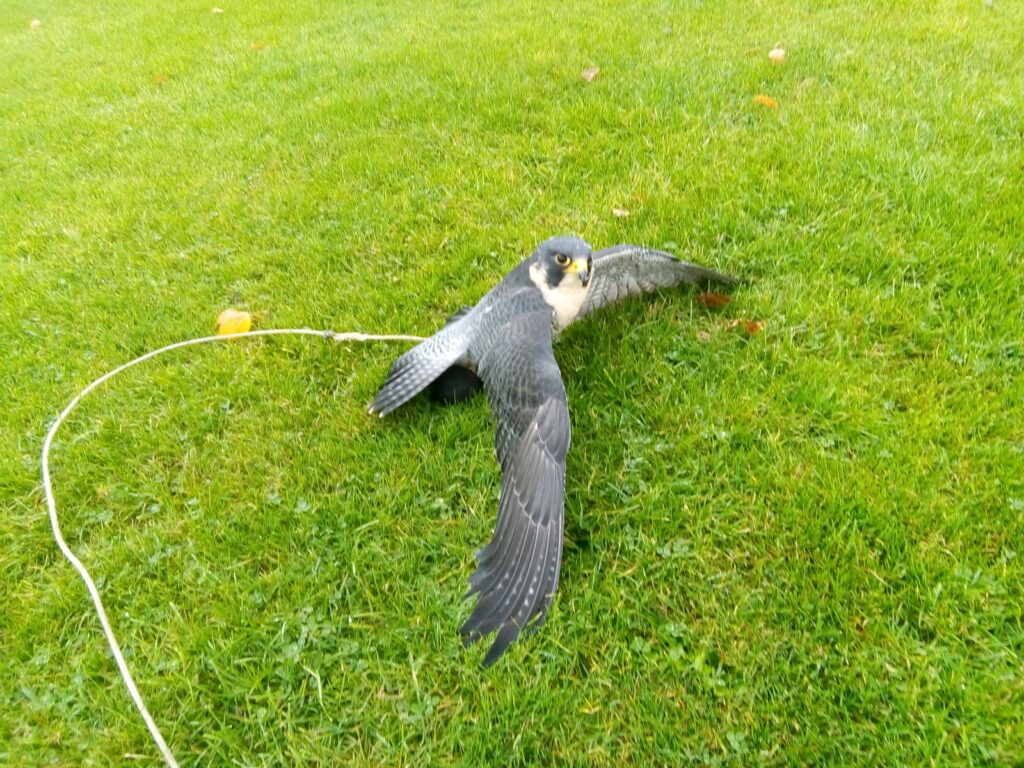
It is very easy to lose a bird in high condition – just like this – off the lure. So you have to be careful. I very much followed my own advice set out in my book ‘Falconry – aspects of care of the trained falcon and hawk’ and I have to underline the use of the sock lure. It is such a simple lure but so effective – easy for a nervous falcon to bind to and hold on. It almost snags the falcon.
My book is available through Amazon and other outlets including Coch-Y- Bonddu Books who stock it on their shelves. There are a myriad of AI generated books on falconry now. I have not read them so I cannot judge their quality but my book is based on 50 years of experience with 35 of them as a professional. The book is all about the care and training of the long lived raptor including its housing with a guide to it construction and much more besides.
Anyway Sprite was back and I was mighty relieved. Back home he celebrated by having a bath.
 Posted in
Buzzard again and my hat.
As I mentioned in my last news blog a scruffy looking buzzard has been hanging around in fields I walk the dog since last Spring (at least) and ‘slowly but slowly’ it has been moulting through the summer. As you remember I picked up a tail feather which I suspected was from this bird the other day.
I have some photos now of him in this field a couple of days ago. Quality not brilliant as it was taken on my mobile phone. I flushed him out of a tree – unexpectedly – and he lumbered into the air with a full crop and crossed the field and pitched into a tree. The picture shown below. In fact I got a lot closer to the bird then the picture suggests.
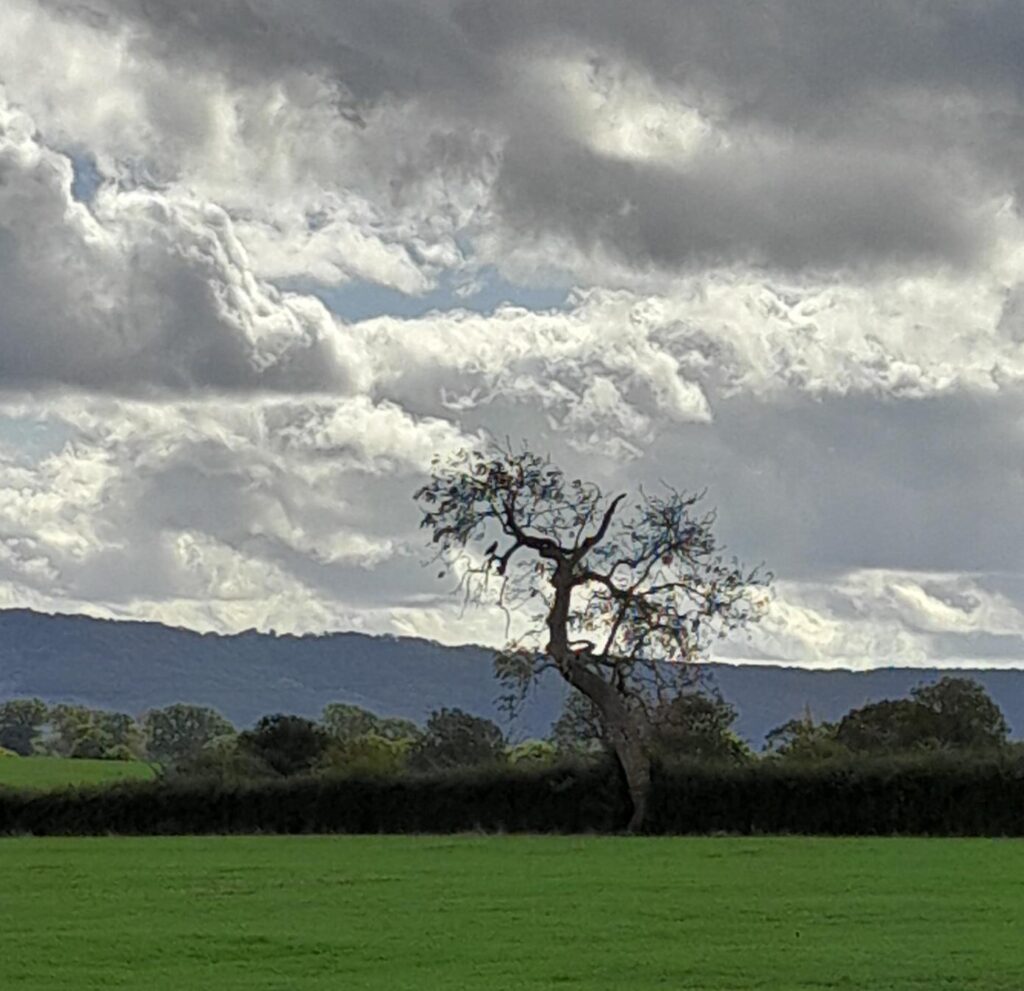
He then took flight again and began to circle and climb and soar.

I could tell that it wanted to return to the tree he had previously left and wheeled over the top and beyond which would allow him to come back into the breeze and pitch back into the tree unseen.
At that moment the dog discovered a deer sleeping in a hedge nearby and it burst out of cover – it took me by surprise – and the dog! Years ago she would have given chase and I would have had a problem but she is too old now and we watched it scoot away. It ran right under the sightline of the buzzard who aborted its landing and it began to gain height and drift away. It did think about coming back but thought better of it and I watched him drift away into the distance.
The following day he was back in the tree again! and as I passed under he flew out again with a full crop! He had come back to his favourite field and tree. It is obviously good for hunting as the tree stands along in an ancient hedgerow. I assume he was catching rats.
Changing the subject now.
I had a bit of fun with Sprite our peregrine today and this relates directly to my book – life imitating art if you like. I was stooping him to the lure and he was coming across the breeze and making life difficult for me -I knew I would have to duck as he can get very close to my head! Anyway he did and managed to snatch my hat off! He then disappeared down the field prize in foot. If it had not been for a thin strip of woodland he would have just kept going. He appeared from my distant view to take it into the cover of the wood. He may have navigated his way through though and gone out the other side- I was not sure.
I very carefully went beyond the wood into the field the other side and called him and swung the lure. I did hear a bell but from what direction – at least I thought he was nearby.
Then I heard his bell again and realised he was indeed in the strip of woodland on the ground.
My book warns about spooking a bird in cover and dangers of finding a bird and then losing it again. Even though he was a stones throw away this was a high risk situation. I gently made way towards the strip of woodland and again heard his bell and cautiously in a wide circle went back round into the flying field thinking this might be a better way to get to him.
It was and I found him sitting on my cap in cover. I knew that if I attempted to pick him up in the conventional way he would likely spook. So, instead I swung and lobed the lure towards him and after couple of moments where he dragged himself and my cap towards the lure only to stop and drag it away protectively away – back into cover.
I was patient and eventually he gave up his prize and jumped onto the lure. I wanted for him to relax and start feeding on the lure before trying to pick him up. Which I did – crisis adverted – and soon had him feeding on my glove. Even though I have had him 12 years there was no certainty that it would end well. I was relieved!
I discuss this in my book ‘Falconry – aspects of care of the trained falcon and hawk’ about the fragility of training when something goes wrong and how best to deal with challenging situations My book can be found almost everywhere online Amazon, Cochy-Y-Bonddu Books – who stock it on their shelves, Waterstones and other outlets too. I hope those who have bought it have found it useful.
Buzzard
I found this buzzard’s tail feather in a field I walk through with the dog. It may be from a rather scruffy looking buzzard that has been hanging about for most of the summer. It is certainly is from a buzzard that hatched last year – by its look( light brown and slightly tatty at its end indicating it had been in a nest last year) – and is therefore experiencing its first moult. 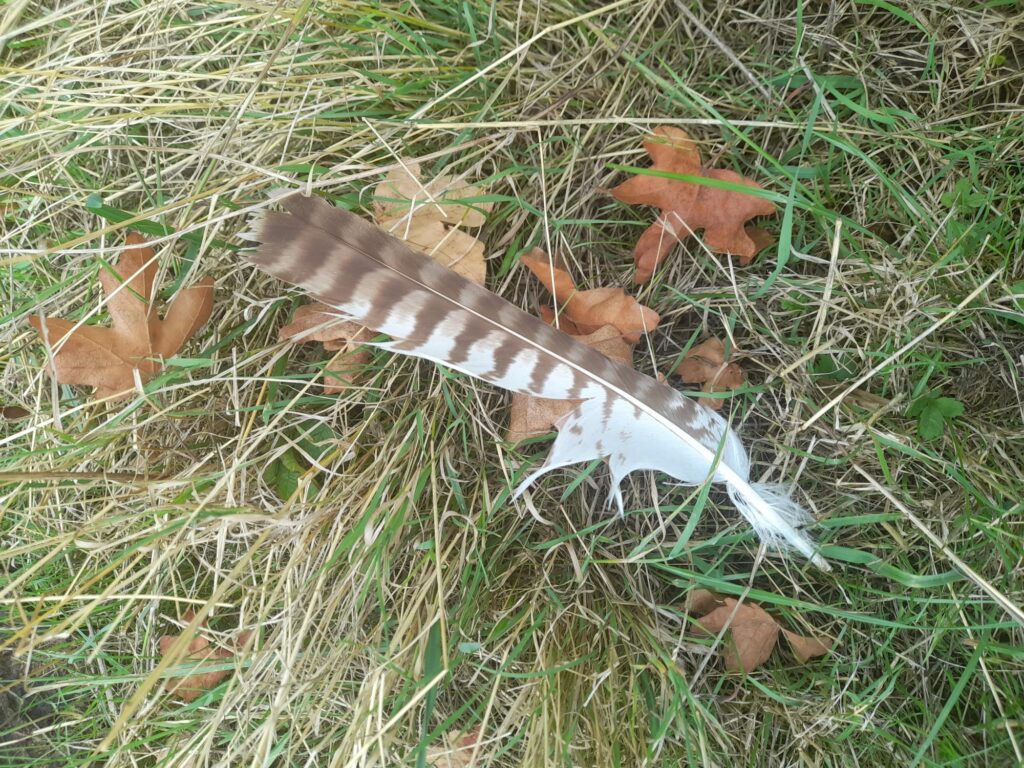
Our own birds Frank and Sprite are both moulting albeit slowly because they are in flying condition. Although I do fly them at top weight or the highest condition possible with plenty of energy to grow new feathers. In fact Frank dropped a very similar tail feather to the one above mirroring its wild cousin.
I do remember having my own trained buzzard back in the 1970s and the fun we had with him hawking along the brook and then in the summer at rabbits. A bit of a come down after flying a Sparrowhawk but there you go. If you can get a common buzzard hunting you can do anything.
As I say in my book ‘Falconry-aspects of care of the trained falcon and hawk’ summer rabbit hawking is an option for those birds in good condition – in fact they can be flown all year round. I had some of my best evenings ever summer rabbit hawking.
September
Well Autumn is officially here now. My father always considered the first two weeks of September as part of Summer. It is raining today and this is why I am tapping away on the keyboard rather than flying the birds. I fed them both in the hawk room – which gives you a chance to have a really close look at the birds etc. and check their feet.
One thing I am not doing is complaining about the rain which we desperately need. I checked the local streams the other a day and noticed the main brook is still flowing while the stream, where I walk the dog, a tributary, is totally dry and as I said in my previous blog it is difficult to imagine it ever running again.
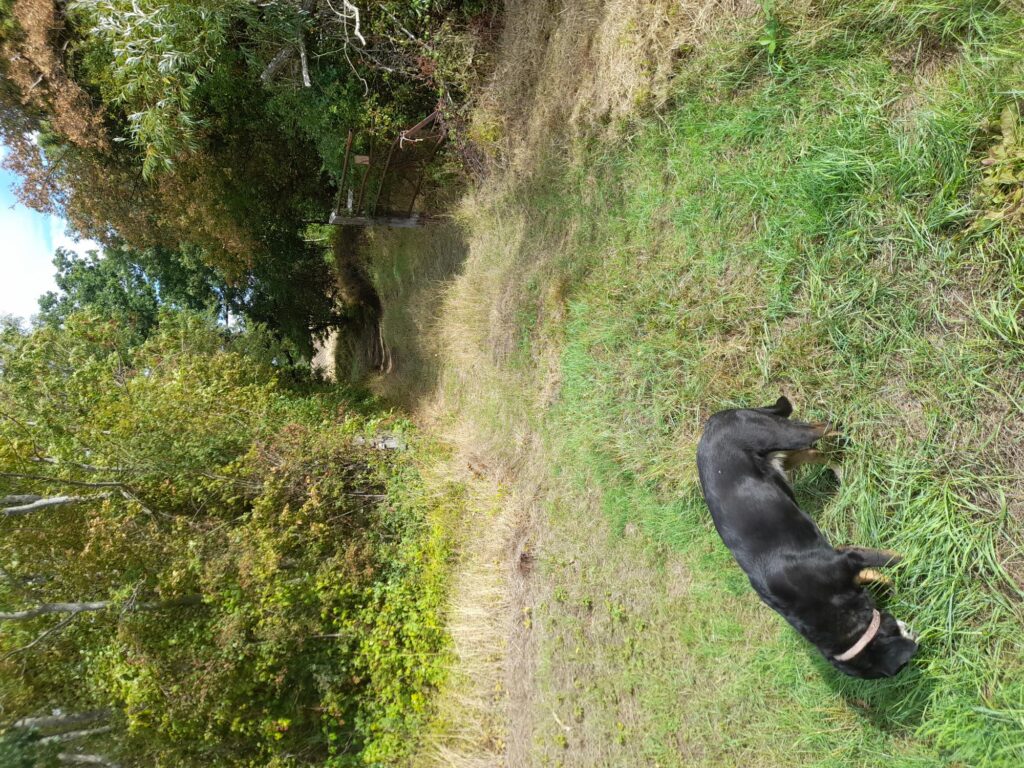
Here is a picture of where I walk the dog and the track which leads over the stream – where is rains hard is becomes a ford. It is a beautiful spot and in the dip beside the stream is a lovely old oak tree. Our now aging dog still enjoys her walk and her shiny coat always looks amazing.
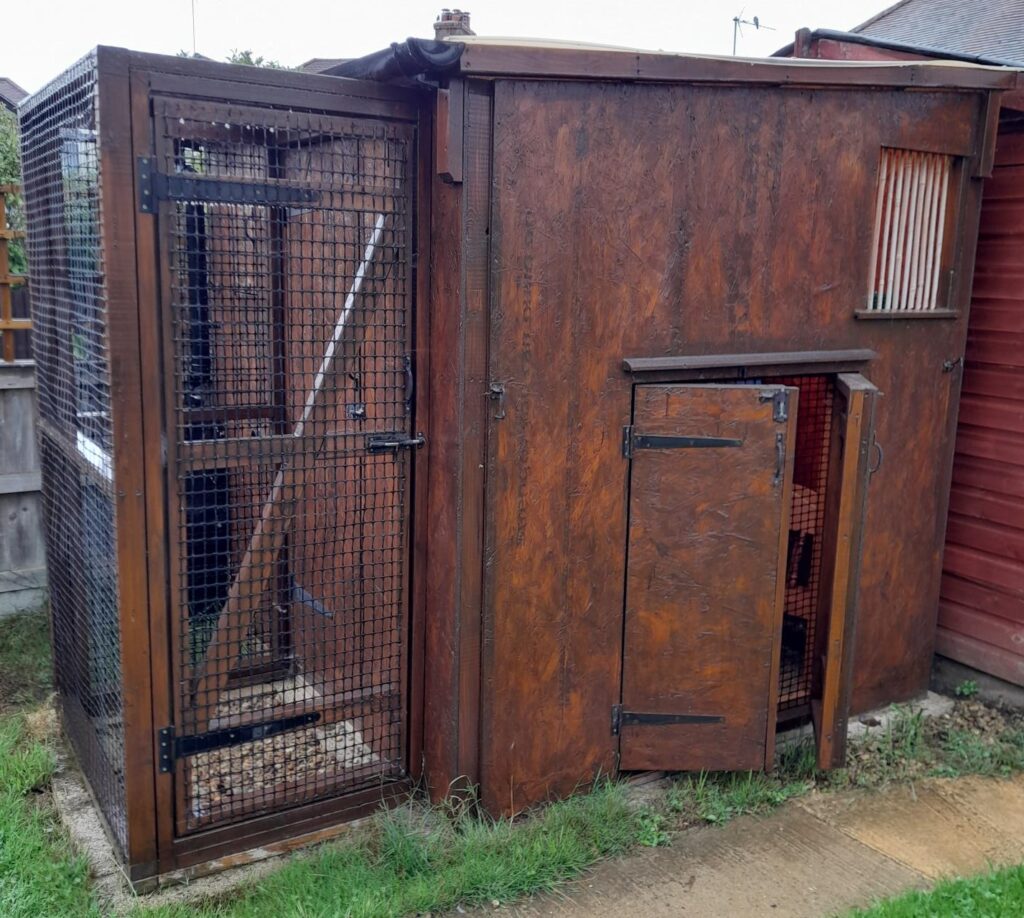
I had a look this morning at the weathering loft that is shown in my book ‘Falconry – aspects of care of the trained falcon and hawk’. It is now nearly 3 years since its construction and as I suggest in the book it is very important to maintain it. Which I have tried to do. It does not take much to get the brush out and give it an extra coat of exterior wood stain – do it in stages. I always say it is amazing what you can do in an hour. The structure has had punishing heat on it for two summers and so it needs renewed protection. From a bird welfare point of view also needs very good ventilation. On a very hot day if the bird is loose in the loft the shutter doors can also be opened to increase the flow of air along with the ventilation hatch and window at the front.
Here is a photo of the weathering loft taken this morning – shutter doors slightly open to make my point.
Changing the subject again I have seen a fair number of wild peregrines recently and one in particular which was flying into a stiff breeze using a high hedge with trees not only to shield it itself from the wind but also to conceal its approach to pigeons feeding on the other side – on the stubbles. I thought how crafty. You rarely see peregrines doing this hunting like a Sparrowhawk. Really interesting.
Harris hawk to stay.
For the last month I have been looking after a friends female Harris hawk while he was recovering from an operation. I am glad report she went home today.
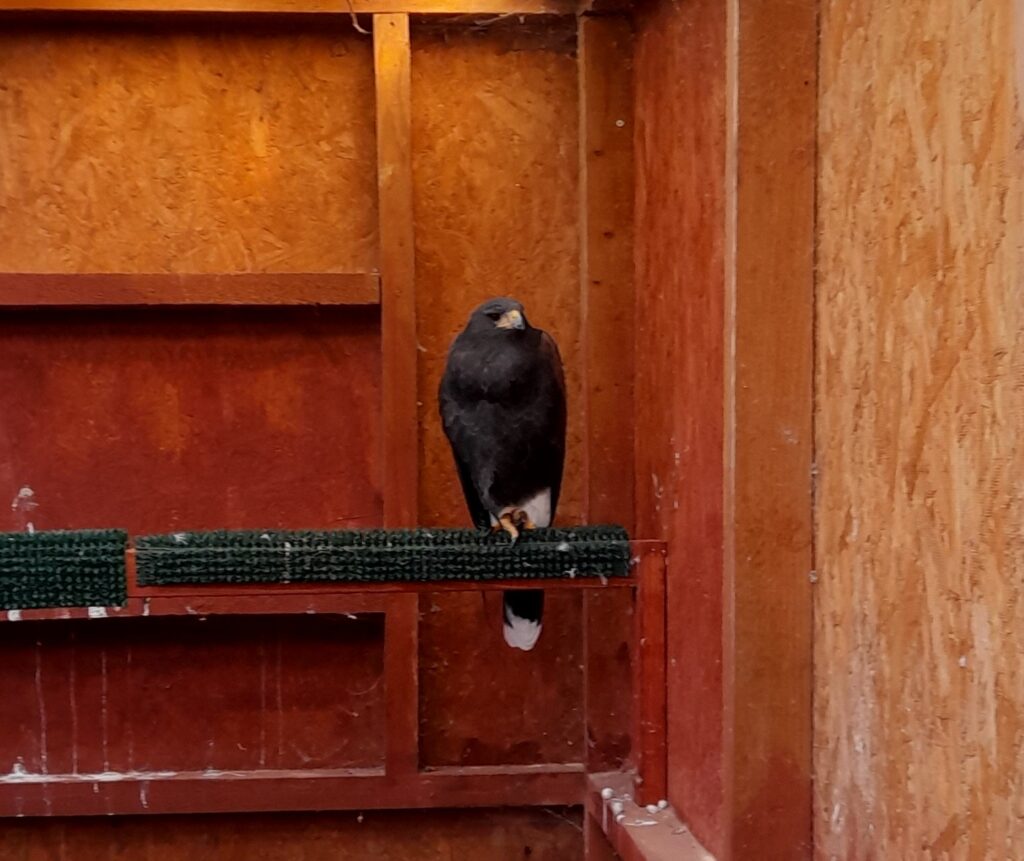
While she was with us she was lofted in what I call the ‘standard’ weathering loft as seen in my book. In the book it is just over 9ft x 7ft and about 8ft high at its highest point or so – actually in practice very roomy. It was this particular size because I wanted the materials to be readily available from a DIY store in a cost effective way.
The Harris hawk ‘Lakota’ was very comfortable in the loft and with plenty of food – 6 chicks a day – she started moulting very heavily. Because she has not been flown for a while there had been no stop or endpoint to the season – when on being ‘fed up’ she would then start to moult. So she was moulting quite slowly.
With Lakota left to her own devices in the loft in the very hot weather with plenty of food this acted to speed her up and she started to moult very heavily.
Apart changing her bath water just inside the loft door and her feeding mats I left her alone – just checking twice a day to make sure she was alright.
As I say in my book the old falconers of yesterday were well aware of the importance of heat and would often use the loft of a building with some artificial heat to moult groups of falcons through as quickly as possible. We do not do that now.
Of course you can moult a falcon or hawk through in a weathering (on a block or bow perch) and feed it on the fist everyday but if you are away lofting a bird is a much safer option. It means you can leave the bird to be looked after by a non specialist carer.
Harris hawks can be flown through the moult if in good feather condition and some of the best hawking at rabbits can be had during the summer.
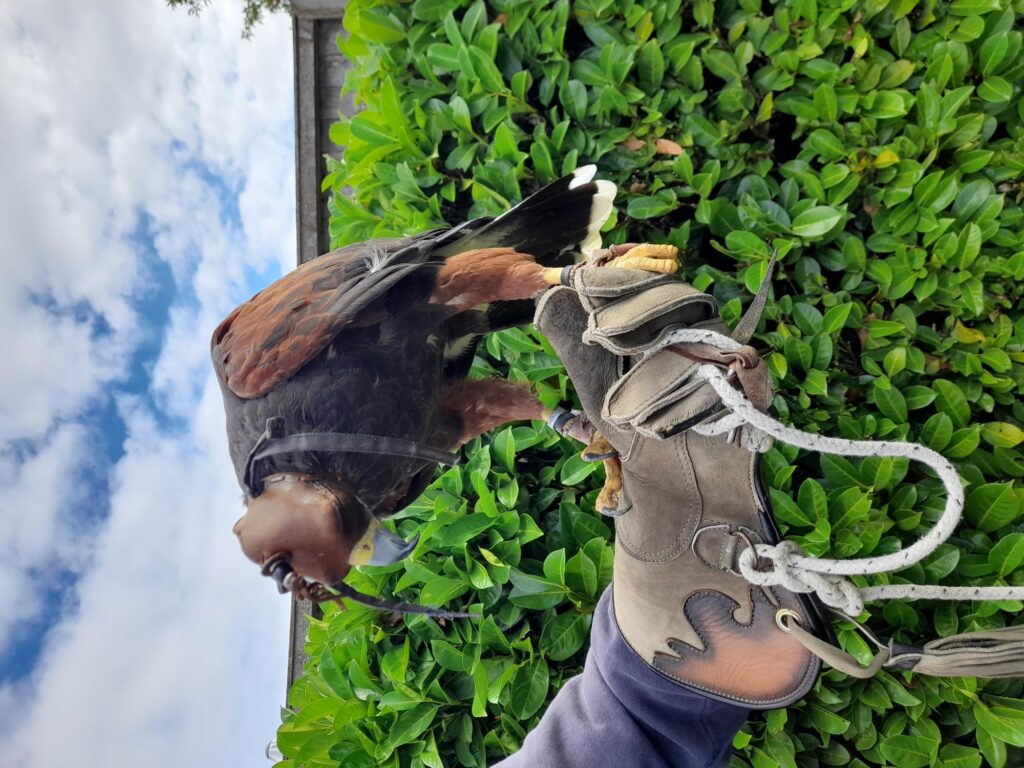
Here are a couple of photos of Lakota one in the loft and the other when she was picked up today.
My book ‘Falconry – aspects of care of the trained falcon and hawk’ is on sell at Amazon, Coch -Y-Bondu Books ( who stock it on their shelves), Waterstones, Blackwells and others. It is a very large paperback of 346 pages with nearly 600 hundred photos and retails around £30.
Rain
Well it has finally happened. It is raining! It is a welcome relief with some sadness too as summer ends. Apart from the drought it has been a wonderful summer and although we are expected to see these more frequently with climate change – a worry for all – it should not preclude us from enjoying the warm weather where we can. Eating outside in the evening.
Despite the rain the brooks and streams are still bone dry and it is quite a stretch in the imagination to picture them full again. I will report back on that. A French friend from the south of France told me how shocked she was to see England – parched and yellow – from the plane as she flew in. England is supposed to be green!
Back to the falconry. of our two falcons Sprite our tiercel has been flying really well – plenty of pace and now quite fit. As I have discussed before he is some kind of imprint and I have found it hard over the years to find his ideal flying weight. It does not matter so much now because I am no longer doing events – but I have continued to experiment with his conditioning. He needs to be flown in the highest condition possible but it does make him high spirited and at times tricky to handle. You have to adapt to accommodate this and I mention this in my book ‘Falconry – aspects of care of the trained falcon and hawk’ in the section on hooding.
With Sprite I use a heavier weighted lure stick because – again I mention this in the book – because peregrines are so powerful and will just keep going with a lure attached to a lighter lure stick. I noticed the cotton line was wearing a little thin so I replaced in the week. Following the steps I set out in the book. See below.

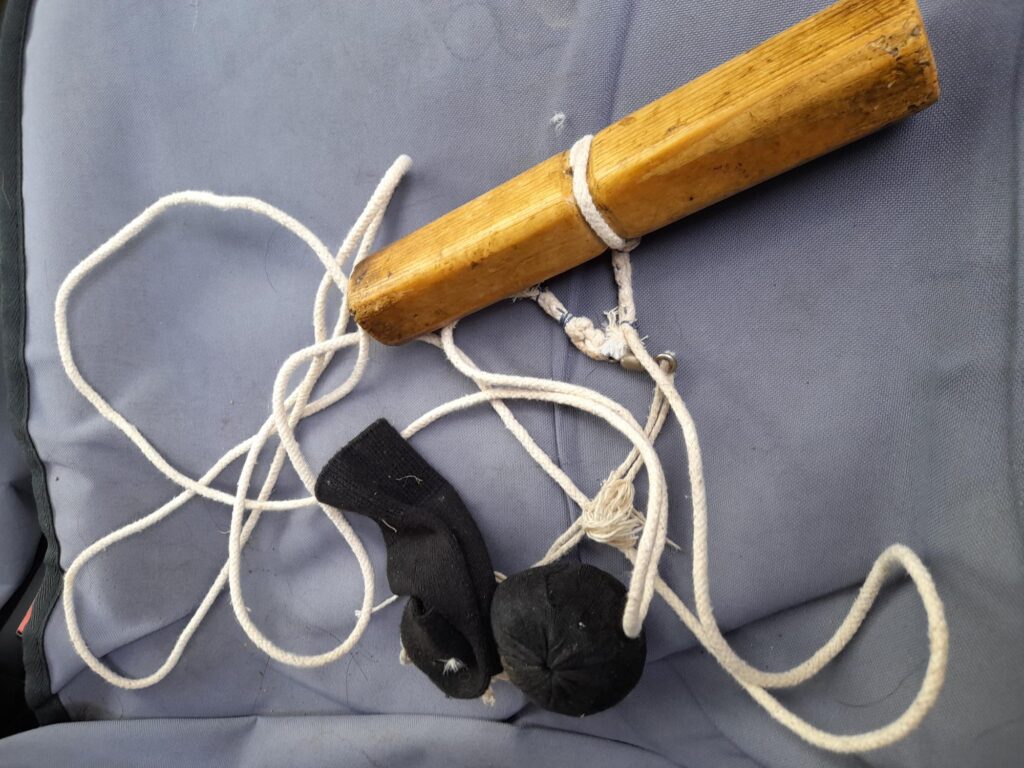
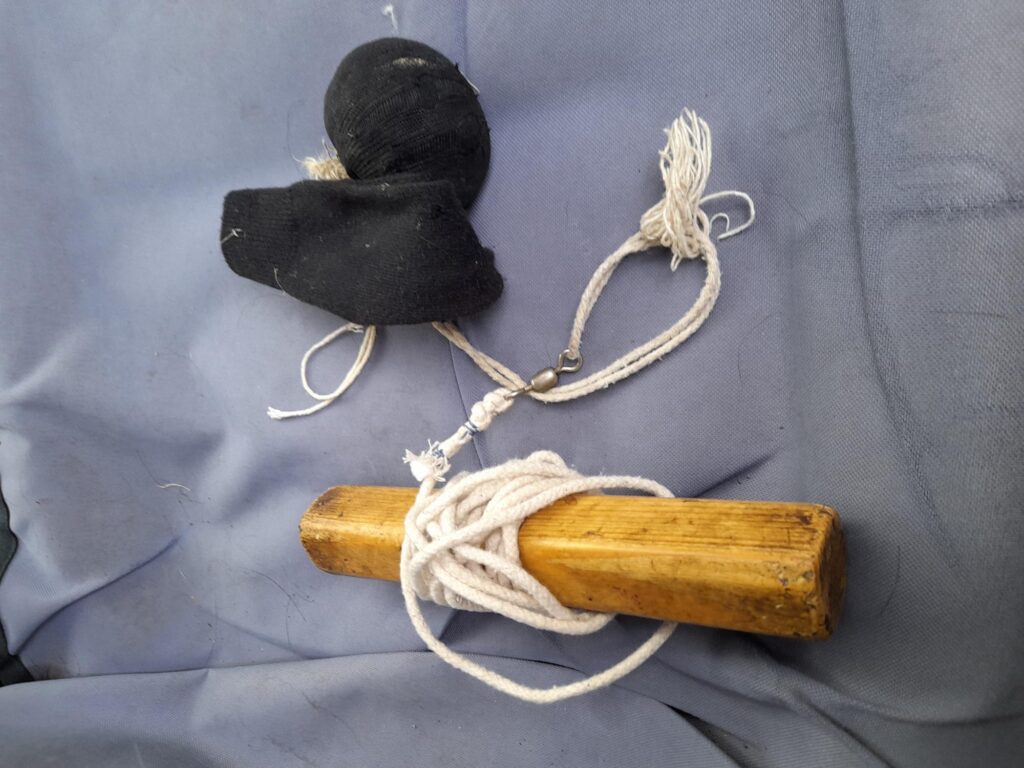
A broken lure could be a disaster. The cotton lure lines are nice to use – less finger burn than nylon cord – but less durable.
Kestrels
I have a sub-section in my book ‘Falconry – aspects of care of the trained falcon and hawk’ in Section 20 – telemetry and lost birds the dangers of falcons in particular being lured away by wild kestrels. I had that famous episode with ‘Slick’ our 3/4 peregrine /saker falcon at Blenheim Palace years being lured away by a kestrel. There are always extenuating circumstances and in this case we had a sudden change from cold weather to hot weather over night – the bird already in high condition – and so the weather further taking the edge off his appetite and so easily distracted. Of course I had a large audience and for years afterwards return visitors were still talking about it!
Now that I am flying birds for fun the birds are flown in very high condition and so I am always on the look outlook for anything that may result in a lost falcon either a pigeon feeding in the field or a kestrel or indeed a wild peregrine turning up unexpectedly. In fact one year – many years ago we had a wild Merlin stoop at one of our falcons. Very exciting! the Merlin shot off allowing no time for the trained falcon to follow.
Below is a photo of Frank our lanneret – who is such a lovely falcon – calling to a wild kestrel that came over to investigate last Sunday. Thankfully he was already down on the lure. As you can see.
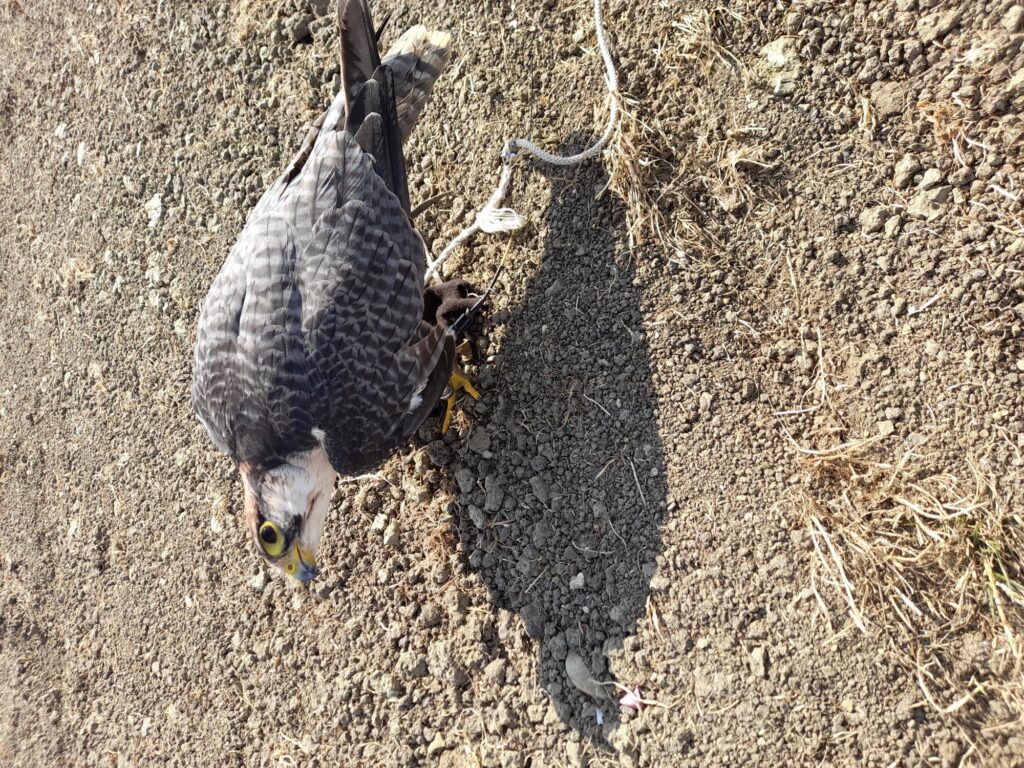
I did fly him a second time but this time the kestrel had gone up on the soar and was beyond range so to speak.
As I say in my book do not be in a hurry to lose your bird. Always check the coast is clear before you fly your bird
Hood Making
I cover the topic hoods in my book ‘Falconry – aspects of care of the trained falcon and hawk’ from the perspective of usage and problems that can crop up with birds. I also discuss the different types of hoods and touch on their construction.
Many falconers will source a hood from an equipment maker and as I say in my book buy two hoods perhaps a Dutch hood and an Anglo-Indian hood. Of course it is useful to have a spare hood but may fit better than the other. In which case if you have bought the hood from a reputable hood maker they should take it back (if not damaged) and discuss its replacement.
Of course hoods – Dutch hoods – for many years hoods were supplied by the Mollen family from The Netherlands until the mid 1930s when production stopped. Thereafter falconers would have to learn to make their own hoods. Many of the homemade hoods afterwards looked rather crude – from what I have seen – and it was not until Phillip Glasier began making his own version of the Dutch hood using a set of Mollen hood blocks that things began to look more professional.
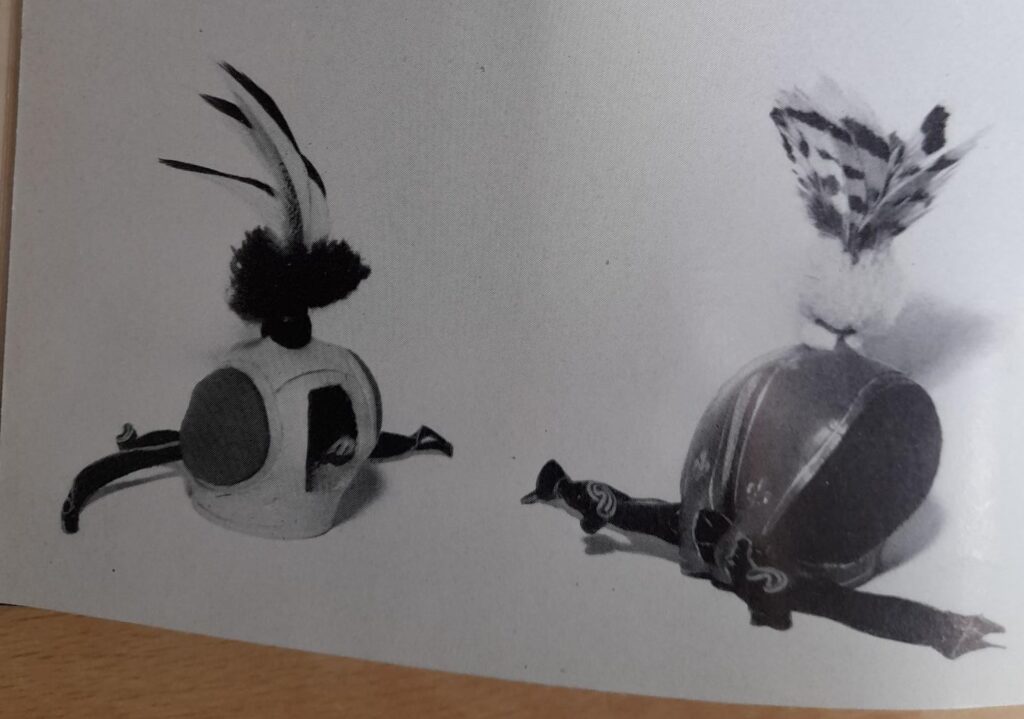
Above photo taken from the book ‘As The Falcon Her Bells’ Phillip Glasier 1963 of two Falconry Centre type hoods and they later became to be called. At the time the best hoods since the Dutch hoods.
In facts his hoods were quite ingenious in the the way there were made. They had all the qualities of the Dutch hood minus some complexities of construction. It was a hybrid hood between a Syrian hood and a Dutch hood proper. When I was an apprentice falconer at the Falconry Centre these hoods were used all the time. I remember Paul Bevan showing one that he had made. Even though they are simpler to make than the Dutch hood they are nonetheless still challenging.
The Anglo – Indian hood – another hybrid hood are relatively straight straight forward to make and usable for all birds. They are made from a single piece of leather and do not need to be blocked.
Phillip led the way but now hood making has changed again with modern modifications particularly around beak opening – more like an Anglo-Indian hood – and changes in construction technique with a generally a lighter very high quality build. Some of the modern hoods are works of art but they still have to fit well.
You can buy hoods that are made in Pakistan as cheap as chips. I am told they are made on machines – that needs to be verified – and their build quality is fantastic – but again they have to fit.
Like many falconers of old I like to make make my own hoods and I use Phillip’s patterns to make the Falconry Centre hood using my own hood block based on the Mollen design. We have to thank Phillip for providing the patterns for these hoods and guide on making them plus guides and patterns for gloves and hoods. They are used the world over. As a teacher of falconry he was second to none.
I have not made a hood for some time and I started to make one the other day. A journey of rediscovery if you like. I made a right mess of it getting the stitching tension wrong so the hood was lop sided. You can adjust when the hood is wetted and turned by stretching the one side down. But in the case the adjustment needed was too much and so I have binned it!
Here is a photograph from some time ago when I was making hood – actually that one was perfect and I use it everyday on Sprite the peregrine.
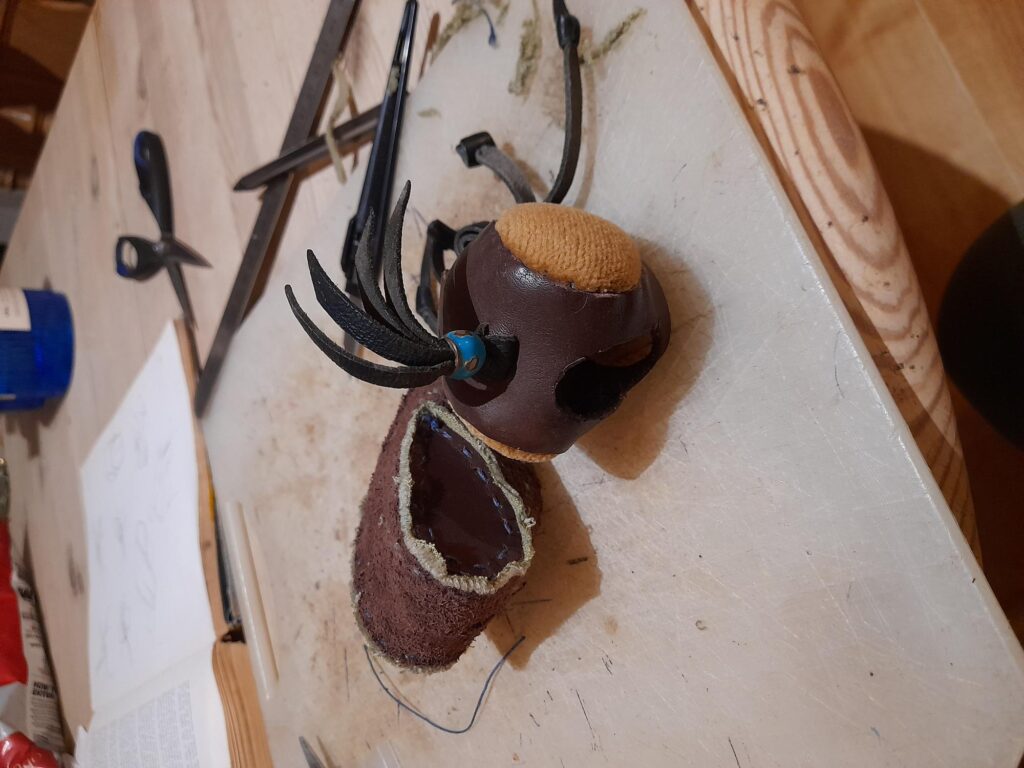
Many falconers just buy in all the kit they need but actually falconry is both an art and a craft and making your own equipment can be very much part of it.
My own book – with its own construction guide to the weathering loft with lots besides is still also very much on sale at Amazon, Coch Y Bonddu books, Waterstones and many other outlets.
Me now!
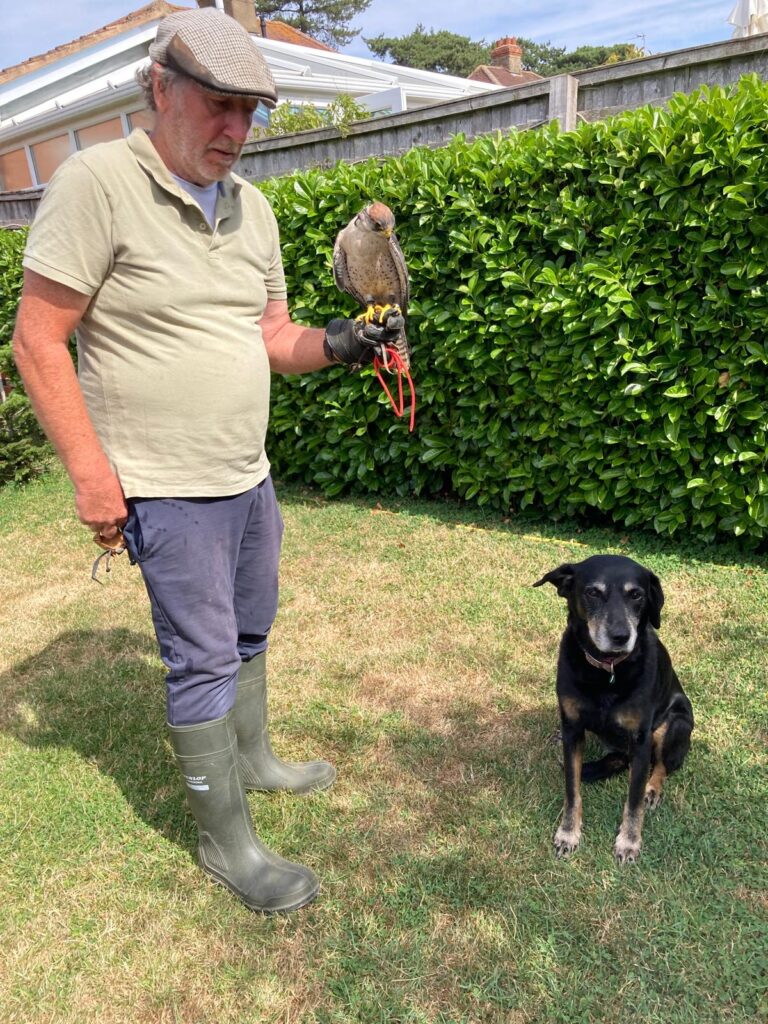
Taken the other day of an aging falconer and an old dog. The falcon is ‘Frank’ a lanneret – 7 years old -who for various reasons I kept back along with Sprite our peregrine. Frank is a typical lanner – lovely – easy to handle, hood and he flies well.
August.
Well the dry hot weather has continued into August and not since 1975 and 1976 have we had two very hot long summers back to back. In 1976 the River Severn was so low you could practically walk across it at Wainlodes in Gloucestershire. Now the water is much higher due to controlled release of water much further upstream.
Looking after animals in hot weather is always a challenge and in my book ‘Falconry – aspects of care of the trained falcon and hawk’ I have a separate section called Water (section 15) which underlines the importance of its availability at all times. It sounds like a no brainer but actually birds can exist without water – obtaining the moisture they need from their food. Nonetheless it is necessary particularly on hot days when birds can often be seen sipping from their bath water after flying and throughout the day or indeed while taking a bath.
In former times with different husbandry methods with nervous wild caught passage birds who were kept on a screen perch or when weathering out on the lawn were often too nervous to routinely hop up and down to sip from their bath water – signalling that it was not needed. We know better now. So I change the bath water every 2 days or more frequently if soiled.
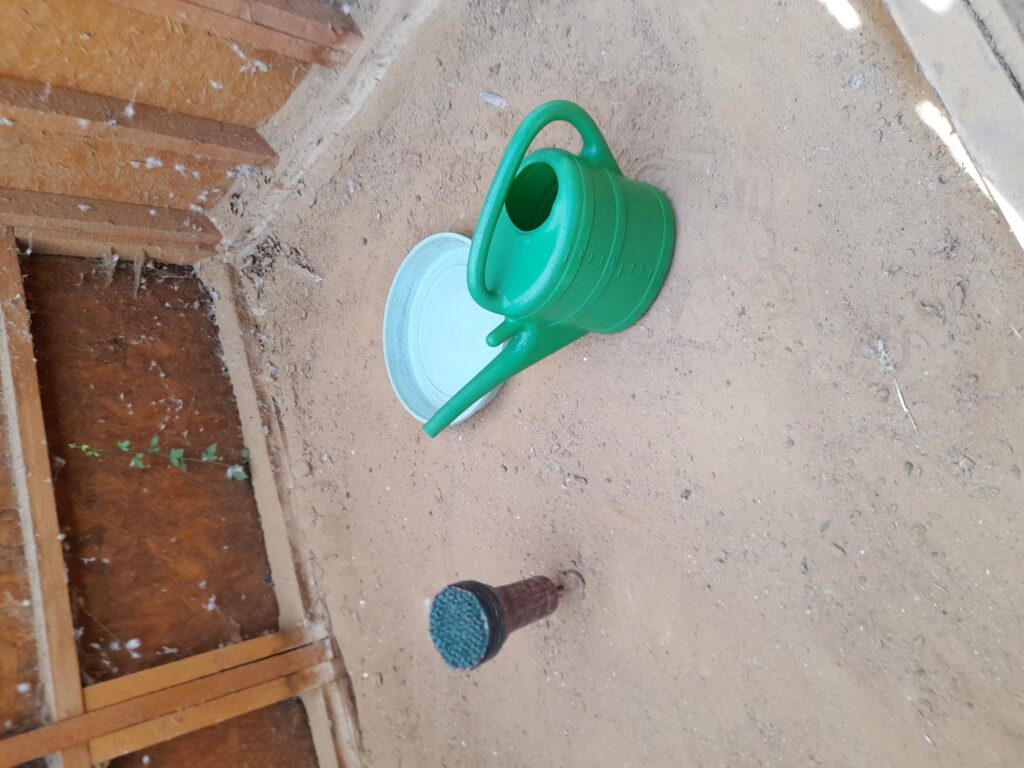

Husbandry of the trained raptor is something I discuss in great detail in my book. Indeed it prompted the section of the ‘weathering loft’ as I call it. A structure where a bird can either be tethered or free lofted. I wanted to make the point with many years of husbandry experience that many parent reared birds in flying condition unless exceptionally tame cannot be kept free lofted. They have have a habit of going wild in the loft and are practically impossible to get out of the loft for daily flying. Imprinted birds because they are imprinted on humans and very tame can in the main be kept lofted in flying condition. There is much confusion about lofting versus tethering and people postulating it should be possible for all birds. This is not so.
At other times however when the bird is not been flown – for moulting, a period of bad weather or the falconer is on holiday – then it can be safely lofted. You are not having to get it out everyday. Food can be dropped down a chute onto a feeding platform and the bird left to get on with it. The ‘Weathering Loft’ is two structures in one. Its construction is presented in my book in a step by step guide.
On to more local matters now. Since last winter – I may have mentioned it in a previous blog – I have seen on several occasions a rather ragged looking buzzard with most of its tail missing. At one point it was being chased about by other buzzards and one could speculate on what calamity had caused its feather damage. Anyway it has been quietly hanging around and has begun to moult. Each time I see it now it is looking more trim. Despite everything it managed to survive the winter and from the moulted broken tail feather – below – I can see it is young bird from last year.

I have seen the peregrine about fairly regularly – it may be more than one bird. It gets drawn at the sight of a falcon stooping to the lure and it hangs around and until it has seen enough. I have also seen a peregrine where I walk the dog always exciting to see.
Below is our peregrine Sprite on the lure after stooping to it. You can see how dry it has been this summer from the yellow grass.
