Archive for March, 2025
Flying Weights
 March 29th, 2025 |
  Author:
 One of the sections in my book ‘Falconry – aspects of care of the trained falcon and hawk’ is a diary of training Jarvis the lanneret. As I have indicated in my news blogs we left Jarvis at the end of his first year just prior to his first moult.
Since the book has been published – November 2024 – we are now at the end of season two and because Jarvis is in good feather condition I will continue to fly him through the Summer – so through the moult.
It is possible to fly a first-year falcon through the moult but generally because the transition in a bird’s plumage is so great it is worth allowing the bird to ‘get on with it’ in the comfort of a loft with plenty of food. It may be the best thing to do anyway if the feather condition of the bird is poor which can be the case in some first-year birds.
So, with Jarvis still flying I am looking forward to warmer days to see how he gets on. So far on days with a lifting breeze he is showing signs of his own style which is quite lovely to watch.
He is also beginning to show that independent streak which is associated with flying a bird in high condition. When a bird flying is well you feel you are often on the verge of losing it. Particularly if the weather is warm and your conditioning has not been accurate enough – the bird having lost the edge to its appetite. This is why we use the scales. From its weight we can gauge its appetite and from previous records predict its level of co-operation and performance when flying.
Because Jarvis is flying at about 1 pound 6 ounces which is extremely high for a lanneret. It has forced me to reconsider his sex because no lanneret flies at such a high weight. The strange thing he does look like a male but as they say the ‘scales never lie’.
I am not worried what sex he is but if you are flying a lanneret at 1.6 sooner or later the bubble will burst. His behaviour recently has suggested we are approaching that point. He is slightly more difficult to pick up in the morning – the procedure is shown in my book – and he has become more nervous a sure sign he is slightly overweight or too high.
I had a bit of a fright yesterday when flying Jarvis in great weather. He was wafted up and over a line of trees into an adjacent field. Often the first time this happens the bird is disorientated because it loses direct sight of the falconer. This can be made worst if the bird is overweight and not particularly hungry. The behaviour associated with place is suddenly gone and you find yourself in the lap of the Gods.
Jarvis not seeing me started to wander away in a kind of circling motion- all too familiar to us falconers! As it happened Jarvis cleared the tree line at a moderate height and while circling looking in my direction, I managed to get his attention by swinging the lure. He started heading back my way and I shouted Ho! And he came in and caught the lure. Crisis adverted. As I said in my book you always lose a bird when you least expect it. The ‘Ho’ shout guarantees the bird food and is an extra incentive for the bird to return.
How close I was to losing him I am not sure but sooner or later with every bird something will crop up to test you.
Today Jarvis flew without a hitch. But I am mindful that his flying weight is now too high, and I need to do something about it. Adjusting his weight down by 10 – 20 grams is what I am planning.
This is why the scales are so useful – as I have said above. The weight of the bird reflects its readiness to fly – his level of appetite. This is why record keeping is important.
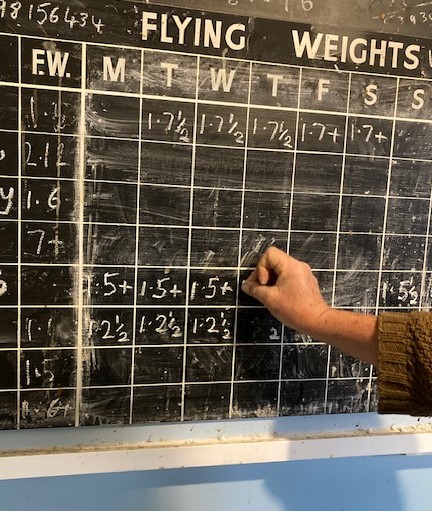
Below a week flying weights chalked up and recorded on a board in the Hawk Room.
 Posted in
‘Falconry – aspects of care of the trained falcon and hawk’ by Michael Davie
The home page on my website has now been changed to indicate that for the time being I will not be doing any falconry displays – at least for 2025. I have used the down time to write a book – ‘Falconry – aspects of care of the trained falcon and hawk’. Something that I never for one moment contemplated doing – I was just too busy with displays. Once I had decided to write the above book, I wanted to do it while I was still actively flying my remaining birds. This is so I could accurately report my technique and methods rather than do it from memory. This at least makes it a true reflection of how I do/did things.
I am pleased with the outcome – of course like all book writers I have come to realise – that we are never entirely happy with the outcome feeling perhaps that it should have been held back from publication at least for a while. I have been told that this is very common. But the functionality of my book whether it was held back 6 months or 6 years would not have changed. This I think is the important point.
While writing the book we got into the habit of recording things that I felt would be useful to show in the book. I have continued keeping a record of Jarvis the lanneret that I trained specifically for the book. He has now moulted through – the point in the book when I stopped flying him – and has been flown throughout his second winter.
Even in year two he is still vulnerable to wind tip oedema and so he was lofted and rested during a very cold patch and at other times when it has been less cold, he has been on a block perch under a heating lamp. The description is a slight misnomer because the lamp does keep the bird warm but just keeps the frost off. They are generally turned on if the temperature drops below 3C. Next winter Jarvis will be out of the danger zone for this condition but we will still loft him during cold weather.
This leads onto the ‘weathering loft’ – the structure we build in the step-by-step guide shown in the book. It can either be used as a weathering or a loft. I hope people may take inspiration from it to build it or something similar. We tried to build it in the most cost-effective way possible with materials that are commonly available – which is important.
I have cited foot care as the most important chapter in the book. Regular checking of the feet is so important with the coping of talons – taking their needle sharpness off – to prevent bumble foot.
Also, beak care is important, and has its own section. The peregrines beak we coped in the book has largely kept it shape since that time. The tip of the beak was shortened when he came out of the loft after having the summer off to moult but the notch in the upper mandible was pretty much as we had left it. We took a photo of his beak this morning to show this. This is ‘Sprite’ by the way with a full crop after been flown.
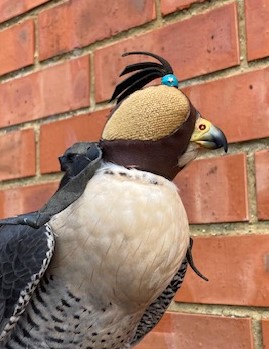
Warm Spring Day – Jarvis the lanneret again.
It is a wonderful day. The sort of weather you dream about during the winter which has been long, wet, cloudy and cold. But with a sudden onset of warm weather dangers abound if you are flying birds of prey.
I discuss in my book ‘Falconry – aspects of care of the trained falcon and hawk’ that a sudden overnight change in weather can affect the birds conditioning. It means simply in warm weather the bird losing its appetite with the potential to wander off or disappear on a thermal.
As a professional demonstration falconer – in the past tense – I have had cases during a three-day event where the first day was very cold – the birds having their normal ration – and overnight the weather changing to hot. I lost a peregrine at Blenheim Palace in just such conditions – he went up enjoying the weather and drifted away. For many years afterwards people kept coming up to remind me of it! He was found a week later 11 miles away – his transmitter had run down but he had an ID tag with my telephone number. I have mentioned in the book that these plastic ID tags are so useful.
I noticed today when I picked up my current birds in training to put them in the van ready to be flown that that the cheery open winged expectation particularly with Jarvis was not quite there.
This was confirmed on the weighing scales – his weight was up – which told me that I would need to reduce his ration – slightly – to compensate for the warm weather. He flew very nicely – a lot of this would be habituated behaviour which could easily be broken because he is in high condition. Apart from being slightly difficult to hood after flying – another sign his condition was up – everything went well. But the warning signs are there and if I do not want to lose Jarvis then I need to do something about it.
In fact, a friend of mine today phoned up and said his Harris hawk was acting rather independently and showing signs of wandering off. Showing that the warm weather had probably pushed her condition up too – like Jarvis. She had lost the edge to her appetite. Of course, older birds naturally come into breeding condition at this time of year and this is another factor. His hawk is featured in my book.
We learn from our mistakes but ‘A stitch in time saves nine’ and in this case never is statement more true. Of course, it is a good idea to keep an eye on the weather forecast and try to plan ahead.
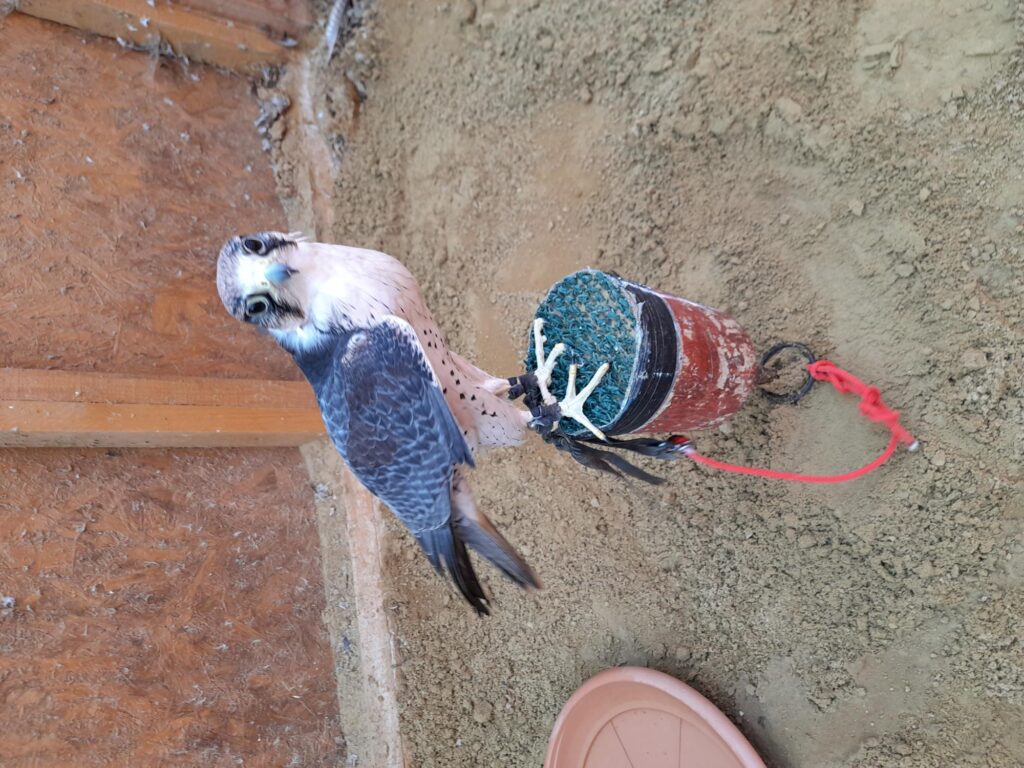
I will sign off with a picture of Jarvis after flying – back at home – thankfully!
Peregrines.
I read with some alarm that wild peregrine ′numbers have significantly dropped in certain areas – globally. The last catastrophe that peregrines faced in the past was the wide spread post war usage of DDT to improve crop yields by protecting them from pests. Thankfully since the ban peregrine numbers have bounced back and along with their ancestral coastal haunts they have become a familiar urban dweller nesting on high buildings – inland cliffs – with plenty of feral pigeons to catch down below.
The key word here is their coastal haunts because these seem to be the places where peregrines have recently disappeared. There are always local reasons why certain pairs are absent but the general decline requires a wider explanation.
It seems that avian flu may well be responsible as coastal peregrines predate seabirds who are particular vulnerable to this disease and likely to pass it on if they are predated by peregrines.
This means that urban peregrines may be important in repopulating coastal sites – rather than the other way around which has been the traditional arrangement.
Peregrines after DDT were captive bred and released using the falconry technique of hacking in North America. Who knows this expertise of breeding and ‘hacking back’ may be needed in the future again. One of course hopes not. Wild birds may slowly become immune to this condition – it has become so widespread that this may happen. Those survivors pass on their immunity to their offspring. Sea bird communities reportedly have bounced back after heavy loses to the condition. But raptors are particularly vulnerable at the top of the food chain.
At home we take special measures against bird flu including foot dips and keeping wild birds away from where the falcons are housed. This is difficult with free range poultry. Raptor husbandry of course is different but precautions are still required. Vaccination of poultry is something that is now being considered. Zoo birds can be vaccinated. This is becoming an important topic because bird flu is beginning to jump the species barrier. This has happened in America with bird flu crossing over into in diary cattle. Which is very worrying.
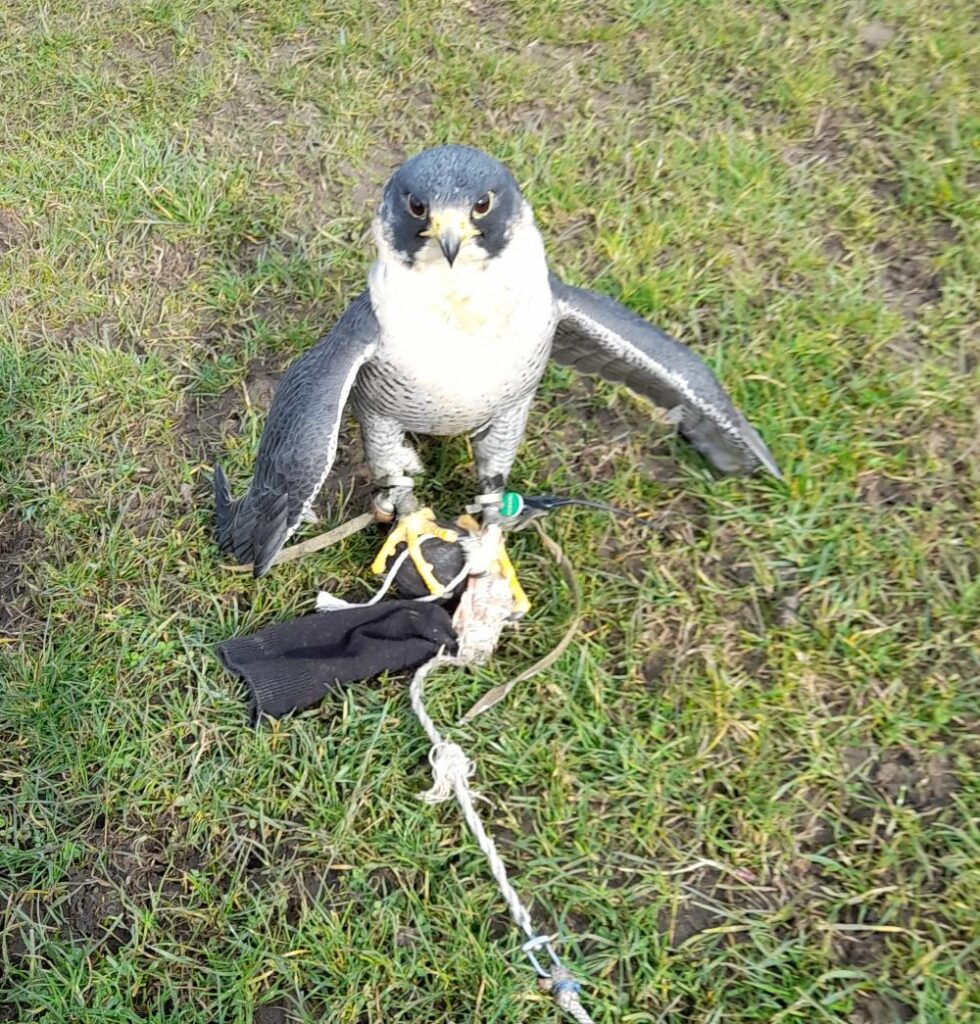
Our own peregrine ‘Sprite’ is well and continues to be flown everyday. He was going to another falconer – as I have explained elsewhere – but it fell through and he remains with us. He is featured in my book ‘Falconry – aspects of care of the trained falcon and hawk’. He is a big personality!
Here is a recent photograph of him sitting on the sock lure after catching it.
Out with the dog.
This morning after a wonderful weekend – warm and Spring like we are back to cloud and rain. It was an on balance decision whether I would fly the birds this morning – it began to rain more heavily and so I gave them a day off. In the the wild they would sit bad weather out – this can affect young birds starting out particularly in the autumn,
The birds themselves are quite pragmatic about it – as long as they are fed. With dogs they expect to go out ‘come what may’.
I cover dogs in my book ‘Falconry – aspects of care of the trained falcon and hawk’ but only from the importance of getting bird and dog each used to the other – in particular Harris hawks. My mate Graham Watkins of ‘Gamegoer Gundogs’ kindly wrote the foreword to my book. He is the expert! but I think it was useful to have somebody from a different discipline but in a similar field to write my foreword – he has seen me at many events over the last 30 years. I was very happy when Graham agreed to do it.
Talking of my book I had a nice review on the Waterstones website from a buyer of my book.
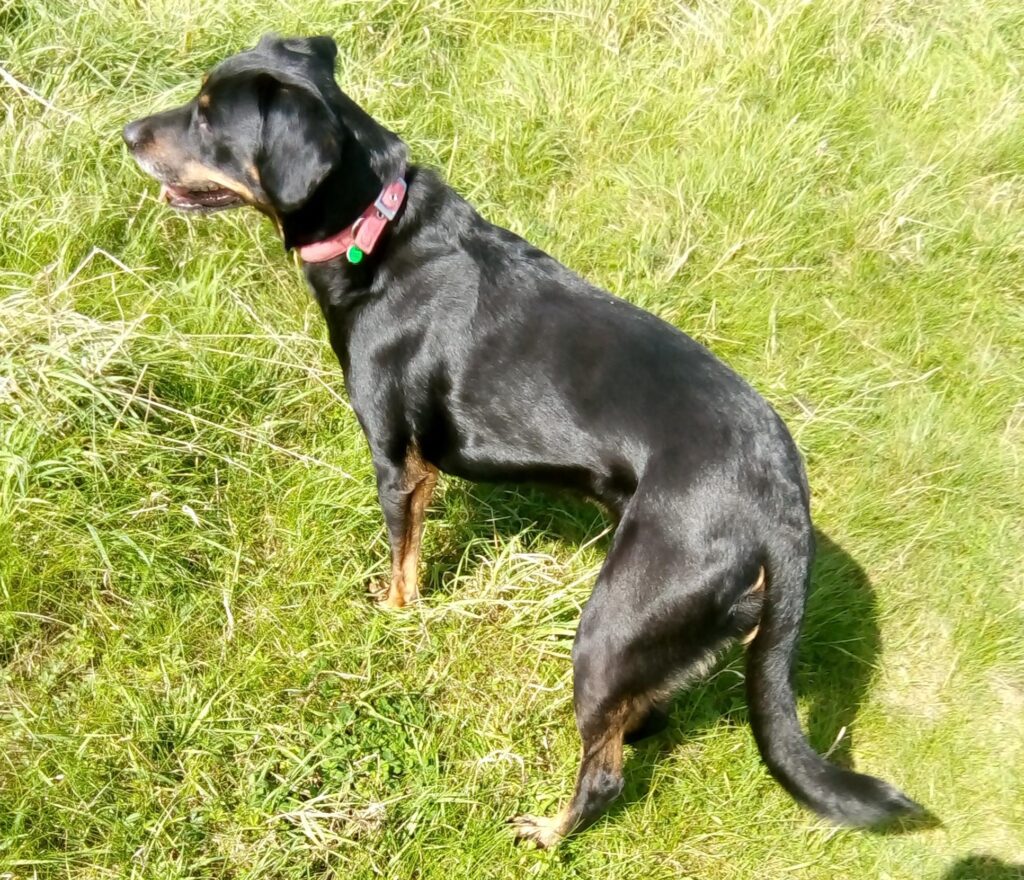
I will sign off this news blog with a picture of Grace taken some time ago when the sun was shining!. She has the most superb coat.
Sparrowhawks, kestrels and buzzards.
Where I walk my dog, I saw in the same field yesterday (5th March 2025) a Sparrowhawk hunting and landing briefly in a tree, a kestrel hovering – my favourite bird of prey and a buzzard circling.
This is the time of year when birds are pairing up or are seen to be pairing. I once watched a Sparrowhawks nest, and they were already paired up in late January – so what we are seeing now is a confirmation of a process that has already happened. The warmer weather providing plenty of lift encouraging birds to circle and display spurred on by raging hormones.
Buzzards were rare in the 1970s at least around here. The only one flying was a trained one owned by me. A very thin young wild buzzard had been given to me to look after by the then Falconry Centre. It had been picked up by a local farmer. It would not have survived had it been left..
Anyway, I had ‘Ted’ as I called him for 3 years. I have written about him in a previous blog posting.
I managed to get him hunting – which is no mean feat with a passage buzzard – and after 3 years and a lot of fun I released him in a good spot knowing he could care for himself. Job done if you like. Many years later I picked up another buzzard that had run out of steam right at the end of winter during a late cold snap of weather. He had survived up to that point and I ‘fed up’ for 6 weeks and then with the warmer weather of Spring I released him close to where I found him. In fact George as he became known is shown in my book ‘Falconry – aspects of care of the trained falcon and hawk’ by me Michael Davie just before I released him.
I will sign with a picture of a wild kestrel hovering. They are such wonderful birds.

March 1st – hooray! Weathering loft update.
It is such a lovely morning blue sky, still and with life stirring all around. It does quicken the pulses.
The construction of the weathering loft as I call it takes up a quarter of my entire book ‘Falconry – aspects of care of the trained falcon and hawk’.
In having a dual-purpose function, it gives the falconer flexibility in bird management. I have tried to make it in a cost-effective way using materials that are widely available. The drawings reflect the use of 2.4m and 3m lengths of 63mm x 38mm timber though out the structure. This is for simplicity. The aim is to encourage people to make the structure – to lift it off the pages and make it a reality.
As I have said different materials may be used in its construction or the weathering loft can be a different size if required. This is all possible with the modular design. In the book there is a method of how to calculate footing size for different sized structures. Also, the same regarding the number of roofing sheets. The step-by-step guide shows the construction pathway from footings – spade in the ground -to the finished weathering loft.
Originally, I was going to show pictures of an existing loft with ‘drawings included’ that I have used for various birds over the years. But I thought well lets just make one – which is what we did. The weather was kind to us during construction. I operated my usual construction method of doing about one hour per day. As my old joinery boss would say it is amazing what you can do in an hour. Without a workshop weather is a key factor and I would advise anyone making the structure to give themselves plenty of time to build it.
As I say in the book the weathering loft is to accommodate a long-lived falcon or hawk and to offer all its needs in the trained environment. The maintenance of the structure is very important and should be done as you go along.
The loft or ‘small weathering loft’ in the book was made to fit into a space and was planned to house a lanneret called ‘Frank’. He is featured in the book. I have used this structure both as a weathering and a loft for Frank. So, its dual-purpose role has been very useful. A lot of Harris hawks can be permanently lofted and after initial training the bird will be loose in the loft all year round. But the weathering if needed is there.
Like building a house once the weathering loft walls are up and the roof is on – it looks finished but sadly the second fix is yet to start and can take just as long. Second fix for the ‘weathering loft’ are the main door, shutter doors, hatch door and then the vertical bamboo slats for the windows, netting behind the shutter doors and then the perching, food platform and chute. Not forgetting the double door entry enclosure.
I have used astroturf to cover all the perches. This not only displaces the weight of the bird through its toes – to prevent bumblefoot – but also to cushion the bird on landing after short flights in the loft.
So, there is a lot to do but it does add to the excitement of getting a bird. The standard weathering loft as I call it is sized for a medium medium sized raptor. I mentioned in an earlier news blog that we had a wild buzzard on rehab for six weeks in a standard loft and it was fine. Amazingly it learned to use the space well. When released it was in perfect condition. I was very happy about that.
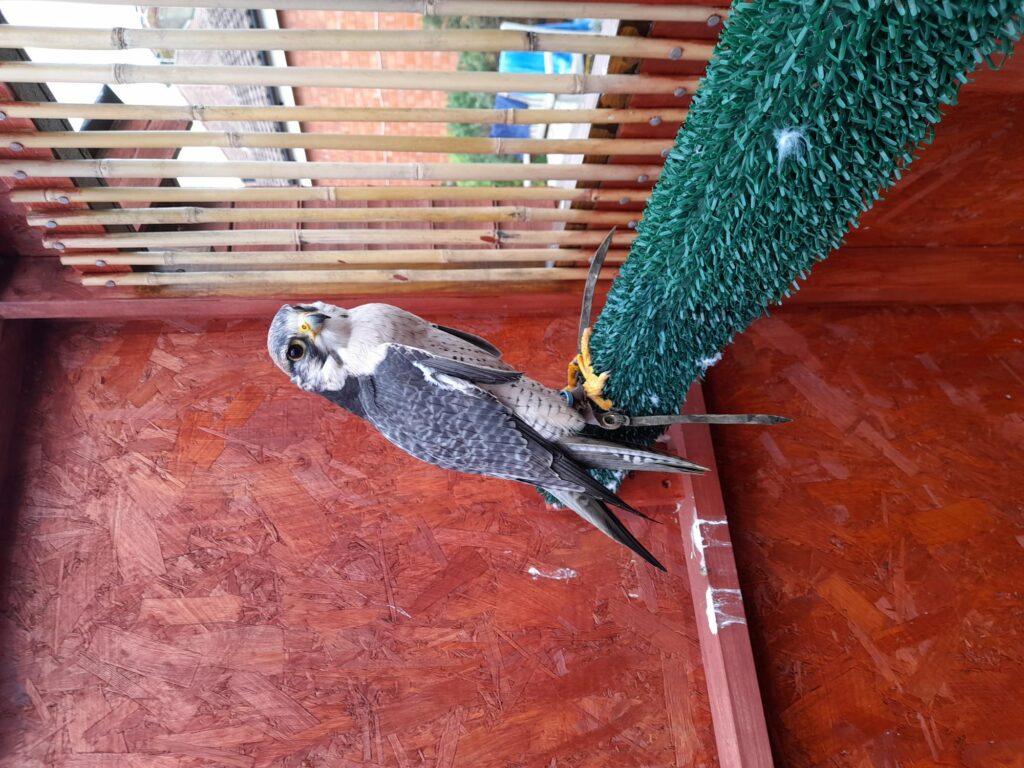
Below is a picture of the weathering loft in loft mode with the shutter doors closed.

Frank below looking out of the loft window. Note the astroturf covering on the perch and also his permanent flying jesses with no slots at the end for the attachment of the swivel These permanent flying jesses are a kind of new invention but ever so so useful when getting the bird out of the loft and when flying the bird.