Looking Back
 July 17th, 2026 |
  Author:
Found this photo on my wife’s desk of me – looking a lot younger! from some time ago in the 90s at an event for ‘Calor Gas ‘- their balloon is in the background.
Duke is sitting on my fist – on of my own gloves (very much a thing of the past!) – looking pretty cool. He was falcon of a lifetime – as I have said before – no bird of mine has ever come close to matching him. A lot of falcons would not like a balloon swirling around in the background with the whooshing sounds of hot air rushing in to inflate the balloon. For Duke he would circle the balloon and use its lift off the top to get additional height!
I do remember this day for another reason my other falcon Peggy – another great flier – decided to disappear and I found her a couple of hours later – using my telemetry – on a Moorhen she had caught. On her day she was a deadly falcon and nothing was beyond her powers – she was great fun – but as the years passed she became less reliable as a demo falcon. But she was so popular with clients for her waiting and stooping flight which was incredible. I was repeatedly asked if was she coming to their next event. She lived to 25 years the last few in retirement with Tizzy Hodson of Tiger airways – who flew her everyday around Staverton Airport.
Also at the Calor Gas event that day was John Whiteley’s Sheep Dog display. We both won arena awards at the ‘Showmans Show’ one year. We got to know many performers on our travels and we were always to happy to meet up and exchange news. Long may it continue. We need young people to come into these activities and take them forward. Nothing can beat training a falcon or dog or to go fishing – they are a good way to help with mental health issues and to connect with nature and wildlife in a different way to just watching it.
Normally I do not remember events having done so many but this one did. No idea who took the photo.
I continue to fly the two falcon here everyday. The lanneret ‘Frank’ is so stylish but our Peregrine ‘Sprite’ has not been flying too great. He is not so good in a stiff breeze surprisingly because peregrines with their extra power usually are. I felt his weight has dropped too low and he was weak in flight. This weight loss or conditioning adjustment was intentional as I was experimenting to try and get the ‘best’ out of him. I had tried this when I was working with pretty much the same results. So for him to fly well he needs to be flown in high condition and so I have started pushing his weight up again. This is 20 grams either way – has I said in my book ‘Falconry – aspects of care of the trained falcon and hawk’ subtle changes of condition can make all the difference. It can bring on the hunting condition in a bird that is not chasing or conversely rein in a hawk that is self hunting with the falconer becoming a passenger while chasing the bird about.
 Posted in
St.Davids
We have a wonderful holiday break at St.Davids, Wales during the recent very hot spell. Luckily for us it was cooler on the Pembrokeshire coast and we really enjoyed our few days exploring the area. In the evenings we would wander down to the Cathedral to sit on one of the benches that over looked it and sat in the evening sun watching the swifts chasing each other about. Something heard less and less now in other parts of the UK. Here is a picture of that scene.

Our two falcons left at home were looked after by our son including caring for the dog. She spent most of the time lying on the tiled floor trying to keep cool.
Both the falcons Frank the lanneret and Sprite the peregrine were lofted – making them so much easier to look after by the non specialist carer. Much of my book ‘Falconry – aspects of care of the trained falcon and hawk’ is about the flexibility of the loft and its construction and lots else besides including looking after birds in hot weather.
The weathering loft is a 2 for 1 structure. I have always had a very collegiate approach to falconry and so nothing I say is prescriptive in the book. It is just my take on how I have done things over the years with much repetition and refinement of technique and husbandry. The book is for sale pretty much everywhere Amazon, Waterstones and Coch y bonddu books.
I will sign off for now.
Wild peregrine waiting on.
3 news blogs in a week – it must be a record!
I got back from walking the dog and the weather – thankfully is much improved – warm but windy.
As I went into the hawk room from outside I looked up and saw the distinctive black anchor shape (Baker) of a tiercel peregrine holding itself against the wind at about 300ft.
I watched it expecting it to speed away but remarkedly it circled the area for the next 10 minutes. It kept coming back over – dropping it legs to lose height – clearly looking for something. My own falcons were calling to it from their weatherings.
As a falconer I assume it had seen something go into cover – and was quartering back and forth to see if it would reappear. Even though it was windy at no time did it attempt to hover like a kestrel – something Baker in his book ‘The Peregrine’ – in my opinion got wrong.
Rather it was waiting on – at a typical peregrine height. Bakers peregrines were far too terrestrial in my opinion.
Trained peregrines can be trained to wait on for game hawking – for grouse or partridge – normally over a dog. In my book ‘Falconry – aspects of care of the trained falcon and hawk’ I talk about teaching a falcon that ‘stoops to the lure’ to also ‘wait on’. This gives variety to whole process and allows you to spend more time flying a falcon. As I say this is distinct from training a game hawk which are not stooped to the lure but taught to circle and climb from the word go.
‘Peggy’ my Lanner-lugger would do everything well including to waiting on. She is featured in my book in the section on the development of the falcon.
Anyway here is a picture of the peregrine above the house – we live in an urban area now and the peregrine clearly does not mind as long as there is prey in the area. Spot the falcon! it was taken on my mobile phone.

Rain.
Well it is not ‘nose’ pressed up against the window time waiting for the rain to stop because this morning it is set in. Pretty miserable for June. I think of those late nesting birds like Sparrowhawks with recently hatched chicks getting wet.
So today for us I have fed the two falcons in the hawk room – it allows me to have some contact with them – feed enough to keep them in flying condition which is more like a winter ration at the moment because it is so cold and then hope for better weather tomorrow.
Sadly my latest flying field is under threat of imminent development – now in train with trenching. I am going to have restricted access to the ground in the short term and no access in the medium to long term. It is such a shame that a sports field used by the community far and wide is going to be ripped up for development – how is that possible? it follows a long line of development in our area and I have lost several places where I fly the birds to development and so now again I must find somewhere new.
I have continued to fly birds – which I still enjoy – and of course I have my book ‘Falconry – aspects of care of the trained falcon and hawk’ which because I continue to have birds I often think about. One is always learning and I ask myself if I would make any changes to the book.. Of course the answer is yes but only small ones. I am very proud of the book as it reflects my working knowledge and life as a professional falconer – which I hope others find valuable.
At some point this morning the rain will ease and I can take the dog out.
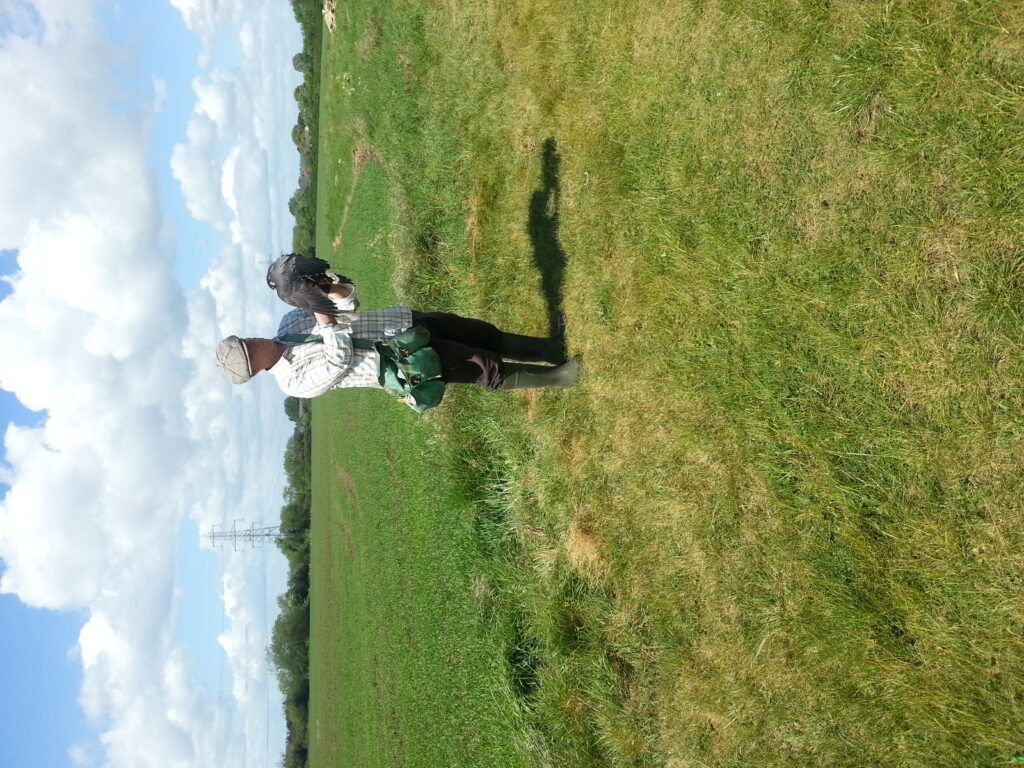
I will sign off with a picture of me I think with Sprite our peregrine taken down at the Knoll some years ago – which was a beautiful strip of grassland – and only 200 yards from home! sadly it has now gone with the building of 460 houses.
Worcester
We had a trip to Worcester on Saturday to see the John Singer Sergeant exhibition – his association and friendship with other artists in the area. We really enjoyed it – not too big – an hour of intensive viewing and reading. What a brilliant artist! then a bacon sandwich and then a good look round at the other exhibits – very interesting – and then we made our way to the cathedral.
It was raining quite hard and it vindicated not taking the sports car – that we are looking after – it is 36 years old and does not like the rain. We decided to take a tour of the cathedral which was so interesting. It reminded me of the book ‘The Pillars of the Earth’ by Ken Follet that I am currently reading. I noticed on looking up on the way in the shape of a peregrine falcon sitting up high on the tower – huddled like a little old man in the rain. At the end of our tour in the herb garden the sun was out and as I looked up a peregrine flew over head.
Worcester was a lovely city – never been there before – with the river, the race course and some lovely railway arches with many house martins hawking insects. It was race day and place was really vibrant despite the weather. In fact it helped because some race goers decided to stay in town and watch the racing from the various bars. It was Ladies day and the place was very colourful.
On our way home we went past the cathedral and Patricia took a short film on her phone of two peregrines chasing each other around. The female telling the male that the rain had stopped and to go hunting! Here is a still from the movie. The two dots upper centre right are the falcons! Subsequent to this posting I learnt that the falcons nested on a nearby Church and then returned to the Cathedral – where they had nested last year – once the chicks had fledged. This means that the two falcons in the picture could well have been youngsters having fun and chasing each other about.

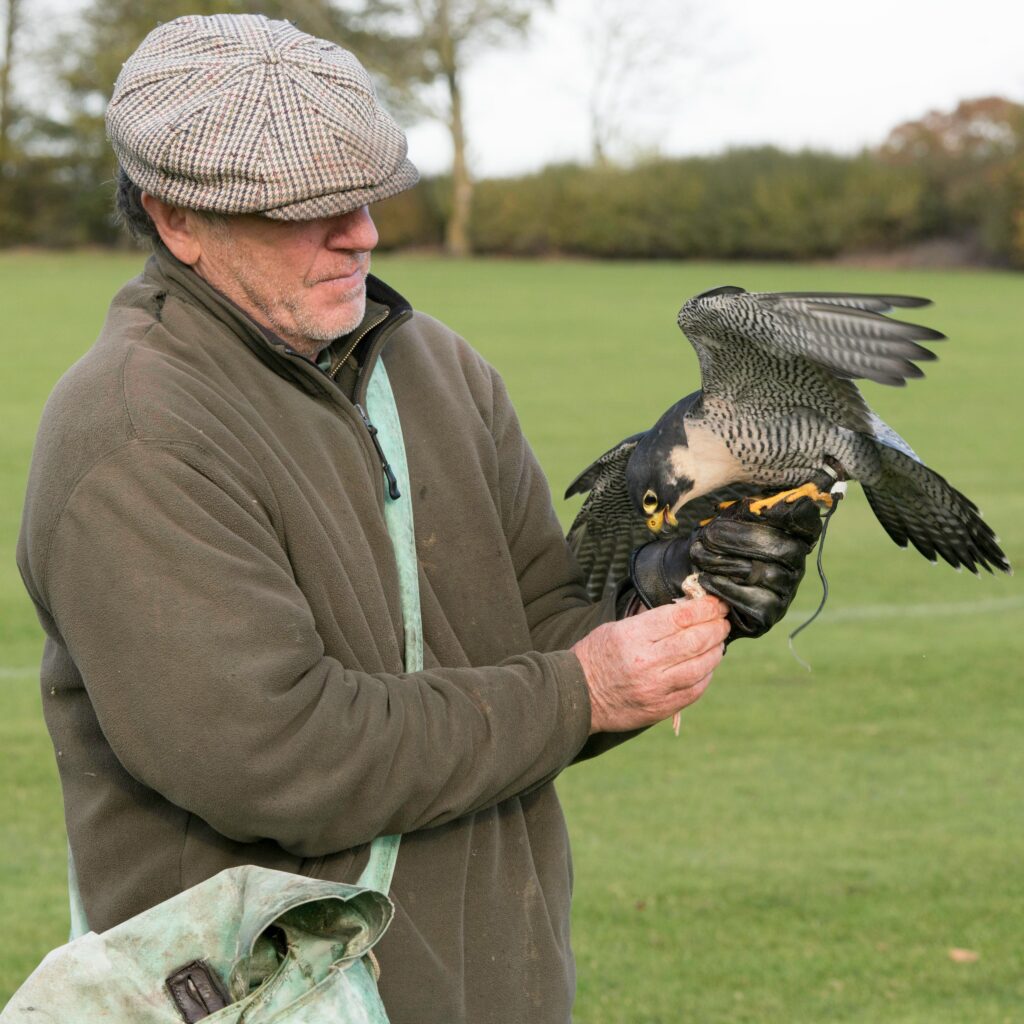
And here is our own trained peregrine ‘Sprite’ taken after flying. He is peering down at the meat on my glove. As I say in book ‘Falconry – aspects of care of the trained falcon and hawk’ it is important that the hawk or falcon feeds properly on the fist – sitting the right way round and not snatching or trying to rob the fist of food.
Bo
It has taken me a while to get over the passing of Bo our Indian Eagle Owl who we had for 38 years. A passing of an era – I thought at one moment she may outlive me. But her absence has left a big hole.
She was the most amazing demo bird and once I had got the hang of flying an owl – it took me several seasons – she went from strength to strength. Owls are not like hawks and falcons – they need a different method of training and I often used to say to guests that they are tamed rather than trained.
It is not quite true because food still has to be the motivation for them to do anything but since they are hand reared or imprinted from a young age they are excessively tame seeing their human companion almost as a parent.
They are sensitive to loud sounds – they have excellent hearing and with both eyes facing forward – in the facial disc – they have little peripheral vision and can panic on hearing on hearing a loud noise like a motorbike.
So introduction to shows is a slow and gentle process and building up to flying at a show takes time. Bo was coming to shows to sit on or in her canvas t-pee long before I started flying her.
But once I had the confidence she was flown almost everywhere and was always centre stage – people love owls. She would also chase the dummy rabbit. I wanted people to see owls as highly evolved hunters and not just as a cuddly toy.
She is in my book ‘Falconry – aspects of care…’ on the section on casting – not quite in keeping with the title but nonetheless useful to show that particular hold in the absence of an available Harris hawk.
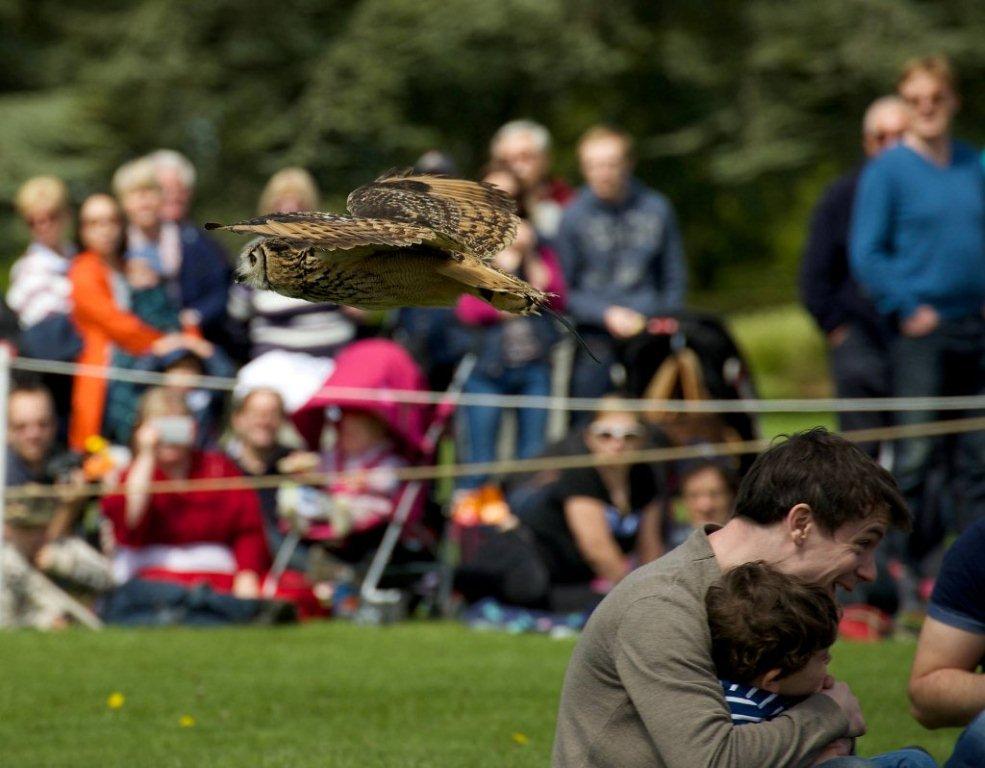
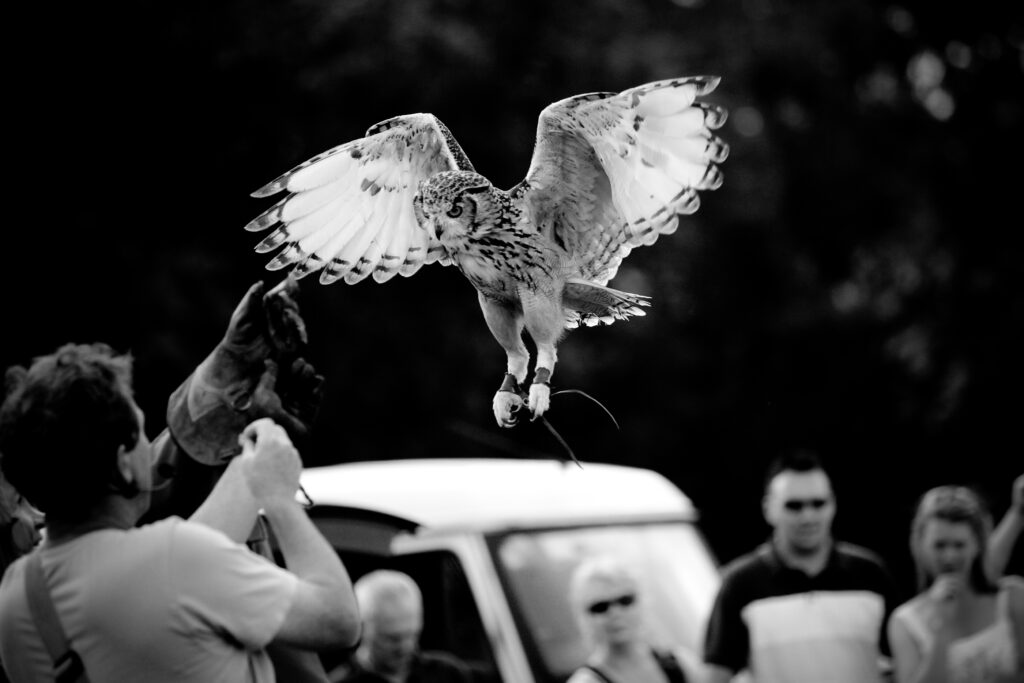
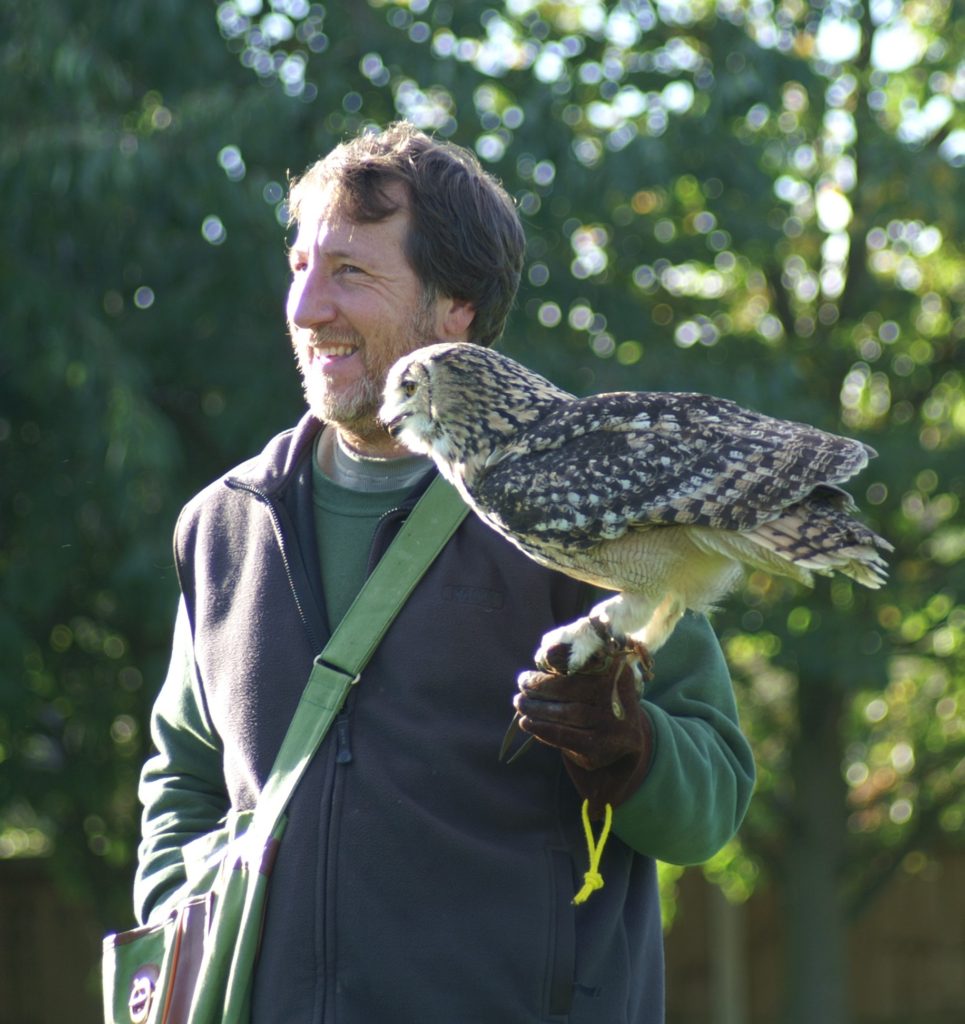
Here are some picture of Bo from down the years.
At Blenheim
At an Army fun Day. Bo sitting relaxed in her t-pee

At a wedding – flying to a guest.
At home with me – many years ago!
June
Well June is here and I hear myself saying do not wish away May – we will have to wait another year for it to return. It is, however, the best month of the year along with the last two weeks of April. The weather in the last part of May has been very warm and for those that like the heat – just great!
Finally the House Martins have turned up and there are now several pairs in the village – in their usual spots. This is good news because I was lamenting their absence in an earlier blog. I counted 9 swifts the other night flying around the village – which again is good news and a wonderful watch.
Both the falcons are flying well. It looks like we are about to lose another flying ground to development – which is such a shame as it is a loss of a green community space absolutely packed with wildlife. Lets hope the pressure group – that is to be formed – can have some effect on the planning outcome of this valuable space. The thought of football pitches being dug up for an industrial park is unbearable and unacceptable.
In this green space this morning we saw our first Hobby of the year. Frank the lanneret was on the lure and he started calling looking skyward. Initially I could see nothing. I thought it was either a kestrel or a peregrine – more likely the later but I was delighted to see – after a while – the distinctive shape of a hobby. I left Frank on the lure hoping it would draw the hobby in. It came over our heads and suddenly closed up and with great pace stooped at some swallows hawking insects along a high hedge. It was so exciting. Seconds later the hobby appeared empty footed – I have yet to see a hobby catch a swallow – after having seen several attempts – but they must be able to do it.
The hobby disappeared to continue hunting no doubt – hopefully we will see again it over the summer. A few minutes later a male Sparrowhawk appeared carrying prey – it made its way – straight lining it – to some distant nest to present it to the female.
It reflects a busy time of year. Last night from our front room we saw a peregrine – a male or tiercel – carrying heavy quarry into a stiff breeze – again on a journey to a distant nest site. He was flapping wildly under the burden but still making headway. It may have been a pigeon.
Our own falcons Sprite and Frank are both flying well. Both are featured in my book ‘Falconry – aspects of care of the trained falcon and hawk’ which is available at all good outlets including Waterstones, Amazon and Coch-Y-Bonddu books. I am honoured by those people who have bought the book and I hope they have found it useful in the daily care, training and housing of their birds.
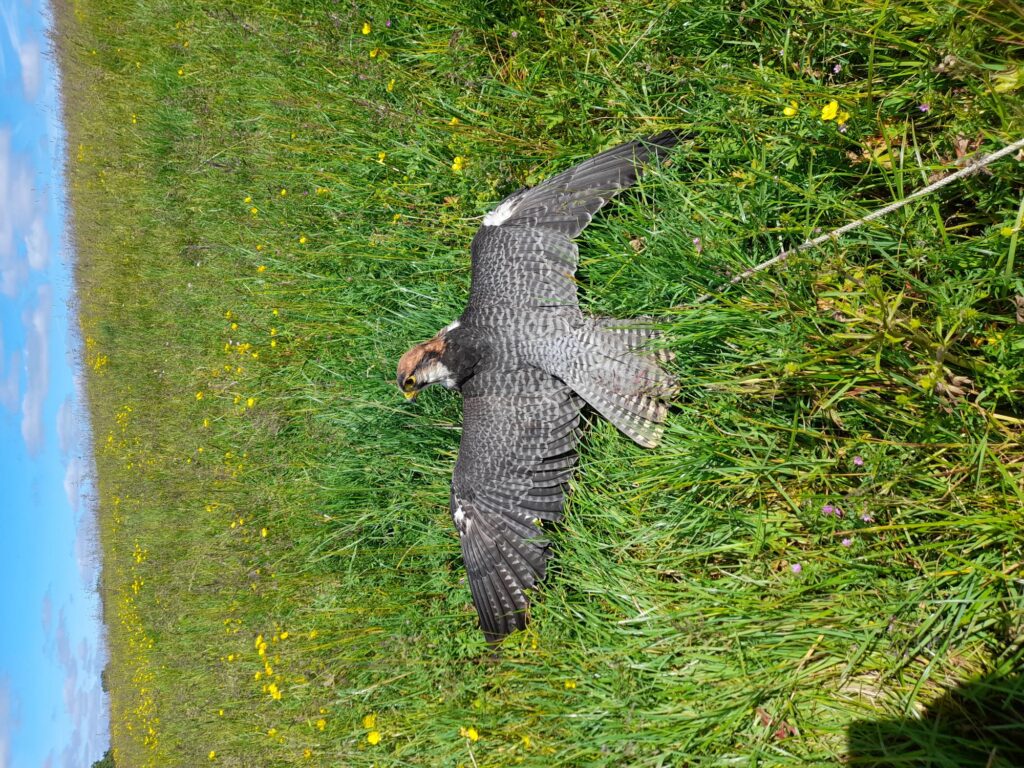
I sign off with a picture of Frank on the lure on a lovely sloping meadow.
The last of the 4 Amigos ‘Bo’.
It is with sadness that I report the passing peacefully of our old Eagle Owl ‘Bo’ who was 38 years old.
She was held in such reverence in the family as she predates my marriage and my children – she has always been there.
She was a wonderful flier and will always be remembered in the arena at Blenheim Palace gliding over the heads of children sitting on each side of the jousting rail. A flight of some 50 yards. It was difficult with children running everywhere! after being sent into the arena by their parents – but it was worth it.
Bo was flown almost everywhere and did many many corporate days and even more at Thornbury Castle Hotel – for guests – which was like a second home to her. She would gladly fly to any body and so was a wonderful asset to have. She did her share of weddings as the ring bearer and particularly memorable was her flight in St Mary’s Church, Thornbury where she flew from a release box down the long aisle and up onto a stage at the end to my fist carrying a ring. It was a vowel renewal for a Canadian Couple and complete surprise for the wife and their children!
She was one of my earliest birds and I bought her from Langley Mill, Nottingham in 1988 with my late brother Tim who drove me up in his mini. I flew Bo right up until 2022 when her powers began to fail – her last 4 years she spent at home in her aviary. She was still laying an egg or two every Spring until a couple of years ago.
She as the title suggests was the last of the 4 Amigos with Peggy a ‘lanner-lugger falcon’ Duke a lanneret and Red a Harris hawk all living into their twenties. They were a superb team and were strengthened a few years later with Waqar a male lugger falcon and together we did many hundreds of events across the whole of the UK.
Bo was a wonderful bird and already much missed. Here she is flying at Blenheim Palace in her prime.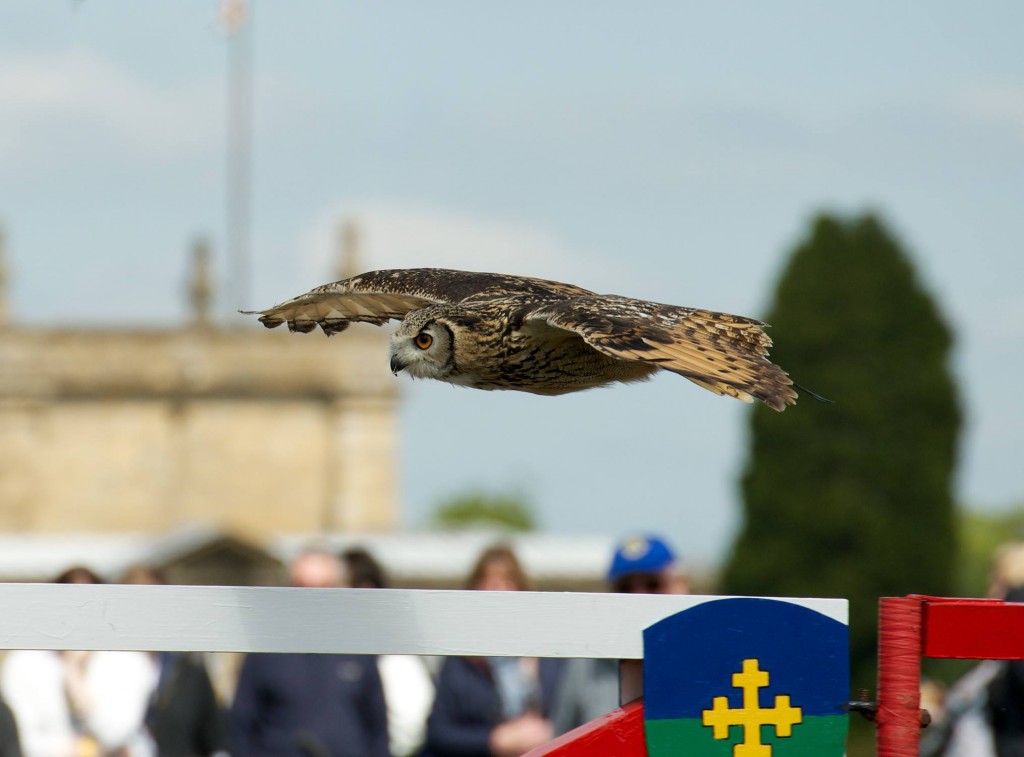
And a picture of her beautiful face.

Wild Peregrine
I have been fretting about the lack of House martins and swifts this year. Only having seen one House martin so far. It is a worry – I forlornly hope they are late back. It is almost the same for swifts although they are always the last to arrive.
Swinging back round to falconry Sprite our peregrine falcon excelled himself today and flew really well – wind was just perfect for him. After he had caught the lure I noticed him looking skywards – looking in the same direction I noticed a wild peregrine coming towards us – having been drawn in by a fellow member of the brethren stooping to the lure. The wild falcon got quite close and slowed right up to almost a standstill by dropping his legs – to act as an additional brake. He stayed around for about 10 minutes which was wonderful to see and slowly slid away to carry on hunting.
I mention this is my book ‘Falconry – aspects of care of the trained falcon and hawk’ where wild falcons can often be quite curious. I also say I have never had one join in and stoop to the lure! Most instances pass off without incident but the falconer must have the mindset to call the bird down – just in case.
Changing the subject. Earlier in the week I was asked to help a friend with his Harris hawk. Apparently the bird – an adult female – had been scratching with its talon the underside of its beak – the chin and neck area – and had removed quite a lot of small feathers. The area also extended to the area above the beak and onto the head.
Harris hawks – again a topic in my book- can do some very odd things – including feather plucking. This including the above can be included in the list of perplexing problems.
I coped its beak and feet and looked for mites while the bird was cast- another possibility – and then sprayed the bird with Johnsons anti mite spray for mites and other parasites.
It is important if this is a behavioural problem to change the management of the bird to jolt it out of its behaviour. To this end my friend has put the hawk back onto a bow perch and during the day it is brought out into the garden for a complete change of scenery and placed on a high ring perch. I also advised a change of diet in the sense that if you are feeding rats and quail you do not need a vitamin supplement and I would go as far to suggest to reduce the richness of the food when the bird is being rested and for a while feed only deyolked day old chicks. This can help to reduce the octane in the bird. Of course if a Harris hawk is in good feather there is no reason not to fly it all year round.
It is early days – too soon to say – lets hope it helps with a change of manage and spraying for parasites.
The next step would be a veterinary visit and have a scrape taken to check for a fungal condition or something else.
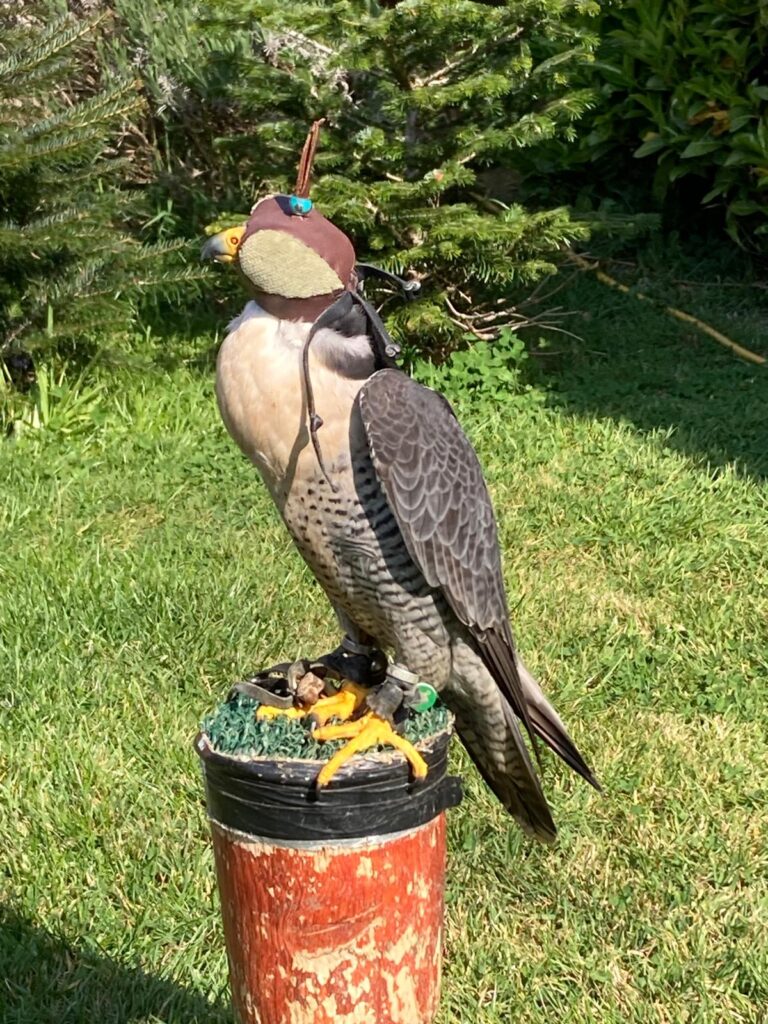
On a lighter note here is a picture of Sprite when I first got him in early 2015. He came from another falconer who had partially trained him. First year birds were called ‘red hawks’ by trappers in bygone days – you can see from his colouration why. Of course Sprite is a captive bred falcon
May.
Well May has arrived and the first half at least are the best 2 weeks of the year. I saw a party of 4 swifts yesterday – on their way to somewhere – it was wonderful to see them. In the evening we took the ‘on loan’ sports car down to Wainlodes on the River Severn and were delighted to see so many Sand Martins.
In fact a couple of years ago a pair nested in the lock gates where the River Chelt enters the main river. Today I saw our first House Martins of the year back in the village. They nest under the eves of the village pub. Their – sadly – numbers have greatly diminished over the years and to see that they have returned for another year is uplifting. It is lack of insects which I feel is their main problem – we can help with nesting sites but the lack of insects is a culmination of many factors affecting them here and across their entire range.
At this time of year as a schoolboy I used to ride out to the Falconry Centre in the hope of going out hawking in the evening with Paul the head falconer. The were the best days and we had some wonderful hawking. It was worth the long ride home in the dark stopping off in Newent to buy fish and chips – what could be better! I learnt so much and was lucky enough to have my own birds at home to practise on.
And this is what my book shows – ‘Falconry – aspects of care of the trained falcon and hawk‘ 50 years of knowledge and joy. Of that 35 years as a professional falconer and now that I am retired as an amateur again. My friend Graham Watkins the gundog trainer who kindly wrote the introduction to my book is similar to me in that we both have a love of what we do which goes beyond retirement. With my book I hope the reader can use it to enjoy their falconry and create their own stories..
Below is a picture of Sprite our peregrine falcon still hooded after flying – while I changed his bath water and further below from earlier in the week Frank our lanneret on the sock lure after flying. I flew him in a different place today and he was just amazing – really stylish. As I have said before it is a good thing for trained birds to be familiar with flying in different places. This is essential for display work but also if any bird is lost it will not be disorientated and fazed by finding itself in an unfamiliar setting. It will be much easier for the falconer to call it down. Anyway here are those photos.