Out and about.
 December 30th, 2024 |
  Author:
 Just a reminder until my website is updated that I will not be providing falconry displays for 2025.
I have noticed down at the flying field – which is adjacent to farmland – flocks of migratory starlings feeding on the fields along with an equal number of fieldfares. Starling numbers have dropped over the years. At one time the sky would almost blacken with large flocks moving en masse to feed. Sadly no more. Perhaps my sightings over the last few days may indicate that the breeding season last Spring in northern Europe was a good one. Lets hope so.
I saw a pair of tree creepers yesterday. I have not see a pair around here since the 1970s and it was a double take moment – it was a real thrill. I think the loss of all the elm trees due to Dutch elm disease had an impact on many species including tree creepers.
In my book ‘Falconry – aspects of care of the trained falcon and hawk’ I mention in the introduction the abundance of game in the countryside when we were youngsters. The countryside was mixed – with established grassland for a diary herds and sheep, some arable land, apple and pear orchards, some abandoned scrubby areas and a stream running through the middle which contained many water voles, moorhens and in the winter snipe. This was greenbelt farmland and not exceptional. Sadly many of its wildlife inhabitants have now gone or are greatly reduced. Diary farming has completely disappeared. Large flocks of house sparrows have gone, skylarks once so common are completely absent along with yellowhammers and other small birds. But the list is endless including raptors like kestrels, barn owls and little owls. It is a familiar story throughout the land.
Nobody it quite sure what has happened. The lack of insects propping up the whole ecosystem – their absence – is something we all have noticed and this must be a key factor. People should be able to walk in their local countryside and see these once common farmland species. This is the attraction of the writings of J A Baker in that the peregrine existed with other species in large part on unexceptional farmland. Something we are all familiar with. Ironically his beloved peregrine is back but sadly not the other species to go with it.
I walk in the countryside everyday and sadly there are no youngsters playing in the countryside that were once building dens – having fun – away from the gaze of grownups – as we did.
Perhaps because of this it is more important than ever when planning for the new conurbations to come that ecological provision is made for wildlife – to live among us and enrich our lives. It has done that for me.
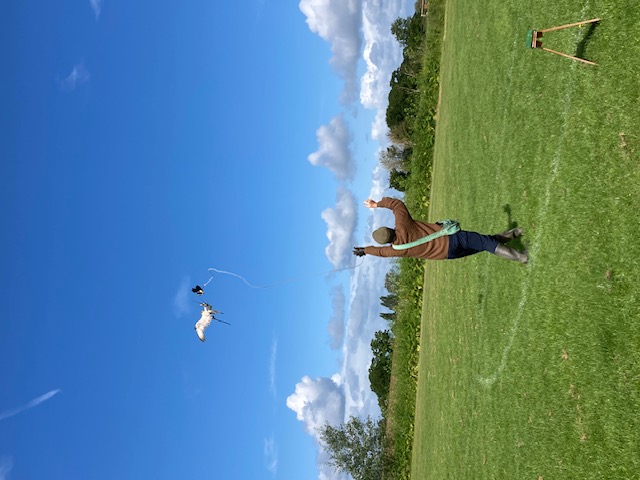
I sign off with a falcon called ‘Frank’ just about to catch the lure from last summer. The lure itself is the one I make in my book – known as the ‘sock lure’.
 Posted in Uncategorized