Lost birds.
 February 7th, 2025 |
  Author:
 I am still waiting for my website to be updated with the news that I will not be doing any displays this year – 2025. i have been on medical leave. So sorry about that.
As I have said my treatment period has at least allowed me to write a book on falconry called ‘Falconry – aspects of care of the trained falcon and hawk’. I hope it will be useful as a resource for the falconry community. I do wonder how I have managed to do it – but it kept me mentally stimulated. My family and friends supported me throughout which of course was important. I must also thank The Choir Press – Gloucester – who published the book for me. They took on board the need to get it out there. In normal circumstances I would have held the book back for longer before clearing it for publication.
As the title of this news blog suggests one of the sections in my book is on lost hawks. This can happen in variety of ways but if you fly a bird it will happen at some stage. Even if the bird is out of sight just for a few seconds it is worrying. The main thing is not to panic – of course easier said than done especially for a novice falconer.
It is recommended that for bird welfare reasons they are now flown with telemetry on,
Telemetry itself has developed over the years and now there are lightweight GPS transmitters available. This should make finding a lost bird a lot easier. Its position being shown on a smart phone map. These systems are expensive but to keep costs down falconers can still use non satellite systems. There are a lot of theses second hand systems around which you can buy new transmitters for.
The whole book is based on affordability and this includes the building of the ‘weathering loft’ and in this news blog the buying of second hand telemetry systems. The older systems are durable and work well. Of course they have their limitations but in most cases with practised usage they will get your bird back – normally after a lot of effort! It is important that the batteries are changed regularly so if a bird ‘is out’ the transmitter will last at least several days hopefully a lot longer.
I am now going to recount my latest adventure.
Last Sunday morning at 6.45am I had a phone call. Calls on our land line are rare now. Anyhow as it turned out this guy in Cheltenham said that he had a peregrine falcon sitting on one of his chickens that it had killed the previous evening and then spent the whole night eating it – in the chicken run. He thought it might be my bird and wanted to ring me before it got light. I said to him it cannot be a peregrine because these commercial hybrid chickens are huge. It had to be a Harris hawk. He sent me a picture of the bird in the gloom. Amazingly it was a peregrine! sitting on the floor of the chicken run with an enormous crop! It clearly was a trained bird rather than a wild one – although I was once called out to a wild Sparrowhawk that was in comatose state after killing and eating a Jackdaw in a haystack. I could have picked it up but instead I rustled the hay and it suddenly came back to life and rapidly flew off. It was a very strange happening – it had gorged itself.
I managed to net the peregrine and it had both a bell and a GPS tracker on it. Of course with bird flu in the news I had to be very careful and on arrival at home the bird went into isolation. I now use because of the need for increased bio-security a foot bath before entering my property.
I then took the birds ring number and phoned the IBR which is an organisation set up to reunite lost birds with their owners. The bird had been reported lost. Then through a process of triangulation the relieved falconer rang me and said he would pick the bird up later that morning.
Several things come to mind that I discussed in my book – firstly because I am well known in the area the original call came to me. This underlines the point that when a bird is lost the falconer must inform not only the IBR but also wildlife rescue centres – birds often end up there, the RSPCA in the area, local farmers and anybody else who may help. If you make enough noise then someone may hear and you may get the important phone call you are hoping for. The second point is the advantage of having your own easily read ID tag on the bird. This means one phone call and the bird is back. It can be very difficult to trace a bird if it turns up from nowhere – particularly if it has not been reported to the IBR who offer a nationwide service.
I put the the peregrine’s transmitter in the front garden which is the recommended thing to do. The falconer may in the area looking for the bird and the transmitter may be still be working.
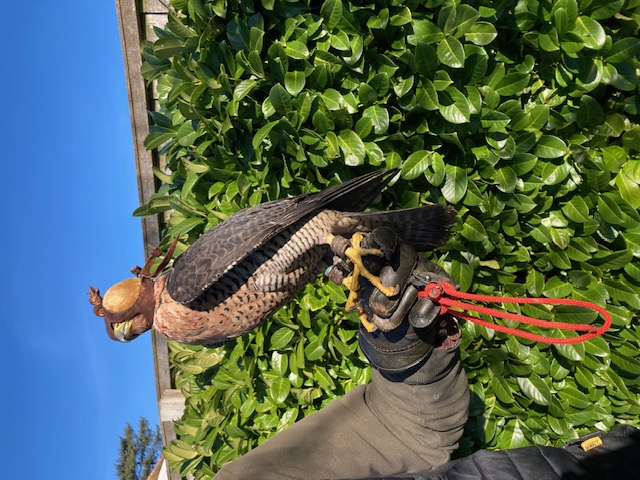
I thought the bird because of its size was a tiercel or male peregrine but apparently she was a female. She was a mixture of a peregrine – that we know – and a smaller tropical peregrine from Africa known as a Barbary falcon. She was only 2ozs heavier than my own tiercel hence my mistake. But once it was pointed out to me in terms of her colouration it was obvious. She was a lovely looking falcon.
Apparently she was lost doing bird clearance work – pest control – in Cheltenham when she wandered off. The GPS satellite transmitter stopped working shortly afterwards. They are apparently very high drain on batteries and therefore the recovery window is fairly short. On the other hand they are so accurate that this not be a problem. Clearly if a bird is very fit and active they can be everywhere at once and the batteries may be drained by the bird ‘holes up’ as I call it and stops moving. I am not an expert but I believe these GPS transmitters can also contain a non satellite tracking function which the falconer use if the GPS system is longer functional. It means it all has to work in field conditions working and the falconer learning to use the system. I once saw a falconer lose a falcon wearing a GPS transmitter – find it – but because the bird was not wearing a bell could not locate it in a clump of trees.
Anyhow all was well and the bird went home. She would need to go into isolation for a while just to make sure she had not picked up bird flu – although this is very unlikely but that is the Defra advisory at the moment – and this is what happened. Here are a couple of pictures of her from that day. Lovely blue sky behind!

 Posted in Uncategorized