The moult – an interesting perspective – only for falconers!
 November 10th, 2025 |
  Author:
 I was lucky this morning and managed to fly the two lannerets before the rain came. Both are flying well.
I had no such luck later with the dog – we both got soaked and cold. I thoroughly dried her off and then jumped into the shower to warm up.
I read an interesting article the other day in a falconry club magazine regarding the moulting process. Of course, I write about moulting in my book ‘Falconry – aspects of care of the trained falcon and hawk’ and I am always interested in what others have to say.
This falconer moults his game hawks – peregrines and peregrines/gyrs in open top aviaries and feeds them the most natural diet possible – that his birds caught the previous season. He substitutes quail where necessary and, in an emergency, will feed chicks. Apparently using this method, he has never had to cope any beaks. That is apart from taking the tip off – which is coping – but the point is they maintain their shape. The open top aviaries allow his birds natural sunlight and of course exposure to natural photoperiods which are key to stimulating the moult. The open top aviaries allow exposure to the weather which he suggests is also a natural stimulant to the moulting process. With avian flu now endemic future aviaries will probably need to be covered.
With grouse hawking the key is to get a falcon clean moulted by August 12th – the start of the season. With experienced falcons you can practically just get up and go but intermewed birds – those after their first moult – will need a process of retraining which means the birds should be cleaned moulted by the beginning of August to start this.
This is the holy grail because peregrines are notoriously slow moulters and many will be nowhere near the end of the moult by the 12th of August and will have to be picked up while still in moult so as not to miss the beginning of the season. If the birds are in good feather condition this should not be a problem. Game hawks can be flown in high condition because they love the sport. With first year birds who may be in poor feather condition you do not want to pick up a falcon that is still deep in moult – hence the story that follows.
The writer claims with an early hatch bird – I assume a first clutch eyass – getting a bird clean moulted by the 12th of August is possible using his method and cites a well known falconer who wanted a second clutch bird or late hatch bird – for whatever reason – and found that the bird was nowhere near ready the following year it in fact lost most of its season due to the lateness of the moult. Apparently, the early clutch birds were ready to go.
There is an interesting point i.e. does hatch date effect the start of the moult the following year or if it is stimulated by photoperiod or day length and by other factors like food intake, weather or the date of putting the bird down to moult.
One has often wondered with very late season Harris hawks whether the are late birds of the year or early birds of the following year. There must be a cross over period where one year ends and another starts in the hormonal cycle.
Jarvis the lanneret – trained for the book – was a second clutch or late first clutch bird. He started to moult pretty much as I had expected and almost identical to our other lanneret Frank. Both finished at the same time in early November. They were flown through the moult and even in high condition you can see that the moult was still protracted – you could argue moulting like a wild falcon.
Our own peregrine ‘Sprite’ flown through the summer has moulted very slowly. Once he had a rest with increased rations when we were away on holiday, he practically eclipse moulted. Hence as I reported in a previous blog, I decided to stop flying him for a couple of months.
I think his tail feathers will all be new – as far as I can tell but his two major outer primaries on each wing remain in place. I would not be surprised if they remain so till next year where he will pick up where he left off. So, his moult this year may be incomplete. I flew a peregrine as an employed falconer that had a couple of flight feathers half grown in blood through the winter – without continuing to grow at all – as if waiting for Spring – when they did indeed start growing again.
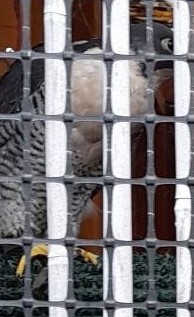
Sprite this morning. He does not like is photo taken. He was about to shuffle out of sight.
Whether hatch date effects the start of the moult given all the other variables is difficult to say. If you have hawks sitting in an aviary or loft at fat weight from the end of the grouse hawking season on December 10th till August 12th the following year, then you are better placed with all other variables being constant to make these observations. The falconer was able to predict under these circumstances – with some consistency – that the last primary would be fully down 100 days after the hatch date of a particular bird the following year.
So given a peregrine may be expected to lay its first egg at the end of march and then another 10 days or so before incubation starts when the eggs are set – then another 32 days till hatching which will be around the 10th of May. Add another 100 days or 14 weeks to this then the completion of the moult the following year will be on August 18th. So, it would be possible using his assertions – give or take – to get a peregrine fully moulted through by August 12th
Perhaps he has cracked it! As historically one reads from other authors that peregrines are rarely clean moulted at the start of the grouse hawking season.
This falconer says birds moult more slowly on a block perch than lofted birds postulating that it may be due to stress. My take on that is loose birds can also be disturbed when lofts are badly sited.
More likely a blocked falcon which can be fed on the fist each day will have a smaller ration than a lofted bird because it will need to eat its ration in one sitting rather than the tendency to pour more food into a loft where the bird has all day to eat it.
In fact, he does this and feeds in sittings throughout the day by placing food on various perches so the birds must take exercise to get to it. A sort of in loft fitness programme with some aviary enrichment. Of course, the falconer needs to be on site to do this, so it is labour intensive.
It is possible to feed birds on an astroturf mat in a weathering and leave the bird to get on with it, but I think the sight of fly blown food waiting around to be eaten would be unbearable for most falconers. Far better to feed the bird on the fist each day and keep it well manned. He mentions the risk of bumblefoot on the block perch but with the use of astroturf and regular checking and coping of the feet as described in my book will minimise the risk of this condition. Birds can get foot problems anywhere including while being lofted – again it is down to the design on the loft and unforeseen circumstances.
In short, a wide-ranging interesting article.
 Posted in Uncategorized