Falconry – aspects of care of the trained falcon and hawk by Michael Davie.
 November 7th, 2024 |
  Author:
 As can be seen from my last news blog I have not been available to do any falconry displays since April 2022. When after feeling unwell for about 18 months, two operations and what I thought was ‘long covid’ turned out to be a diagnosis of cancer.
I thank those medical clinicians who realised there was something seriously wrong with me – but not knowing quite what – to follow it through. It meant a change of medical team but without the offer of treatment – the cancer being so advanced – I only had months to live. The cancer as it turned out was rare and incurable. I was offered a trial treatment at Oxford.
My younger son read through the trial notes and said, “Dad you must do this”. The idea is that the treatment programme using targeted cancer therapy with immunotherapy would be kinder on the body than chemotherapy and hopefully with a longer remission. It has been a long treatment programme, and I must thank the team at Oxford. I am now starting the final year of treatment but up to now it has gone well. I must also thank my sister for her support and driving me to Oxford for treatment and spending many a long day waiting for me to reappear.
Due to the nature of the condition, recovery and side effects of the treatment it was clear that I could no longer continue working. This is the dilemma with animal keepers should they fall ill – do you act or hang on. With an uncertain future I decided to find good homes for my small number of experienced demonstration birds. Thankfully I managed to do that. It has been one of the most difficult things I have ever had to do. I still have nightmares about it now.
I kept back my old eagle owl ‘Bo’ who at 36 years and with many events behind her – including her many appearances flying at Blenheim Palace – was due to retire. Her along with a lanneret called ‘Frank’ who I felt I could continue to fly. The home I had arranged for ‘Sprite’ my peregrine fell through and so he has also stayed with me.
I went from being a professional falconer of 35 years to an amateur falconer almost overnight. Which was a strange feeling, yet I found with my remaining birds my love of falconry was still there. I realised it was an important part of my identity. While receiving treatment at Oxford I still found myself helping other falconers by tail belling a hawk or coping a beak or to be asked for advice. It is nice to be wanted.
They along with friends in the ‘event world’ have been so supportive during my illness. The latter being a group I have known throughout my working life. Though often in different disciplines we recognise ourselves in each other.
It is always great to meet up at events to catch up on news – of the people we know. As a group – as a community – we do not seem to retire. It is not unusual for us to work into our seventies and beyond. It is wonderful to see these ‘old masters’ with perhaps less kit than they once had but still producing wonderful displays. They can pick and choose events. It is clearly a difficult life to give up but for me it has come to an end.
After a year of treatment to fill a void of inactivity I tentatively started to write a book. I have called it ‘Falconry – aspects of care of the trained falcon and hawk’. Without the help of friends and family I could not have done it. There have been times when I have been too fatigued to do anything least of all to write.
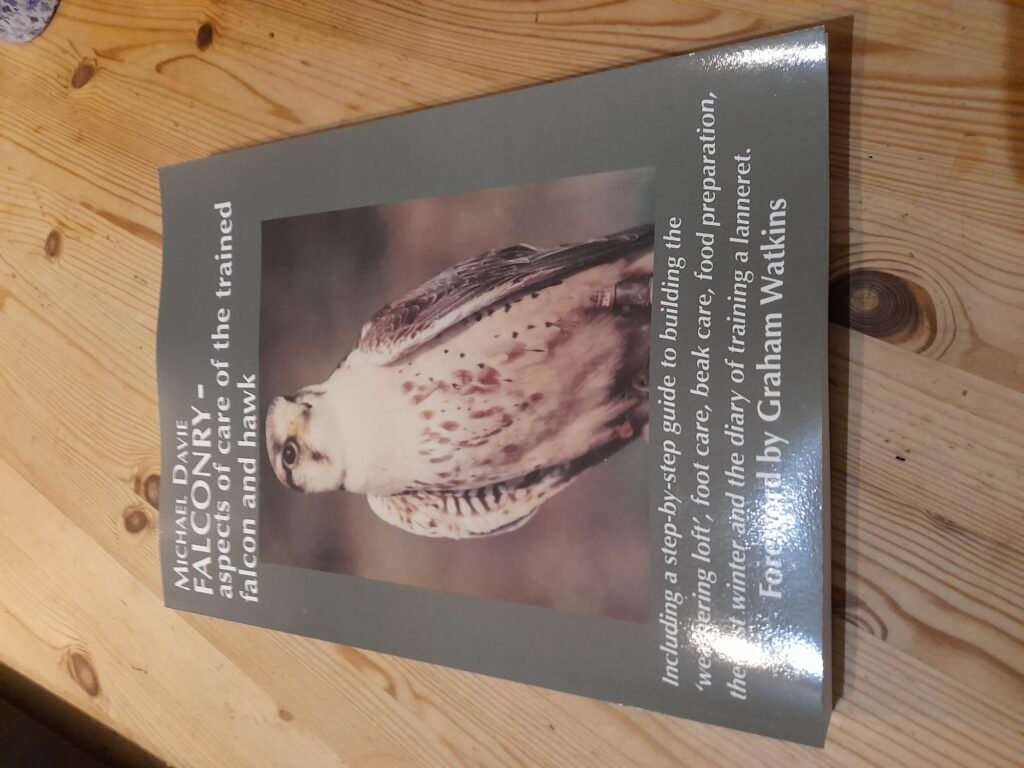
Front cover with Duke – a lanneret I had for 23 years. A brilliant falcon. Graham Watkins the well known gundog trainer from ‘Gamegoer gundogs’ has kindly written a foreword to the book.
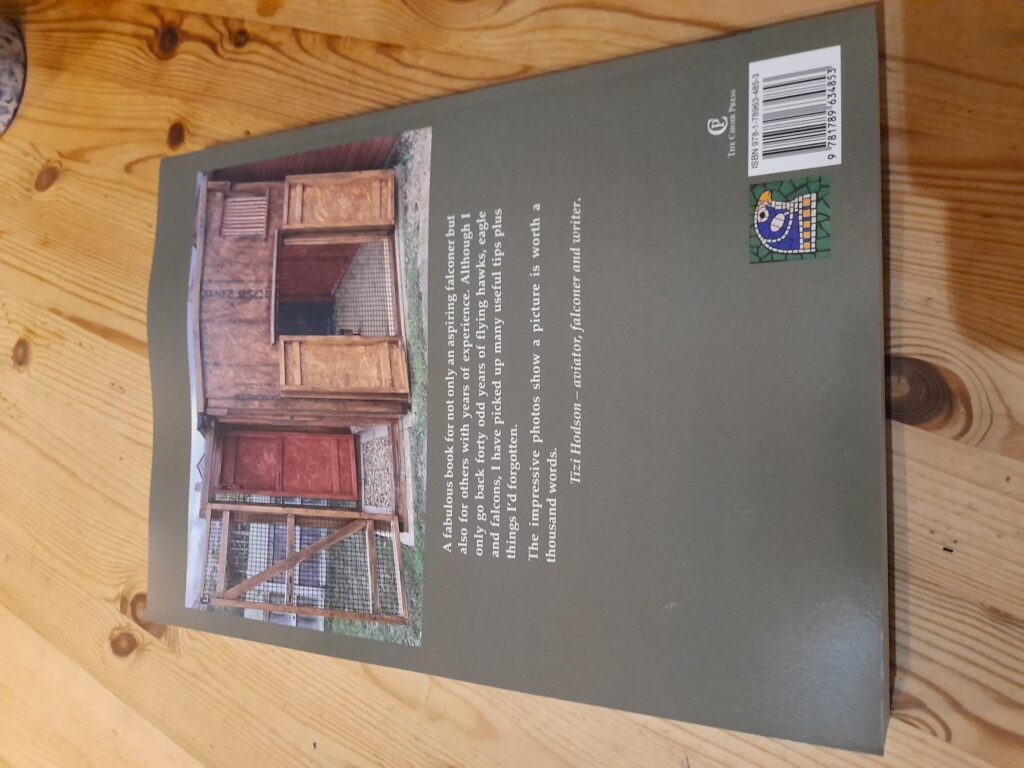
Back cover showing the ‘weathering loft’ with comments from Tizi Hodson – aviator, falconer, equestrian and writer.
I had to establish the best time of day to write. I found between the hours of two and four in the afternoon I was less likely to write rubbish that was full of mistakes.
I wanted the book to be a working guide delivered not just in words but in pictorial form. It would both show and record how I have done things over the years. A resource if you like. The knowledge initially gained from others as an apprentice but then through a process of repetition honing my skills needed to be a professional demonstration falconer. Those ‘others’ that I refer to may not have written books themselves, but their words are here. I do not think I would have written this or any book had it not been for my illness. It shapes ones thinking.
Like many traditional crafts and I include falconry in that list they benefit from fresh input to sustain them. I hope in some way my book can make a contribution.
The book ‘Falconry – aspects of care of the trained falcon and hawk’ will be published by the ‘Choir Press’ on November 16th and more details of its listing will follow then.
The book itself.
As I have said above, I want the book to be a resource for falconers, but it is not prescriptive. I have tried not to replicate other falconry books but to look at aspects of care which I consider important for the day-to-day care of the trained falcon and hawk.
So, there are sections rather than chapters. Each section covering a certain topic. I felt that to talk about ‘training birds’ I should train one for the book. To this end I bought a lanneret that was available locally. I present in ‘diary format’ his training for the first year.
Similarly, with the ‘weathering loft’ I felt it better to construct it in a step-by-step guide for the book. As a trained carpenter it does give me a head start but I think it is achievable with DIY skills and a modest range of tools which many households will have.
The structure is a distillation of a design that I have used over the years and offers flexibility in the management of a hawk or falcon without having two separate structures namely a weathering and a loft. I have also designed the structures for simplicity using materials that are available in DIY stores in a cost-effective way. A bespoke structure must be affordable.
To make the structure ‘during my treatment’ I must thank my older son who fortuitously was at home at the time for doing all the lifting, moving and collection of materials plus assembling the structure. The weather was good during the construction period which considering the wet weather we have had recently was a real bonus.
There are 27 sections in the book. Possibly the one I am most proud of is the section on foot care. This is such an important topic. Simply checking the feet on a regular basis, coping, when necessary, along with the right perching material can do much to avoid bumblefoot and other foot problems.
Similarly, the section on beak care and how to cope a beak I hope will be useful and give the falconer confidence to do it. This along with a section on feather care and imping.
There is a section on food preparation. Not for the squeamish but a vital part of bird of prey care.
Also, a section on how we accommodate our birds. The thinking behind lofting a trained bird in flying condition. The positives but also the limitations of this method which I point out.
I have written a section on telemetry and lost birds. When you have a bird ‘out’ you will read every book on the subject to gain any helpful information. Whereas the modern GPS telemetry makes locating a lost bird a lot easier than in the past many of the same challenges still exist. I hope this section will both be sympathetic and helpful.
We have supplied drawings for the structures in the book for those contemplating constructing a weathering loft or using the modular design to make one for their own needs.
I have written the book to aid the joy of keeping, training and flying a hawk or falcon.
I will provide additional information on the various sections in news blogs to come.
 Posted in Uncategorized