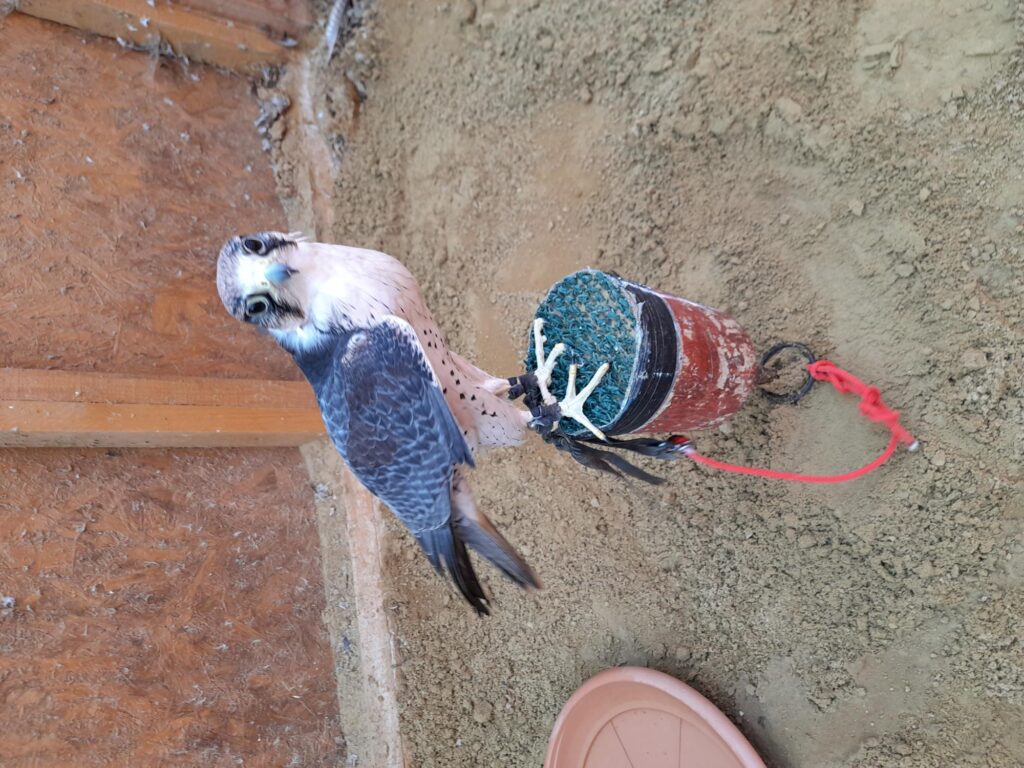
Warm Spring Day – Jarvis the lanneret again.
 March 20th, 2025 |
  Author:
It is a wonderful day. The sort of weather you dream about during the winter which has been long, wet, cloudy and cold. But with a sudden onset of warm weather dangers abound if you are flying birds of prey.
I discuss in my book ‘Falconry – aspects of care of the trained falcon and hawk’ that a sudden overnight change in weather can affect the birds conditioning. It means simply in warm weather the bird losing its appetite with the potential to wander off or disappear on a thermal.
As a professional demonstration falconer – in the past tense – I have had cases during a three-day event where the first day was very cold – the birds having their normal ration – and overnight the weather changing to hot. I lost a peregrine at Blenheim Palace in just such conditions – he went up enjoying the weather and drifted away. For many years afterwards people kept coming up to remind me of it! He was found a week later 11 miles away – his transmitter had run down but he had an ID tag with my telephone number. I have mentioned in the book that these plastic ID tags are so useful.
I noticed today when I picked up my current birds in training to put them in the van ready to be flown that that the cheery open winged expectation particularly with Jarvis was not quite there.
This was confirmed on the weighing scales – his weight was up – which told me that I would need to reduce his ration – slightly – to compensate for the warm weather. He flew very nicely – a lot of this would be habituated behaviour which could easily be broken because he is in high condition. Apart from being slightly difficult to hood after flying – another sign his condition was up – everything went well. But the warning signs are there and if I do not want to lose Jarvis then I need to do something about it.
In fact, a friend of mine today phoned up and said his Harris hawk was acting rather independently and showing signs of wandering off. Showing that the warm weather had probably pushed her condition up too – like Jarvis. She had lost the edge to her appetite. Of course, older birds naturally come into breeding condition at this time of year and this is another factor. His hawk is featured in my book.
We learn from our mistakes but ‘A stitch in time saves nine’ and in this case never is statement more true. Of course, it is a good idea to keep an eye on the weather forecast and try to plan ahead.
I will sign off with a picture of Jarvis after flying – back at home – thankfully!
 Posted in Uncategorized