‘Falconry – aspects of care of the trained falcon and hawk’ by Michael Davie
 March 23rd, 2025 |
  Author:
 The home page on my website has now been changed to indicate that for the time being I will not be doing any falconry displays – at least for 2025. I have used the down time to write a book – ‘Falconry – aspects of care of the trained falcon and hawk’. Something that I never for one moment contemplated doing – I was just too busy with displays. Once I had decided to write the above book, I wanted to do it while I was still actively flying my remaining birds. This is so I could accurately report my technique and methods rather than do it from memory. This at least makes it a true reflection of how I do/did things.
I am pleased with the outcome – of course like all book writers I have come to realise – that we are never entirely happy with the outcome feeling perhaps that it should have been held back from publication at least for a while. I have been told that this is very common. But the functionality of my book whether it was held back 6 months or 6 years would not have changed. This I think is the important point.
While writing the book we got into the habit of recording things that I felt would be useful to show in the book. I have continued keeping a record of Jarvis the lanneret that I trained specifically for the book. He has now moulted through – the point in the book when I stopped flying him – and has been flown throughout his second winter.
Even in year two he is still vulnerable to wind tip oedema and so he was lofted and rested during a very cold patch and at other times when it has been less cold, he has been on a block perch under a heating lamp. The description is a slight misnomer because the lamp does keep the bird warm but just keeps the frost off. They are generally turned on if the temperature drops below 3C. Next winter Jarvis will be out of the danger zone for this condition but we will still loft him during cold weather.
This leads onto the ‘weathering loft’ – the structure we build in the step-by-step guide shown in the book. It can either be used as a weathering or a loft. I hope people may take inspiration from it to build it or something similar. We tried to build it in the most cost-effective way possible with materials that are commonly available – which is important.
I have cited foot care as the most important chapter in the book. Regular checking of the feet is so important with the coping of talons – taking their needle sharpness off – to prevent bumble foot.
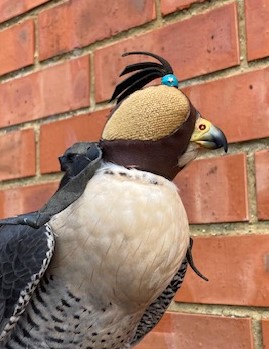
Also, beak care is important, and has its own section. The peregrines beak we coped in the book has largely kept it shape since that time. The tip of the beak was shortened when he came out of the loft after having the summer off to moult but the notch in the upper mandible was pretty much as we had left it. We took a photo of his beak this morning to show this. This is ‘Sprite’ by the way with a full crop after been flown.
 Posted in Uncategorized