Conditioning.
 April 9th, 2025 |
  Author:
 Conditioning is the technique we use to train a falcon or hawk or indeed any bird of prey. We monitor the condition of the bird by weighing it. The weight will indicate the hunger level of the bird and from previous records how it is likely to fly. As my book says the falconer will try to find a happy medium – a balance if you like – where the bird is both independent and responsive.
If the bird is in too high a condition it may indicate trouble ahead. For example, if a hawk is not particularly hungry – in high condition – it is likely to sit in a tree and not want to come down. It is doing its own thing. Similarly, a falcon may go off on a thermal.
For a bird that has been used for hunting there is a chance it will just go off self-hunting and not bother about the falconer. To remedy this the falconer will need to reduce the bird’s condition or it will soon be lost. This reduction will show up when the bird is weighed. It may take a few days with a small reduction in daily ration to achieve the desired effect that is weight loss accompanied with a better response time.
Passage falcons flown in the Spring at rooks on Salisbury plain could easily be lost. In the nineteenth century this flight was followed on horseback. The flight could last several miles, and it was key that the falconer was there at the end of the flight. If the falcon was unsuccessful and the falconer was not there to call it in to the lure it would likely go off self-hunting. Falcons in those days were wild first year peregrines caught on migration – on passage – and were already proficient hunters.
In fact, the demise of classic rook hawking was due to fencing the Plain making riding after the flight impossible. The number of lost falcons would be very high. According to Captain Charles Hawkins Fisher – the famous Stroud falconer – you could ride for twenty miles on Salisbury Plain in those days without encountering a fence. With passage falcons there was no room for error because these birds were not tame and therefore correct conditioning was critical. They did not weigh birds in those days but made a mental record of the bird’s behaviour and how much it was fed the previous day. In those days professional falconers were employed by Gentlemen falconers to train and fly the falcons – and they knew what they were doing. They could assess the condition of the bird by feeling along the breast or keel bone.
As a falconer of 55 years, I have never mastered the technique and do not believe it is sensitive enough to be accurate beyond saying this bird feels thin or fat. Every bird is made differently. Thank goodness for the weighing machine – 20 grams either way can make a huge difference. How could anybody feel the loss of 20 grams? Maybe it is just me!
But the point is that a subtle adjustment in flying weight can make a significant behavioural difference in a trained falcon or hawk.
If a young hawk is not chasing quarry because it knows the nearest food station is in the falconers hawking bag. The bird will need to have its weight increased so it looks less towards the falconer for food. Birds in the wild do not wait until they are very hungry to start hunting – they are nowhere near this stage. In fact, wild birds that are very thin and very hungry tend to just give up. So, there is no advantage in having a bird over keen or underweight. As the Old Falconers would say when you cast a bird off you want it to fly away from you and not swing back round looking for food.
Once a trained hawk has started to catch things then it is difficult to put the genie back in the bottle. A ‘made’ hawk will always be looking for opportunities to hunt and the falconers main concern is to make sure the bird is at the right weight or hungry enough to come out of a tree when you call it.
When stooping young falcons to the lure to develop fitness they need to be flown in the highest condition possible. So, you are flying on a knife edge particularly when the hunting instinct kicks in as fitness is gained. A bird’s condition can drift up in warm weather and it can lose the edge to its appetite. The scales will indicate this to the falconer this and a decision will have to be made whether to fly the bird and potentially risk losing it. A lot of falconers would take the risk – that is the nature of the falconer – just to see what would happen and the possibility to learn something new about the bird even increasing it flying weight.
My book ‘Falconry – aspects of care of the trained falcon and hawk’ by me Michael Davie is for sale through a wide variety of outlets. It was published in November 2024 by the Choir press, Gloucester.
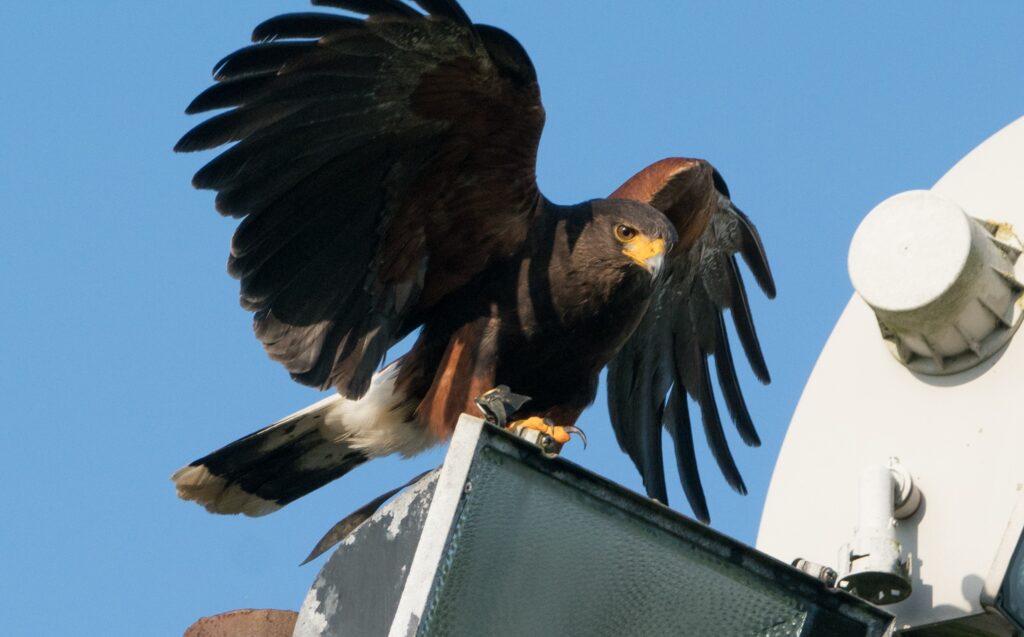
I will sign off with a picture of a male Harris hawk on a flood light. Will he come down? Actually, he was one of my hawks and yes he did come down.
 Posted in Uncategorized