Wales – beginning of April 2025.
 April 6th, 2025 |
  Author:
 We have just come back from Wales after a short break to St. Davids, and the surrounding area. We love the Preseli Hills, and we retraced our steps of a previous walk in 2019. Thankfully for me it was not too taxing. We were surrounded by larks and pipits as we progressed across the moor which was wonderful. We also saw a ring ouzel which is a kind of upland blackbird that has a white chest. It had just arrived back after migrating from Southern Europe or North Africa. Its white front was quite striking, so it was a male bird. We came across a common toad on a pathway in the middle of the moor. Which was rather strange.
We saw an early swallow making its way across the moor to some distant farm and the following day we also saw a sand martin – rarer because they tend to be embankment nesters. They used to nest down at the River Severn where we live but like other similar species swallows, swifts and house martins they have all declined in recent years. I say this with much sadness. It mirrors a decline in insect numbers that these birds rely on. Hopefully numbers might pick up again in the future through active management schemes. As I have said in a previous blog I would much rather that wildlife be just out there living amongst us. Unfortunately, this is no longer the case – so many of our farmland birds have declined or gone. We must find ways to encourage them back. Various conservation efforts have shown that this is possible in ways that does not exclude food production – the latter point I personally feel is very important.
On our previous Preseli Walk we took a wonderful picture of a buzzard sitting on one of the many rocky outcrops. Of course, the blue stones for Stonehenge came from the Preseli mountains and so spiritually this is a very special place. We did see a buzzard and a kite but not one sitting conveniently on a rock. There were also plenty of ravens about and, we saw a flock of golden plover.
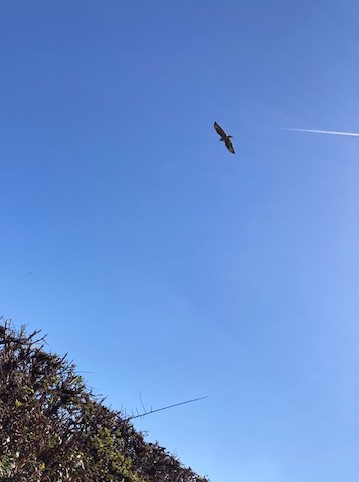
We did see a lovely buzzard on our way down to Poppit Sands a few days later. It was hunting from a roadside telegraph pole and was watching something very intently. It hardly noticed us trying to manoeuvre the car to get a photograph while looking out for traffic. We managed to get a couple of shots as it took flight, and I will post one at the end of this blog.
Before we left home my birds were all lofted and my son came back for the week to look after them along with the dog. He fed the birds each day down feeding chutes. This underlines the usefulness of the lofting system as shown in my book ‘Falconry – aspects of care of the trained falcon and hawk’. Lofting as my book suggest does allow the birds to be fed by a non-specialist carer when the falconer is away.
I was particularly pleased that Jarvis the lanneret – the falcon I trained for the book allowed me to take him out of the loft without fuss after not seeing me for a week. We shall start flying them again on Monday.
Here is that Welsh buzzard. Notice the exhaust from a human flying machine to one side. We had a great time the weather was fantastic.
 Posted in Uncategorized