See pigeon must chase pigeon!
 May 6th, 2025 |
  Author:
 Yesterday we saw our first two swifts of the year. A pair returning to breed. They are always the last of the swift, swallow, martin family to return from migration and always the first to go. Normally gone by the end of August or shortly after. So it is a brief stay.
In fact I may have seen a hobby today – a migratory falcon returning from Africa – but it was so high it could have been either a kestrel or a peregrine so I will not claim it as a definite sighting. But they really are the most exciting fliers having the most astonishing pace that I think no other bird can match.
Talking about speed. Yesterday I was flying Sprite our peregrine tiercel who is now 11 years old. I was looking at a couple of Carrion crows feeding in the field and was wondering whether Sprite would be able to resist chasing them. The crows see the falcons everyday and they know which ones to avoid. With the three remaining falcons I have none chase crows. I was fairly confident that he wouldn’t.
Too busy concentrating on the crows I had not noticed a Woodpigeon feeding at the bottom on the field. Pigeons are a different story and many falcons cannot resist chasing them – particularly peregrines. They have evolved to catch pigeons primarily Rock doves so it is no wonder they will give chase at the sight of any pigeon clattering away.
Back to the story – Sprite did give chase. It was exciting to watch – he loved it. Thankfully the pigeon wisely crashed into a line of trees with Sprite flat out on its tail.
Peregrines are not good in cover like goshawks and when the pigeon exited right and Sprite came out the other side the chase was over. Behind the trees I could hear his bell but not see him. Had the pigeon straight lined it out of sight – without the intervention of a row of trees Sprite would have continued to give chase with a high risk of being lost.
It was quite windy and now the out of sight Sprite had to navigate his way back to the flying field flying against a strong breeze. Thankfully he does know the area – perhaps not as well as I would have liked! – and on clearing the trees I managed to catch his attention by swinging the lure and shouting Ho! He would know the ‘Ho’ shout guaranteed a catch of the lure first time – a free meal if you like – acting as an incentive to come straight back.
He responded and began to tact his way back against the strong breeze. As a falconer your heart is in your mouth as you ‘will’ the bird back against a strong breeze. Hoping it will not get disheartened, give up and begin to drift downwind.
Within a few seconds he was back with me and so full of the joys of Spring he missed the catch – so I stooped him a couple of times and then let him have it.
J A Baker in his book ‘The Peregrine’ described the relationship that peregrines have with pigeons as similar to that of humans to cattle. An amusing description but does underline the importance of pigeons in the diet of wild peregrines. Falconers historically never fly falcons at pigeons because a pigeon can draw a chasing falcon many miles downwind resulting in a lost bird.
Here is a photo of Sprite from that morning.
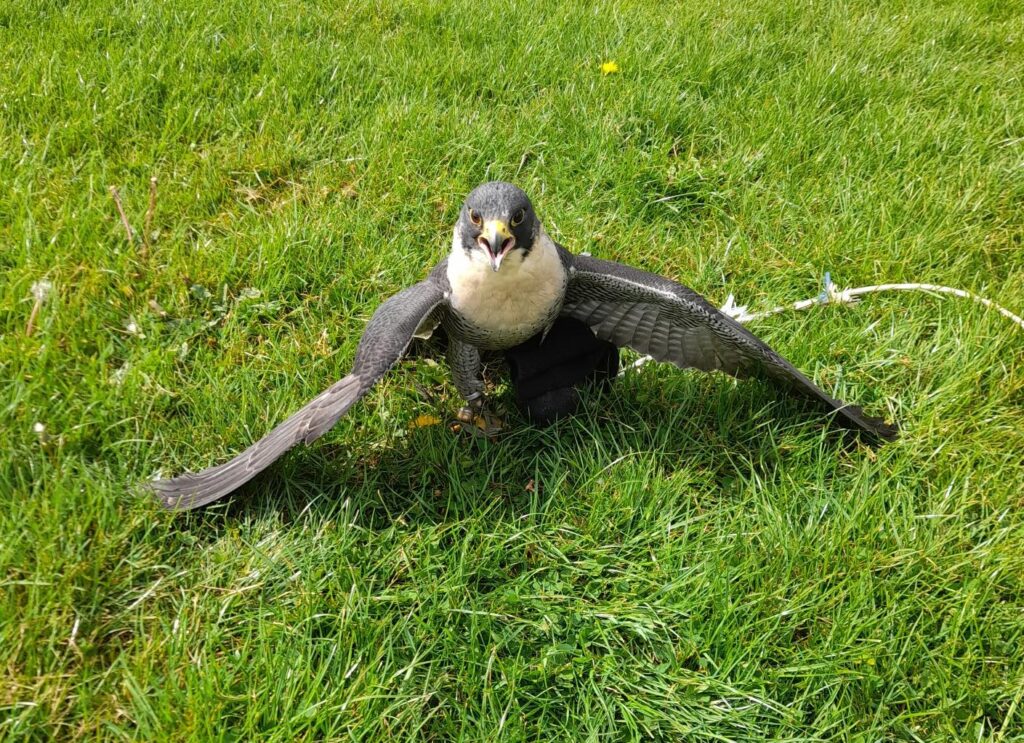
I mention in my book ‘Falconry – aspects of care of the trained falcon and hawk’ in section 22 ‘Use of telemetry and lost birds’ the importance of scanning for pigeons before flying with the cryptic comment on p226 ‘Do not be in a rush to lose your bird’. I should listen to my own words!
 Posted in Uncategorized