Monday
 November 24th, 2025 |
  Author:
 I flew both the lannerets this morning. Frank below on the sock lure after flying.
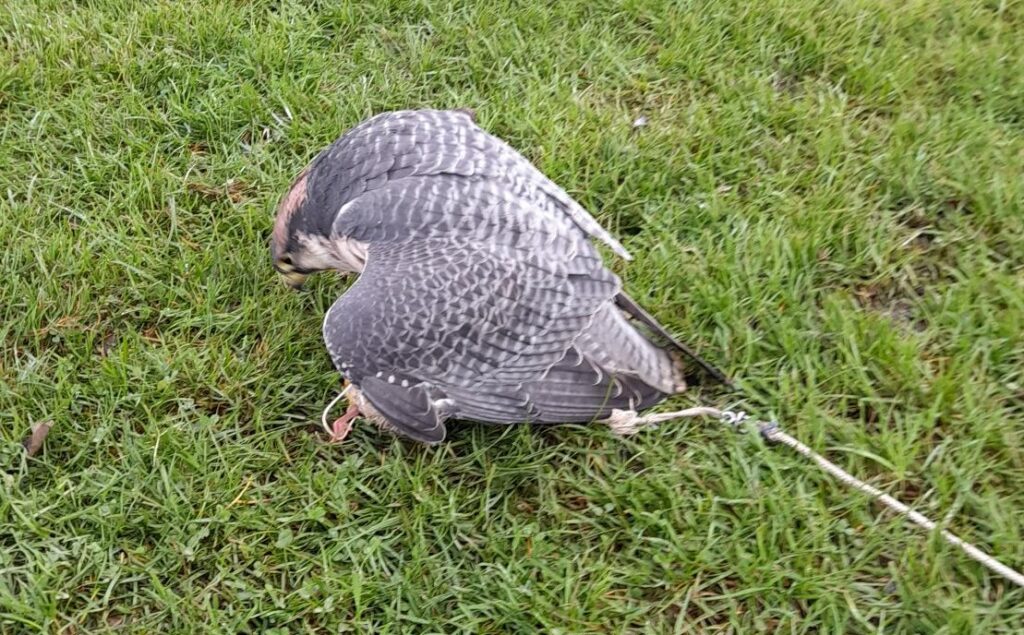
He has actually done quite a number of events when I was still working and had the promise of being a really fine demonstration falcon. Several years later I can confirm he a really lovely bird – easy to handle and hood and with a lovely flying style. I have developed him in the way I suggest in my book ‘Falconry-aspects of care of the trained falcon and hawk’ by positive reinforcement and it has worked. He flies well in any conditions including in a stiff breeze where he cuts into the wind using his momentum to climb. He is a lanner falcon and even Phillip Glasier called them charming birds.
Our other lanner is Jarvis and he or I think I should say she – I am fairly sure is not a lanneret now. Flying at 1.6 he can’t be. I think he is more likely to be small female rather than a large male. He too is flying well and at times he puts in a noteworthy performance showing signs he is learning – he is not at all afraid of stooping vertically. He is quite fit and this was the problem I had with him when I was training him for the book. We started quite late and he was not fit or had little endurance fitness by the Autumn. So a few days off for poor weather and we were back to square one. His hooding is much improved and I can hood him with confidence after flying – which can be tricky with some birds. But with patience and possible conditioning changes it is worth persevering with.
Changing the subject before I sign off I am currently reading the book ‘in Answer to the Cry’ by Dorothy Yglesias. It is about the wild bird sanctuary at Mousehole in Cornwall that they set up in 1928. I remember visiting the sanctuary in 1975 while on holiday in Cornwall on the hill road outside Mousehole.
Cornwall has a special place for me because my father went to school in Camborne and then spent the last 25 years of his life working as an artist in his rural retreat of Newbridge outside Penzance until his death in 2012. Anyway the book is of great interest the sisters who ran the sanctuary were themselves from a well known artistic family and ‘Pog’ one of the sisters was a fine sculptor mainly in wood. It is beautifully written and covers such topics as the Torrey Canyon disaster of 1967 where thousands of seabirds were oiled up – many died – but the sisters and helpers dealt with huge numbers – cleaning them up and finding them sanctuary – as far away as Slimbridge – until well enough to be released. A charming book which I will continue to read.
 Posted in Uncategorized