Flying Weights
 March 29th, 2025 |
  Author:
 One of the sections in my book ‘Falconry – aspects of care of the trained falcon and hawk’ is a diary of training Jarvis the lanneret. As I have indicated in my news blogs we left Jarvis at the end of his first year just prior to his first moult.
Since the book has been published – November 2024 – we are now at the end of season two and because Jarvis is in good feather condition I will continue to fly him through the Summer – so through the moult.
It is possible to fly a first-year falcon through the moult but generally because the transition in a bird’s plumage is so great it is worth allowing the bird to ‘get on with it’ in the comfort of a loft with plenty of food. It may be the best thing to do anyway if the feather condition of the bird is poor which can be the case in some first-year birds.
So, with Jarvis still flying I am looking forward to warmer days to see how he gets on. So far on days with a lifting breeze he is showing signs of his own style which is quite lovely to watch.
He is also beginning to show that independent streak which is associated with flying a bird in high condition. When a bird flying is well you feel you are often on the verge of losing it. Particularly if the weather is warm and your conditioning has not been accurate enough – the bird having lost the edge to its appetite. This is why we use the scales. From its weight we can gauge its appetite and from previous records predict its level of co-operation and performance when flying.
Because Jarvis is flying at about 1 pound 6 ounces which is extremely high for a lanneret. It has forced me to reconsider his sex because no lanneret flies at such a high weight. The strange thing he does look like a male but as they say the ‘scales never lie’.
I am not worried what sex he is but if you are flying a lanneret at 1.6 sooner or later the bubble will burst. His behaviour recently has suggested we are approaching that point. He is slightly more difficult to pick up in the morning – the procedure is shown in my book – and he has become more nervous a sure sign he is slightly overweight or too high.
I had a bit of a fright yesterday when flying Jarvis in great weather. He was wafted up and over a line of trees into an adjacent field. Often the first time this happens the bird is disorientated because it loses direct sight of the falconer. This can be made worst if the bird is overweight and not particularly hungry. The behaviour associated with place is suddenly gone and you find yourself in the lap of the Gods.
Jarvis not seeing me started to wander away in a kind of circling motion- all too familiar to us falconers! As it happened Jarvis cleared the tree line at a moderate height and while circling looking in my direction, I managed to get his attention by swinging the lure. He started heading back my way and I shouted Ho! And he came in and caught the lure. Crisis adverted. As I said in my book you always lose a bird when you least expect it. The ‘Ho’ shout guarantees the bird food and is an extra incentive for the bird to return.
How close I was to losing him I am not sure but sooner or later with every bird something will crop up to test you.
Today Jarvis flew without a hitch. But I am mindful that his flying weight is now too high, and I need to do something about it. Adjusting his weight down by 10 – 20 grams is what I am planning.
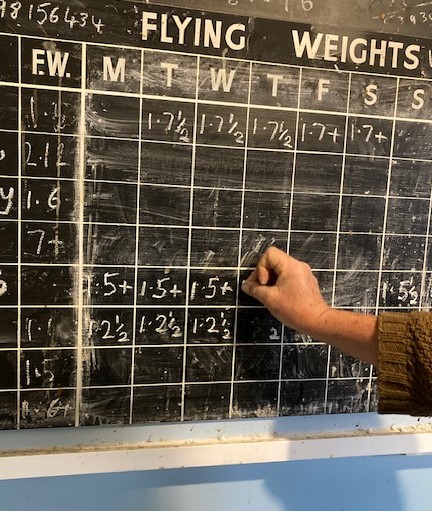
This is why the scales are so useful – as I have said above. The weight of the bird reflects its readiness to fly – his level of appetite. This is why record keeping is important.
Below a week flying weights chalked up and recorded on a board in the Hawk Room.
 Posted in Uncategorized